Navigating Revolutionary War Pensions

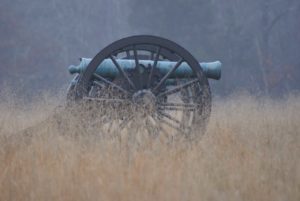
Civil War Cannon

Cathy inquired about her ancestor, a Pennsylvania militia veteran who died in Virginia in 1810, regarding potential pension eligibility. Dennis explained that pensions were restrictive initially, with federal pensions not widely available until after 1810. Only some veterans received state-level aid, and eligibility for widows or children came later. He recommended searching both Pennsylvania state archives and federal pension files for relief records and applications, while noting Virginia records might be useful but are less likely to provide benefits.

Revolutionary War Pension and Bounty Land Warrants

Civil War Cannon

This article helps you access the Revolutionary War Pension and Bounty Land Warrants for free. Following two simple steps, one to search, and the other to browse the actual microfilms, you can quickly find your ancestors Revolutionary War pension record, or Bounty-Land record and download the images. During 1800-1900 the United States issued more than 80,000 pensions and bounty-land-warrants to soldiers of the Revolutionary War, their spouse, or their children. Was your ancestor one of them?

Record of the Smith family descended from John Smith

Record of the Smith family descended from John Smith

This book contains the history of the descendants of John Smith, born in Ireland in 1686, died in Uwchlan, Chester County, Pennsylvania, December 19, 1765; and his wife, Susanna, born in Ireland in 1691, died in Uwchlan, Chester County, Pennsylvania, December 24, 1767.

The Wilson Family of West Virginia

The Wilson Family of West Virginia

This brief history has been gleaned from old family records, correspondence with other members, and histories of Ritchie, Barbour, Harrison and Randolph Counties, West Virginia. The first known ancestor was David Wilson, who was born in Scotland about 1650; he had a son David, born about 1685, who was forced to flee from Scotland to Ireland owing to his being on the losing side in the Scotch Rebellion of 1715. His son William (b. Nov. 19, 1722; d. June 12, 1801) came to America about 1736; married Elizabeth Blackburn, also of Scotch-Irish descent, about 1746, and settled on Trout Run near Moorefield, Hardy County, W. Va. The Land Office at Richmond shows that he and his sons patented many tracts of land in what is now Hampshire, Hardy, and Grant Counties. Nothing further is known of him as to where he lived and died.

Fisher Genealogical History

Fisher Genealogical History by Gertrude Fisher Harding

This manuscript starts with Sebastian Fisher, a native of Germany, with his wife Susanna and their two small children, embarked for England at Rotterdam, Holland, on July 28, 1708. The family came with the intention of settling on land in the Schoharie Valley in New York, but found on arrival that they did not hold legal tender to the land, since the land was not first purchased from the Native Americans. Sebastian then moved with other German immigrants who had also purchased land to the Tulpehocken Valley of Pennsylvania, where he settled his family. The 76 pages of the manuscript take some of the descendants of Sebastian and Susanna Fisher into the 20th century.

Chronicling America Historical Newspapers

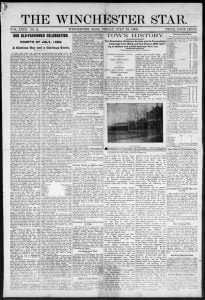
Winchester Star

Chronicling America is a Website providing access to information about historic newspapers and select digitized newspaper pages, and is produced by the National Digital Newspaper Program (NDNP). NDNP, a partnership between the National Endowment for the Humanities (NEH) and the Library of Congress (LC), is a long-term effort to develop an Internet-based, searchable database of U.S. newspapers with descriptive information and select digitization of historic pages. Supported by NEH, this rich digital resource will be developed and permanently maintained at the Library of Congress. An NEH award program will fund the contribution of content from, eventually, all U.S. states and territories.

West Virginia World War 2 Casualties – Army, Air Force

World War 2 Casualties - Army, Airforce

This database contains War Department casualties (Army and Army Air Force personnel) from World War II for West Virginia. Information provided includes serial number, rank and type of casualty. The birthplace or residence of the deceased is not indicated. An introduction explaining how the list was compiled, a statistical tabulation, and the descriptions of the types of casualties incurred are also included.

Small Town Newspapers

Winchester Star

Small Town Papers gives you access to the people, places and events recorded in real time over the decades or even centuries! Browse and search the scanned newspaper archive from 1846 up to the current edition! Their archives contain millions of names of ancestors not found anywhere else. Enhance your Ancestry research with their high resolution scanned newspaper archive. Find distant relatives and discover your ethnic heritage by reading the articles about family and friends written back in the day.

Appalachian Colonists from the Mediterranean Basin

1591 Floridae Americae Provinciae Map

In the Southeastern United States, rural “old families” display diverse ancestries that blur the lines between European, African, and indigenous roots. Many identify as Cajun, Melungeon, or similar, often claiming ties to Native American tribes without substantial evidence. Notably, some families possess Jewish surnames but have long identified as Christians, losing touch with their heritage. In contrast, a distinct mestizo population in the Appalachian mountains has maintained its identity for centuries, often referring to themselves as Melungeons, recognizing their unique differences from neighboring groups.

Richard Stewart’s DNA Results

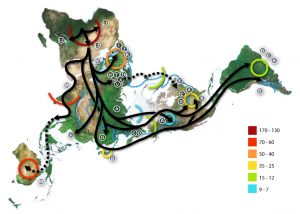
Map of Known Human Migrations

Richard Stewart, who believes he has Shawnee or Cherokee ancestry, has taken multiple DNA tests to explore his ethnic background. His tests indicated minimal Native American heritage, with the majority revealing European ancestry. Although he was raised with the belief of having Native American roots, subsequent tests showed consistent results aligning with European heritage. He is seeking more refined testing and hopes to procure additional results from his records to clarify his genetic lineage further.

Captivity and Escape of Mary Inglis (Ingles) – Indian Captivities

Mary Draper Ingles Chimney Plaque

The captivity of Mary Draper Inglis (Ingles) is a third person account of her captivity and eventual escape. Mary was captured by Shawnee Indians along with her two sons, and sister-in-law from Draper’s Meadow in 1755. She eventually made her escape, along with another dutch woman, a few months later. This is her story.

West Virginia Naturalization Records

Naturalization Certificate

Naturalization in the U.S. involved a two-step process: the Declaration of Intent (First Papers) and the Naturalization Record (Final Papers). Typically, First Papers were filed five years before Final Papers due to residency requirements. Before 1906, records were decentralized, but federal forms standardized the process. These naturalization records are accessible through Ancestry (paid) and Family Search (free), with various records spanning from 1814 to 1991, including numerous county-specific documents throughout West Virginia.

Lord Dunmore’s War

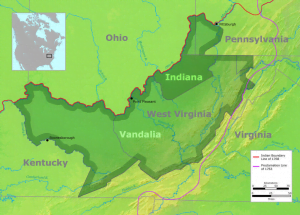
Vandalia Colony

The text details the events leading to and during Lord Dunmore’s War, sparked by illegal encroachments into the Vandalia Colony and violent acts against Native Americans by Virginians. It highlights the treaties made with various tribes and the resultant loss of their lands. The war began in response to brutal murders committed by settlers, leading to conflict with the Shawnees. Despite military advances by Virginia’s forces, Dunmore ultimately sought peace, yet tensions persisted as violence against Native Americans continued unabated.

Cresap’s War – Indian Wars

Logan Monument

Logan, a Mingo chief with Cayuga lineage, became a prominent figure in the 1774 conflict known as Cresap’s War following the murder of his family by settlers. In retaliation, he led a series of attacks against white settlers, which prompted the Virginia government to send militia to combat the Native American forces, commanded by Cornstalk. After a contentious battle at Point Pleasant, a peace treaty was negotiated, but Logan remained isolated in his grief. He ultimately delivered a powerful speech expressing his loyalty to white men before being murdered shortly after the treaty’s conclusion.

Burial Customs of Southern Ohio

The earthworks of southern Ohio, Kentucky, and West Virginia present a mystery regarding their origins and reasons for abandonment. These impressive constructions, built by a sedentary population, hint at sophisticated customs and beliefs. Various sites, including the Marietta earthworks, have undergone extensive examination, revealing burial practices and community structures. Sites like the Cedar Bank Works and Tremper Mound demonstrate diverse mortuary customs, including cremation and inhumation. The remnants suggest these were likely the works of Siouan tribes, providing insight into their cultural practices and eventual migration.

West Virginia Genealogy at Ancestry

Ancestry.com is the largest online genealogy provider, offering an extensive collection of records for West Virginia. Their databases include military rosters, census records, marriage indices, and historical documents, many of which require a subscription, though some are accessible for free. Users can start with a 14-day trial to explore West Virginia’s genealogy resources. The range covers state histories, family genealogies, and various county records, providing valuable insights into the region’s past for researchers and historians alike.

Biographical Sketch of Rev. William N. Nickell

William N. Nickell, born December 27, 1838, in Monroe County, West Virginia, was the son of John A. and Mary J. Nickell. He received his early education in Virginia and attended Washington College. Enlisting as a private in the Confederate Army in 1861, he rose to sergeant-major and fought in several key battles. After the war, he farmed and pursued ministry in the Cumberland Presbyterian Church, being ordained in 1875. He married Sue P. Wicklin in 1864, and they had five children.

Biographical Sketch of John M. Miller

John M. Miller was born on May 31, 1834, in Greenbrier County, West Virginia, and was raised there after his family moved from Virginia. He ventured to California twice in 1859 and 1860 before serving in the Enrolled State Militia during the Civil War. A farmer by trade, he married Elizabeth C. Foster in 1863, with whom he had six children. After her passing in 1877, he married Mary A. Goodbar in 1879, and they had one child together.

Biographical Sketch of Frank M. Harris

Frank M. Harris, born on January 7, 1843, in Marshall County, West Virginia, was the son of John and Drusilla Harris. He received a basic education and learned carpentry from his father but primarily pursued farming after moving to his current county in 1877. He married Eliza A. Wilson on November 30, 1865, and together they had four children, two of whom, John A. and Lydia A., are deceased.