
Siksika Indians

The Siksika, or Blackfeet Indians, derive their name from a native term meaning “black feet,” likely referring to the dye of their moccasins. They belong to the Algonquian language family and primarily inhabit territories from the North Saskatchewan River in Canada to Montana. Historically, the Siksika experienced conflicts with neighboring tribes and were impacted by smallpox. They maintained trade relations with the Hudson’s Bay Company while opposing American settlers. Today, they adapt to modern life, with a population that has fluctuated over the years.
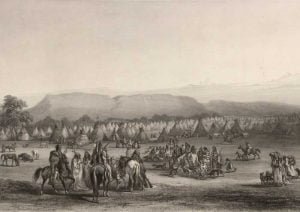
Houses of the Blackfoot Confederacy

"Encampment of the Piekann Indians" Karl Bodmer 1833

The Piekann Indians, part of the Blackfoot Confederacy, comprised tribes like the Siksika, Piegan, and Kainah, among others. Early European traders’ journals reveal their nomadic lifestyle, characterized by buffalo hunting and skin-covered lodges, which were easily transportable. Reports from the 18th and 19th centuries highlight their social structures, ceremonial practices, and interactions with European traders. As they migrated across the plains, the Blackfeet maintained cultural traditions while adapting to external influences, remaining notable for their fierce reputation and elaborate encampments.

Kainah Tribe

The Kainah Tribe, also known as the Kainah First Nation or Blood Indians, is a division of the Siksika or Blackfeet, residing in Alberta, Canada. Historically, they have numerous subtribes and once numbered around 2,400 individuals in 1858, with 300 tipis. By 1904, the population on their reservation was 1,196, predominantly pagan. The tribe is referred to by various alternate names in both English and other languages, denoting their rich cultural heritage and history.

Siksika Tribe

The Siksika, a prominent tribe of the Siksika Confederacy, reside on a reservation in Alberta, Canada. In 1905, they were known as the Running Rabbit and Yellow Horse bands and included several subtribes. Their culture, akin to other Plains tribes, involved buffalo hunting and significant social structures, including various dances and secret societies. Historically, they expanded their territory following the acquisition of horses and firearms, though they faced significant population declines due to disease and resource depletion. In 1909, their total population was reported at 4,635.

Piegan Tribe

The Piegan Tribe, part of the Blackfoot Confederacy, is known as the Pikuni, translating to “people with badly dressed robes.” Divided into numerous groups, their population was approximately 3,700 in 1858, declining to 2,520 by 1861. By 1906, the tribe’s numbers had further decreased, with 2,072 members in Montana and 493 in Alberta, Canada, under respective agencies.

Siksika Indian Bands, Gens and Clans

The post highlights various divisions within Indigenous tribes, focusing on the Siksika and Piegan Siksika, which include sub-tribes and bands like Emitahpahksaiyiks, Inuhksoyistamiks, and Inuksikahkopwaiks. While some of these divisions may no longer exist or lack detailed historical records, they are included to enhance understanding of the tribes’ structure and cultural heritage. Notably, Inuksiks is mentioned as a former division of the Piegan Siksika.