
The Calusa People

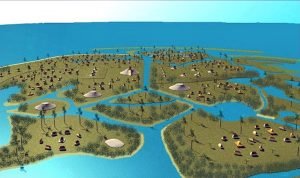
Birdseye View of Calusa

In the 1500s, Spanish explorers encountered the Calusa, a dominant indigenous nation in southwest Florida. Their society was hierarchically organized, with power concentrated in the hands of the king and elite leaders. The Calusa relied heavily on marine resources for sustenance, demonstrating advanced fishing techniques and maritime trade, particularly with Cuba. They constructed complex canal systems in their villages for transportation and protection against flooding. Their religious beliefs included a sun deity and practices of human sacrifice. The Calusa’s cultural connections extended to communities in South Carolina.
Mississippian Symbolism at the Ortona Archaeological Site

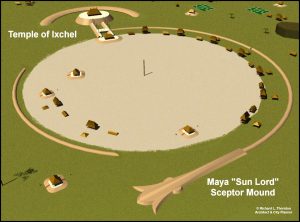
Ortona Sceptor Mound

Archaeologists at the Ortona site discovered earthworks resembling Maya scepters and a ceremonial pond, suggesting significant cultural exchange in the Caribbean Basin before European contact. The Scepter Mound and Pond, which date back to around 700 AD, indicate ritualistic practices possibly related to authority and baptism. The presence of similar ceremonial structures, like serpent mounds in Florida and Ohio, raises questions about their builders and the cultural ties between these regions. The findings at Ortona have largely been overlooked in academic discourse, warranting further investigation.

Choctaws and their Beliefs about the Great Flood

The Choctaws held a significant understanding of the Great Flood, known as Oka Falama, passed down through generations. An encounter between Rev. Cyrus Byington and an elderly Choctaw hunter illustrates this connection. The hunter, although respectful of Byington’s teachings, felt it was too late for him to change his beliefs, turning to his children for guidance instead. Their discussion highlighted a blend of cultural wisdom and reverence for tradition, as the hunter recognized parallels between the biblical flood and his ancestral stories, maintaining a strong faith in his heritage.

Choctaws Views on the Dead

The ancient Choctaws had a unique method for dealing with their dead, involving several stages. Initially, the corpse was placed on a scaffold to decompose. A designated Bone Picker would later remove the flesh, after which the bones were placed in a box and the scaffold burned. The bones were then stored in a bone house until collective burial in mounds occurred. Over time, this practice evolved to include burials in a seated position, marked by poles, hoops, and communal mourning rituals.

The Choctaw Ya-Yahs

Among the ancient Choctaw, customs before 1818 included a mother-in-law’s prohibition from seeing her son-in-law, requiring her to conceal her eyes. Choctaw wives did not use their husbands’ names, referring to them instead by their children’s titles. The Ya-Yahs, or mourning cries, reflected the profound sorrow of the Choctaw people, who expressed heartfelt grief over the dead for up to a year. Their rituals, marked by wailing and eventual feasting, embodied deep familial affection and a communal approach to mourning.

Choctaw Mesmerism, Eclipses, and Dances

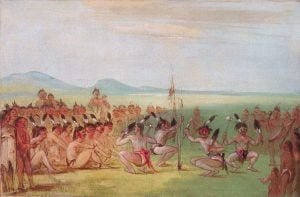
Eagle Dance, Choctaw, George Catlin, 1835-7

The Choctaw possessed a complex relationship with mesmerism, viewing it with awe and fear, often resulting in dire consequences for practitioners. Their superstitions extended to natural phenomena, such as eclipses, which they believed were caused by squirrels attempting to consume the sun. To avert this, they would make noise to drive the creatures away. Additionally, the Choctaw engaged in various dances, with significant emphasis on war, hunting, and ball playing for young men, while women focused on domestic roles, reflecting a distinct societal division.

Choctaw Religion

Eagle Dance, Choctaw, George Catlin, 1835-7

The Choctaw religion emphasized a Great Spirit, believed to be omnipresent and powerful, yet not requiring worship. Their concept of the afterlife included a “happy hunting ground” for the virtuous, contrasting with a painful realm for wrongdoers. Rituals around death included preparing journeys for the spirit and prolonged mourning, with specific burial practices that reflected their beliefs in the spirit’s continued existence. Healing practices by Choctaw doctors, both male and female, utilized herbal remedies and traditional methods, demonstrating their deep understanding of natural medicine.

Letter from Rev. Gilbert Rockwood to Henry R Schoolcraft

In a letter dated August 1, 1845, Rev. Gilbert Rockwood provides an update on the Tuscarora Mission, noting its origin under the New York Missionary Society and subsequent affiliations. The church, organized in 1805, has seen a total of 123 native members join, with 53 currently active. Rockwood highlights community advancements in morality, temperance, and marriage practices, alongside the establishment of a school. While challenges remain, he expresses optimism for the Tuscarora’s continued progress and industriousness.

Letter from Rev. Asher Bliss to Henry R. Schoolcraft

Rev. Asher Bliss wrote to Henry R. Schoolcraft on September 4, 1845, detailing the establishment and progress of the Cattaraugus Mission Church, organized in 1827. The church has seen 118 members, with significant advances in morality and education among the native population. Public worship has been consistently maintained, alongside schools promoting English language education. Bliss highlights the ongoing efforts in temperance and the visible improvements in the community’s living conditions, attributing these changes to the influence of the gospel over the past thirty years.

The Iroquois Origin

Iroquois tradition describes a dualistic creation narrative involving an upper world inhabited by human-like beings and a lower world filled with monsters. A female figure descends to the lower world, giving birth to twin gods, Inigorio (the Good Mind) and Inigohatea (the Bad Mind). They embody opposing forces in creation, with Inigorio shaping the continent and life while Inigohatea introduces dangers. Their conflict culminates in a battle, resulting in Inigorio’s victory, and the establishment of the world as known to humans. This allegorical tale reflects the philosophical depth of Iroquois beliefs.

The Sacred Fire of the Iroquois

The Iroquois practiced an annual rite where priests provided sacred fire to the community, symbolizing renewal and divine favor. Prior to this event, villagers extinguished their lodge fires as a sign of desolation. The priest, upon arrival, invoked the Master of Life and reignited the fire, leading to a communal feast. This ritual reinforced the significance of the priesthood and was likely tied to lunar cycles. Unlike the Aztecs, the Iroquois did not incorporate human sacrifice into their rituals, maintaining a focus on communal strength and hope.

Yuchi Folklore

The Yuchi people’s beliefs encompass various natural and supernatural phenomena. They believe that a terrapin walking around a large tree will dry up, and that storms cause snakes to retreat underground. The moon is said to be eaten by a toad during an eclipse, while thunderstorms result from a great black snake. They attribute earthquakes to a being underground, and twins or deformed children are considered signs from the supernatural. Various animal behaviors, such as howling coyotes, are interpreted as weather indicators, revealing a deep connection to their environment.

Cahuilla Creation Story

The Desert Cahuilla share a creation story rooted in their collective heritage with nearby coastal tribes. It begins with Mukat and Tamaioit emerging from darkness and creating light, earth, and living beings, alongside a cycle of quarrels that highlight their contrasting natures. They fashioned humans, inciting both joy and sorrow as the need for life and death emerged. The tale culminates in Mukat’s death, leading to yearly fiestas honoring the dead and the introduction of agriculture, shaping the Cahuilla’s understanding of life, death, and community.

Religion of the Six Nation Tribes

The Six Nations have distinct religious practices, characterized by their council houses where both Christian and pagan ceremonies occur. The Christian population is notably concentrated along central roads in various reservations, with several churches reflecting differing denominations. Pagan traditions persist alongside new religious movements, particularly influenced by Handsome Lake’s teachings. The spiritual life of the Six Nations is marked by communal dances and rituals, emphasizing gratitude to the Great Spirit while simultaneously confronting the social and political implications of their faiths.

The Cherokee Religion

The Cherokee religion is marked by its rich and authentic expressions, reflecting a deep-rooted belief system prior to European influence. Contrary to misconceptions, the Cherokee were fundamentally religious, with their practices not merely seen as superstitions. Their spirituality was complex, centered around polytheism and the spirit world, with prayers addressing tangible concerns like health and success. The significance of their religious expressions is underscored by their linguistic authenticity, offering invaluable insights into aboriginal thought and belief systems that stand apart from contemporary interpretations of morality.

Great Spirit

An Indian hunter, drawn by enchanting music in the forest, sought its source but found only silence. The Great Spirit appeared in his dreams, instructing him to purify himself before continuing his quest. After following these teachings, he discovered the music came from a healing plant. Despite attempts to cut it, the plant healed itself, revealing its medicinal properties. The hunter learned to prepare and apply the plant, which ultimately healed a dangerous wound, imparting knowledge of nature’s remedies as guided by the Great Spirit.

The History of the Little Orphan who Carries the White Feather

In a Dakota legend, a boy named Chácopee grows up with his grandfather in the woods after his family is slaughtered by giants. Predestined for greatness, he discovers his potential with the guidance of a mysterious voice and receives a white feather. Despite defeating several giants in races, he is deceived by the sixth giant, who transforms him into a dog. Through clever hunting and the support of a kind-hearted woman, he eventually regains his human form and brings prosperity back to his people.

The Magic Circle In The Prairie

In a remote prairie, a young hunter named Algon discovered a mysterious circular path where beautiful girls danced to enchanting music. Enamored by one of them, he attempted to capture her but was thwarted as they ascended back into the sky. Transforming into various animals to try again, he ultimately succeeded in securing the youngest sister as his bride. Their life flourished until she longed to return to the stars, leading to Algon’s profound sorrow. Eventually, they reunited, and upon bringing gifts from earth, became transformed into white hawks, returning to their celestial home together.

The Fate Of The Redheaded Magician

The narrative follows a young Indian boy, Odkshedoaph Waucheentonoah, who, seeking to prove his bravery, embarks on a quest to kill the famed warrior Redhead. After receiving counsel from a witch, he disguises himself as a woman to gain Redhead’s trust. Successfully marrying him, he ultimately seizes the moment to kill Redhead while he sleeps. After returning home with the head, he earns respect among his people and reconciles with his parents, who initially mourned his supposed loss.