
Monacan Burial Customs

In 1608, Captain Newport’s expedition documented the Monacan territory along the James River, revealing their villages and burial practices. Remains uncovered near Rassawek signify a history of shifting settlements, and graves were often located between fire beds or within homes. Notable mounds, such as the Indian grave examined by Thomas Jefferson, contained multiple skeletons in chaotic arrangements, suggesting communal burials. These findings illustrate the Monacan’s distinctive burial customs, emphasizing a connection to their ancestors that persisted even after significant population decline by the 18th century.
Monacan Indians

The Monacan Tribe, likely derived from their own language, is connected to the Siouan linguistic stock and related to the Manahoac, Tutelo, and Saponi tribes. They inhabited areas along the upper James River, with key villages including Massinacack, Mohemencho, and Rassawek. Captain John Smith documented them in 1607, but their population declined significantly following European encroachment. By the early 1700s, remnants of the Monacan likely merged with the Saponi and Tutelo tribes. The name persists today in Manakin, Virginia.

Monacan Tribe

The Monacan Indians, a 17th-century tribe and confederacy in Virginia, inhabited the upper James River region, with their chief village at Rasawek. They allied with the Manahoac and opposed the Powhatan, speaking a distinct language. The confederacy included several tribes, such as Massinacac and Mohemencho. In 1669, the Monacan had about 100 members, but by 1699, their population had dwindled, leading to Huguenot settlement at their former site.

The Monacan Confederacy

The Monacan tribes of Virginia experienced two significant historical periods: the colonization period, marked by initial contact with Europeans, and the colonial period, which saw their gradual decline post-Revolution. The Monacans, primarily located along the James River, interacted minimally with settlers until the expeditions of Lederer and Batts in the late 17th century. Their existence dwindled due to conflict with the Iroquois and encroachment by English settlers, leading to their eventual integration with other tribes by the early 18th century, effectively erasing their distinct identity.

Indians of Virginia

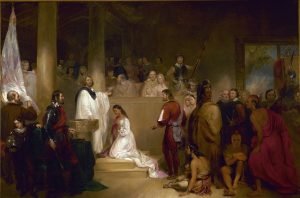
Baptism of Pocahontas

Captain John Smith’s narrative offers a comprehensive account of the indigenous peoples of Virginia, particularly those near Chesapeake Bay. He details early colonial attempts at settlement, highlighting both friendly interactions and violent conflicts with the Native Americans. Smith’s exploration of the region establishes crucial trade relationships while exposing cultural exchanges and tensions. His encounters with figures like Pocahontas illustrate the complexities of these interactions, which were shaped by mutual interest yet fraught with misunderstanding and betrayal, ultimately influencing the colony’s precarious survival amid challenges.