1871 Rocky Mountain Directory and Colorado Gazetteer

1871 Rocky Mountain Directory and Colorado Gazetteer

1871 Rocky Mountain Directory and Colorado Gazetteer, comprising a brief history of Colorado up to 1871 … together with a complete and accurate directory and history of Denver, Golden City, Black Hawk, Central City, Nevada, Idaho, and Georgetown.

Pennsylvania Digital Archives

Pennsylvania State Archives

These 45 genealogy databases comprise part of the Pennsylvania Digital Archives from the state government. We’ve only included those databases and documents which are most relevant to genealogists. All of them are free for you to use.

Pennsylvania Oaths of Allegiance, 1727-1775

Names of foreigners who took the oath of allegiance to the province and state of Pennsylvania, 1727-1775, with the foreign arrivals, 1786-1808

William Henry Egle’s seminal work, “Names of Foreigners Who Took the Oath of Allegiance to the Province and State of Pennsylvania, 1727-1775, with the Foreign Arrivals, 1786-1808” published in 1892, stands as a comprehensive record of immigrants who pledged their loyalty to both the British Crown and later to the State of Pennsylvania. The document lists names and details of individuals who, upon their arrival in America, were mandated to declare their allegiance—a legal requirement aimed at reinforcing loyalty to the provincial and state governance. The text not only catalogs these oaths but also provides vital genealogical data, including ship names, points of departure, and the dates of oath-taking. Despite the original documents being significantly damaged over time, this publication, authorized by the state, offers a meticulously collated and indexed reference that is indispensable for researchers and descendants seeking connections to their early Pennsylvanian ancestors.

The Czechs of Cleveland

The Czechs of Cleveland

“The Czechs of Cleveland” by Eleanor Edwards Ledbetter provides a historical and sociological overview of the Czech (Bohemian) immigrant community in Cleveland, Ohio. This study explores their initial settlements in the city’s East Side, their contributions to its growth, and their cultural integration, reflecting the broader narrative of Czech immigration and settlement patterns in America from the mid-19th century onward.

Early Immigrant Inspection Along the US/Mexican Border

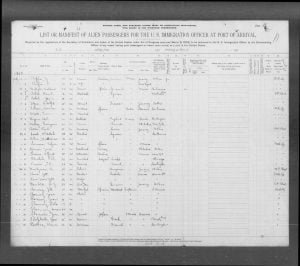
Sample List or Manifest of Alien Passengers for the U.S. Immigration Officer at Port of Arrival

Before the late 19th century, U.S. immigration laws primarily focused on European and Asian arrivals via seaports, with limited attention to land borders. The Immigration Act of 1891 allowed for some inspections along the U.S.-Mexican Border but focused chiefly on maritime entries. By 1906, systematic inspections began at southern ports with an emphasis on enforcing Chinese exclusion laws. However, many Mexican immigrants entered without formal records, complicating statistics and highlighting a growing divide between legitimate and illegitimate entries, necessitating increased inspection efforts.

Mexican Border Arrival Records Glossary

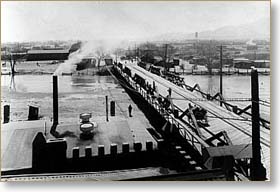
Mexican Border Crossing in El paso Texas, 1917

The glossary outlines key terms related to the documentation of border crossings to and from Mexico. It includes definitions of Arrival Manifests, which record the legal entry of individuals, and various types of border identification cards introduced in the early 20th century. Additionally, it distinguishes between immigrant, nonimmigrant, and visa classifications based on U.S. immigration laws established in the 1920s, including quota and non-quota statuses. This framework aids researchers in understanding the complexities of historical border records.

1787 Convicts Sent to New South Wales

In 1787, a total of 784 convicts were transported to New South Wales, each facing sentences ranging from five years to life. The detailed list includes names, the locations of their convictions, dates, and the duration of their punishments. Notable entries reflect a diverse group from London, Exeter, and other English towns, highlighting the grim realities of 18th-century justice and transportation. This migration marks a significant chapter in the early colonial history of Australia, shaping its societal fabric.