History of Stratford New Hampshire

1861 Map of Stratford, New Hampshire

The “History of the Town of Stratford, New Hampshire, 1773–1925,” edited by Jeannette Richardson Thompson, compiles decades of historical research prompted by Rev. Lucius W. Prescott. Initially prepared for publication in the late 19th century, the work was serialized before being comprehensively revised and published in 1925 for Stratford’s 150th anniversary. It documents the town’s settlement, demographics, and significant events, drawing from original records and community contributions while ensuring preservation of historical narratives and genealogical information for future generations.
History of Shelburne Massachusetts

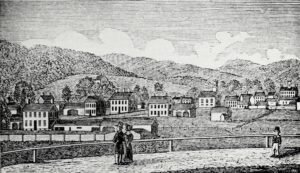
Southeastern View of Shelburne Falls Village Before 1835

The “History and Tradition of Shelburne, Massachusetts” is an account of the town’s development, initiated by a community effort in 1944. The project culminated in 1958 after various committees worked to collect and organize information across multiple aspects, including geology, early settlement, and cultural life. The book, intentionally topical rather than genealogical, features contributions from numerous writers and serves as a reference for understanding Shelburne’s heritage, institutions, and notable figures.

Acton Massachusetts History

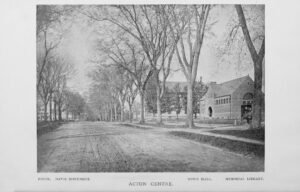
Acton Center,Acton Massachusetts

Acton in History traces the town’s development from its beginnings as Concord Village in the seventeenth century through its emergence as a modest industrial community. It gives particular attention to the religious life of the town, including the building of early meetinghouses and the long ministries of figures such as the Rev. John Swift and the Rev. James T. Woodbury. The work devotes substantial space to Acton’s role in the Revolution, especially the events at the North Bridge in 1775 and the loss of Captain Isaac Davis and his company of minute-men. It also follows the growth of local industries, from blacksmithing and cooperage to the far-reaching effects of the Fitchburg Railroad after its arrival in 1844. Later chapters include brief sketches of notable residents in the 1880s. Throughout, the narrative weaves in discussions of Acton’s everyday life, civic engagement, and social values.

History of the Town of Goffstown New Hampshire

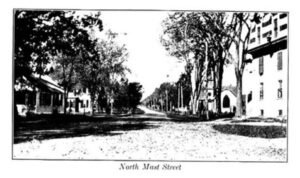
North Mast Street, Goffstown, New Hampshire

The “History of the Town of Goffstown, New Hampshire” chronicles the town’s development from its early territorial origins until the early twentieth century. Emerging from local preservation efforts, the book was formally initiated in 1908, with a dedicated committee tasked with organizing extensive records from various sources. It documents Goffstown’s civic, religious, and industrial life, along with genealogical records and maps. This historical account serves as a vital reference for current and future generations, preserving the town’s legacy and the contributions of its inhabitants.

History of Amherst New Hampshire

Residence of Isaac Brooks in Amherst New Hampshire

The history of Amherst, New Hampshire, unfolds from its 1675 land grant to veterans of the Narraganset War, marking the impetus for settlement along the Souhegan River. From its early governance and incorporation in 1760 to territorial adjustments that birthed Mont Vernon and Milford, this narrative encompasses local geography, economy, and Indigenous presence. Key military engagements, civic institutions, and genealogical records are explored up to 1882, offering a comprehensive view of the town’s evolution and its prominent figures.

Garrisons, Block-Houses, and Forts in the Saco Valley

Saco Fort in 1699

During the Indian wars, settlers along the Saco River constructed various fortifications for protection. Some were built individually, while others were financed by the Provincial Government. Notable structures included Saco Fort, established in 1693, and Fort Mary, built in 1708. These fortifications served as refuges during Indian threats, housing troops and local inhabitants. The construction of blockhouses and stockades ensured safety, although residents faced hardships during sieges. Many forts were later abandoned as peace returned, marking the challenging experiences of early settlers in the Saco Valley.

Genealogy of the Fox Family of Taunton, Massachusetts

The Connecticut-Massachusetts branch of the earlier family of this name of the old Bay State is one of long and honorable standing in New England, and as well of historic connection. The especial family here considered, and which for designation is styled the Taunton family, is that of pome of the descendants of Capt. Jabez Fox, of Berkley, Mass., one of whose sons was the late Henry Hodges Fox and the latter’s son the present Hon. William Henry Fox, lawyer and judge, who for forty and more years has been judge of the First District court of Bristol county and otherwise prominently identified with the public affairs of the city of Taunton.

Descendants of Lucius Reed, of Abington, Massachusetts

Lucius Reed of Abington, Massachusetts, descends from William Reade, who immigrated in 1635. Born in 1808, Lucius was a dedicated farmer and carpenter who prized education and integrity, passing away in 1887. He married Lydia Shaw, whose lineage includes Revolutionary War veterans. They had five children, all of whom were well-educated and active in their community. Lucius’s son, L. Alston Reed, was involved in town affairs, while his grandchildren continued their family’s legacy through education and civic engagement.

Genealogy of the Rhodes Family of Taunton Massachusetts

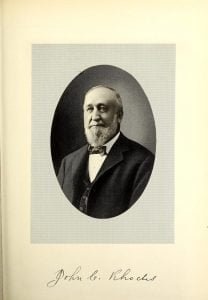
john rhoades

The Rhodes family has a rich history in Taunton and New Bedford, Massachusetts, tracing back to Henry Rhodes, an ironmonger born in 1608 in England. Stephen Rhodes, born in 1716, married Deliverance Walcot and later established a substantial lineage, including notable descendants involved in local business and governance. Among them are Stephen H. Rhodes, prominent in Boston, and Marcus Morton Rhodes, an influential manufacturer in Taunton. The family’s connections continue through the Bird family, further intertwining their legacy in the region’s heritage.

Ancestry of the Mortons of East Freetown, Bristol County, Massachusetts

James Madison Morton

The Mortons of East Freetown, Massachusetts, descend from Major Nathaniel Morton, linked to the prominent George Morton, a key figure in early Plymouth history. George, who arrived in 1623, published the first history of the Plymouth Colony. Nathaniel served as secretary of Plymouth Colony and held various local offices. His descendants continued to be influential in local governance and public affairs. The family remained active in education, law, and commerce, with notable members like James Madison Morton, a respected attorney and judge.

Descendants of Charles Keith of Bridgewater, Massachusetts

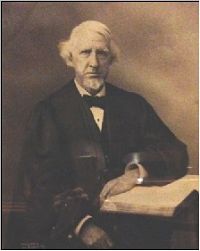
Rev. James Keith

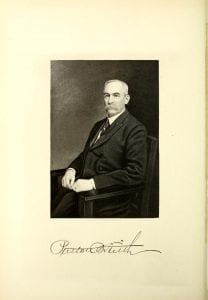
Charles Keith, born in 1794, married Mehitable Perkins in 1817, and they had several children, including Charles Perkins Keith, who became a prominent shoe manufacturer in Brockton, Massachusetts. Charles Perkins Keith’s business thrived from the mid-19th century, establishing a legacy in the shoe industry. His sons, Preston Bond and Rufus Perkins Keith, continued this tradition, holding significant roles in local manufacturing and banks while actively contributing to the community and the South Congregational Church. The Keith family remains a notable presence in Bridgewater’s history.

Indian Wars of New England

Indian Wars of New England

This post discusses the historiography of early Indian conflicts in New England, highlighting the contributions of William Hubbard, Church, Belknap, and Palfrey. It critiques Hubbard’s narrative as tedious and emphasizes Palfrey’s general overview, noting the limited focus on Indian-hostilities. The text outlines the periods of peace and subsequent violence, particularly referencing the impact of French and Indian alliances on English settlers from 1688 onward. It suggests the narrative is intended to offer a comprehensive account of these tumultuous interactions, from the Pequod Wars through French incursions.

Collections of the Connecticut Historical Society

Collections of the Connecticut Historical Society

From 1860 to 1930 The Connecticut Historical Society published a series containing items from their collection of historical documents. The following are 30 volumes of their works freely made available online. To assist the researcher with determining the contents for each volume, we’ve included such in the description. Connecticut genealogists will want to pay particular attention to Volumes 8-10, 12, 14, and 22. Willis and Wyllys family researchers, who descend from George Wyllys will be ecstatic over volume 21. And to our Native American friends, volumes 2 and 3 contain some information on early Connecticut Indians.

The French and Indian War from 1754 to 1759 – Beaver Wars

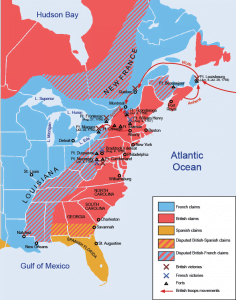
Map of French and Indian War

Following the conclusion of the peace in 1748, France sought to expand its territory westward in North America by constructing forts linking the St. Lawrence and Mississippi rivers. The English, alarmed by these actions, organized the Ohio Company to assert claims to western lands. Tensions escalated when French forces captured British traders, leading to conflicts involving both colonial and Indigenous forces. This set the stage for the French and Indian War, marked by George Washington’s early military engagements and the subsequent establishment of Fort Necessity, igniting wider hostilities in the region.

Genealogy of Henry Austin, Sr.

Henry Austin, Sr. (1736-1821), son of Samuel Austin and Elizabeth Marshall, married Sarah Harrison in 1758. He served in both Lord Dunmore’s War and the French and Indian War, receiving land grants for his service. By 1790, he had a sizable family and plantation. In 1795, he gifted land for a church, now known as Bingham’s Church. His will, written in 1821, detailed his estate and bequests to his wife and children, affirming his legacy in Albemarle County, Virginia.

Biographical Sketch of Capt. Hart

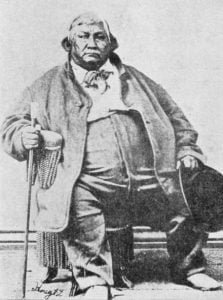
Capt. Hart, a New Jersey native, served as a Captain during the French and Indian War and fought at the pivotal battle of Quebec in 1759, leading his company known as the “Jersey Blues.” His son, Honest John Hart, was a signer of the Declaration of Independence. Nathaniel Hart, Honest John’s fourth son, migrated to Kentucky in 1795 and later to Missouri. Now aged 83 and residing in Boone County, Nathaniel carries a cane that belonged to his grandfather, a testament to their storied legacy.

Brief History of the French and Indian War

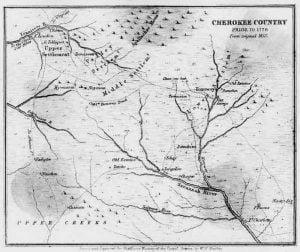
1776 Cherokees Map

Most histories of the French and Indian War overlook the Southeast, where conflicts primarily involved colonial militias battling the Cherokee rather than European armies. The war radically transformed the political landscape; by 1763, British control extended over once contested territories. Although some Southeastern tribes like the Creeks maintained neutrality or alliances, tensions escalated, culminating in violent confrontations. The fragile balance shifted as the British expanded their territories, ultimately leading to significant shifts in Native populations and alliances, particularly following the war’s end in 1763.

Biography of Edward Franklin Warner

Edward Franklin Warner (1844-1911) was a notable farmer and dealer in agricultural implements in Cummington, Massachusetts, where he lived on his family’s 300-acre estate. Born and passing away on the homestead, he was deeply involved in local affairs. Edward married Ellen Lovell in 1869, and together they had one daughter, Ethel Susie Warner, who also actively contributed to her community. His lineage traces back to distinguished ancestors from England, highlighting the Warner family’s long-standing heritage both in America and abroad.