Scanned Ledgers from the Yarbrough Dry Goods Store
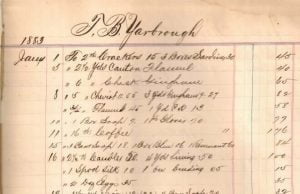
Original images, and index, of Thomas B. Yarbrough’s store ledger which he kept while conducting business in Honey Grove, Texas. Volume 1 covers the years of 1 Jan 1883-Jul 1884.

Original images, and index, of Thomas B. Yarbrough’s store ledger which he kept while conducting business in Honey Grove, Texas. Volume 1 covers the years of 1 Jan 1883-Jul 1884.
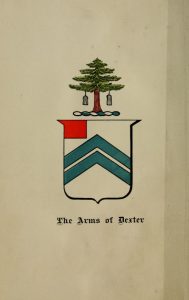
Being a history of the descendants of Richard Dexter of Malden, Massachusetts, from the notes of John Haven Dexter and original researches. Richard Dexter, who was admitted an inhabitant of Boston (New England), Feb. 28, 1642, came from within ten miles of the town of Slane, Co. Meath, Ireland, and belonged to a branch of that family of Dexter who were descendants of Richard de Excester, the Lord Justice of Ireland. He, with his wife Bridget, and three or more children, fled to England from the great Irish Massacre of the Protestants which commenced Oct. 27, 1641. When Richard Dexter and family left England and by what vessel, we are unable to state, but he could not have remained there long, as we know he was living at Boston prior to Feb. 28, 1642.
Among the early residents of Helena, Montana, notable figures include Isaac D. McCutcheon, a lawyer and former secretary of Montana, and F. S. Witherbee, a physician turned publisher. O. K. Allen achieved mining success with the Gould mine, while F. P. Sterling contributed as a land office register and probate judge. Other prominent citizens included T. H. Kleinschmidt, a banker and two-time mayor, and H. M. Parchen, a druggist and legislator. Together, they shaped the vibrant community that emerged in Helena during the late 19th century.
In 1863, several German and American settlers migrated to Madison County, Montana, bringing diverse backgrounds and experiences. John Willhard, Carl Rahmig, and O. W. Jay transitioned from mining to farming, establishing significant agricultural enterprises. Other settlers like Wilson Butt and Sanders E. Word also shifted from mining endeavors to farming, contributing to the region’s economy. Christopher Richter began brewing before settling into farming, showcasing the varied trades these pioneers engaged in as they developed their new home in Montana.
Sophia Word, a former slave born in 1837, shares her experiences of nearly two decades in bondage. She recounts witnessing the Mexican War and her family’s history, including her grandmother’s auction from Africa. Describing her relatively kinder master, she contrasts his approach to slave sales with harsher practices elsewhere. She offers vivid accounts of daily life, including cooking for special events and the brutality of other masters. Word notes the varied treatment of slaves and the presence of soldiers during the tumultuous Civil War era.