Abbe-Abbey Genealogy

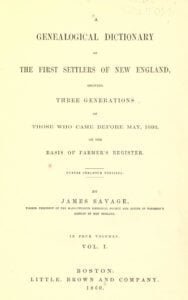
A genealogical dictionary of the first settlers of New England vol 1

The “Abbe-Abbey Genealogy” serves as a comprehensive and meticulously compiled homage to the heritage of the Abbe and Abbey families, tracing its roots back to John Abbe and his descendants. Initiated by the life-long passion of Professor Cleveland Abbe, this genealogical exploration began in his youth and expanded throughout his illustrious career, despite numerous challenges. It encapsulates the collaborative efforts of numerous family members and researchers, including significant contributions from individuals such as Charles E. Abbe, Norah D. Abbe, and many others, each bringing invaluable insights and data to enrich the family’s narrative.

The Cox family in America

The Cox family in America

Two volumes of Cox family genealogy combined as one. The first volume contains information about the various early Cox families across America. The second volume deals specifically with the descendants of James and Sarah Cock of Killingworth upon Matinecock, in the township of Oysterbay, Long Island, New York.

Earliest Known Traders on Arkansas River

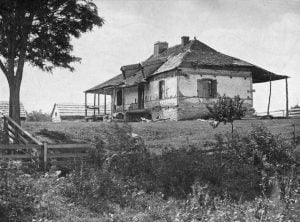
Country Home of Augustus Pierre Chauteau

Before the Louisiana Purchase, early French traders, notably Joseph Bogy, ventured along the Arkansas River, engaging in commerce with local Indian tribes, such as the Osage. Bogy’s expeditions included confronting Choctaw opposition in 1807, leading to government claims for losses. Prominent figures included Nathaniel Pryor and A. P. Chouteau, who established trading posts at the mouth of the Verdigris. These traders influenced the region’s economy, exchanging goods like furs and providing items such as tobacco and tools to Native Americans, fostering significant cultural exchanges.

Establishment of Fort Smith in 1817

Quapaw Cession Map

In 1817, a military post was established at Belle Point, now Fort Smith, Arkansas, to protect white settlers and the Cherokee from Osage hostilities. Major William Bradford led the detachment tasked with this, supported by Major Stephen H. Long, who surveyed the area. The post was strategically located at the junction of the Poteau and Arkansas rivers, facilitating navigation and trade. Subsequent treaties with the Osage and other tribes led to significant land cessions, shaping early relations and territorial boundaries in the region.

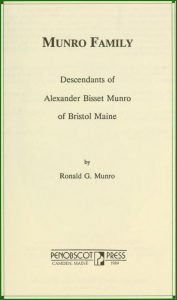
Descendants of Alexander Bisset Munro of Bristol, Maine

Munro Family

Alexander Bisset Munro was born 25 Dec. 1793 at Inverness, Scotland to Donald and Janet (Bisset) Munro. Alexander left Scotland at the age of 14, and lived in Dimecrana in the West Indies for 18 years. He owned a plantation, raising cotton, coffee and other produce. He brought produce to Boston Massachusetts on the ship of Solomon Dockendorff. To be sure he got his money, Solomon asked his to come home with him, where he met Solomon’s sister, Jane Dockendorff. Alexander went back to the West Indies, sold out, and moved to Round Pond, Maine, and married Jane. They had 14 children: Janet, Alexander, Margaret, Nancy, Jane, Mary, Solomon, Donald, John, William, Bettie, Edmund, Joseph and Lydia.

Genealogies of the First Settlers of Passaic Valley

Family Records or Genealogies of the First Settlers of Passaic Valley and Vicinity

Passaic Valley in New Jersey was first settled in the early 1700’s, primarily by families from Long Island, New York and Connecticut. The Family records, or, Genealogies of the first settlers of Passaic Valley and vicinity above Chatham provides genealogies of these early settlers from family records when they could be obtained, otherwise the author used family members to provide the information. Since some of the information comes from memory of individuals, one should validate what is written before relying on it to greatly.

Ridgelawn Memorial Cemetery – Oxford Michigan

This cemetery record from Oxford, west of Burdick Street, lists hundreds of burials collected in September 2001 by Christopher Schnur. The transcription includes names, birth and death dates, military service, family relationships, and epitaphs, offering a detailed historical snapshot of local families, veterans, children, and spouses buried in the cemetery.