
History of Carbondale, Illinois, 1852-1905
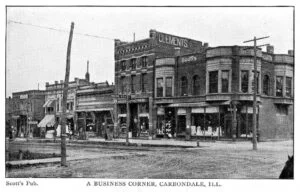
A Business Corner, Carbondale

Carbondale, Illinois, spans about 6,000 acres, primarily in the southwest quarter of Carbondale Township, established following congressional guidelines. Early settlers settled near Little Crab Orchard and Piles Fork creeks. The city’s growth is intertwined with the contributions of its founders, highlighted through 330 biographical sketches in the book, which offer details into their lives during challenging times. Carbondale’s history reflects the influence of individual leadership on municipal progress, celebrated here in the context of the nation’s bicentennial.

Slave Narrative of Mollie Williams

Mollie Williams, an 83-year-old former enslaved person from Mississippi, recounts her life born on the Newsome plantation. Her parents, both laborers, were acquired through a complex arrangement involving Marse George and his uncle. Mollie lived in the Big House due to her mother’s absence and enjoyed the company of white children, engaging in mischief and playing games. She observed harsh treatment of enslaved individuals but herself escaped punishment. The narrative also touches on family dynamics, traditions, and the impact of the Civil War on their lives.

Slave Narrative of Sarah Anderson

In an interview with Bernice Bowden, Sarah Anderson, aged 78, recounts her early memories of the Civil War and her life as a former slave. Born in Bibb County, Georgia, she moved to Arkansas at age fourteen shortly after the war. She reminisces about the arrival of Union soldiers, describing how children hid in fear. Sarah discusses her family life, including her mother and father’s treatment and her experience as a mother of fourteen, with most of her children now deceased, except for one son.

Henry C. Newsome

Henry C. Newsome served as a Private in the Medical Corps of the 81st Division, 306th Regiment, and was born in Union County to A. M. and Sally Newsome. He married Jennie W. Newsome and enlisted on April 25, 1918, at Marshville, North Carolina. After training at Camp Jackson and Camp Mills, he deployed to France on August 8, 1918, and participated in the Meuse-Argonne Offensive. He returned to the United States in June 1919 and was mustered out at Camp Jackson.