
Surnames Maharda to Mullie

This document contains genealogical statements regarding various individuals and families of Creek, Choctaw, Chickasaw, and Mississippi Choctaw descent who sought recognition and enrollment in tribal rolls. The records, primarily from 1909 reports, detail claimants’ ancestry, enrollment issues, and tribal affiliations. Many individuals were denied enrollment due to factional disputes, legal technicalities, or failure to apply within deadlines. The document includes references to official reports and affidavits, offering insights into the complexities of Native American citizenship and land rights during the early 20th century.
List 3, Cherokees

List of Cherokees and Cherokee Freedmen whose names were omitted from final rolls because no application was made or by reason of mistake or oversight. Shows the names of 125 Cherokees by blood and 2 Cherokee freedmen all except 5 being minors, and most of them less than 4 years of age March 4, 1906.

Decision Rendered Clay McCoy

On August 3, 1904, the Secretary of the Interior addressed the Commission to the Five Civilized Tribes regarding the application of Clay McCoy for enrollment as a citizen of the Chickasaw Nation through intermarriage. McCoy, married to an enrolled Chickasaw citizen since 1895, had previously been granted citizenship in 1896, affirmed by a U.S. court in 1898. However, a subsequent 1902 court ruling annulled that decision, leaving the Commission without jurisdiction to act on McCoy’s application, necessitating guidance for similar cases.

Rough Riders

Rough Riders

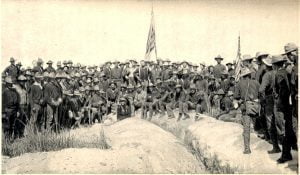
The compiled military service records of 1,235 Rough Riders, including Theodore Roosevelt, have been digitized. Each record features individual jackets detailing the soldier’s name, organization, rank, and medical records. The records also contain personal information and documentation descriptions. Discharges occurred for various reasons, such as age, ability, discipline issues, or hardship. This initiative provides significant insights into the personnel of the 1st U.S. Volunteer Cavalry during the Spanish-American War.

Biographical Sketch of Thomas K. McCoy

Thomas K. McCoy, born on March 9, 1827, in Sangamon County, Illinois, moved to Oregon in 1851, settling in Linn County. He married Margaret A. Kendall in 1848, and they had seven children together. In 1858, the family relocated to the Walla Walla valley, then later to Tumalum in Umatilla County. A dedicated Republican, McCoy served as a county commissioner upon Umatilla’s organization. He passed away on February 19, 1887, during a visit to Illinois, leaving behind a legacy as a respected family man and citizen.

Biographical Sketch of Josiah McCoy

Josiah McCoy, born on May 20, 1826, in Washington County, Pennsylvania, to Colonel John McCoy and Jane Brice, moved to Marshall County, Illinois, in 1850, where he engaged in farming and mercantile activities. He relocated to Westminster, California, in 1873, acquiring 120 acres for dairy and stock-raising. A Republican and Prohibition supporter, McCoy was first married to Mary L. Noe and later to Martha L. Wells, with whom he had several children and was an active Presbyterian Church elder.

Biography of Henry McCoy

Henry McCoy, born in 1829 in Sharon, N.H., significantly improved the Bradford Mineral Springs and Hotel after purchasing the property in 1881. Founding a temperance-focused resort, he expanded the hotel’s capacity and built various facilities, enhancing guest experiences. The mineral spring, known since 1770 for its healing properties, attracted visitors from across the country. A dedicated Prohibitionist and Baptist church member, McCoy contributed to community welfare and education throughout his life, while also supporting the Christian Commission during the Civil War.