Abington Massachusetts Marriage and Death Records
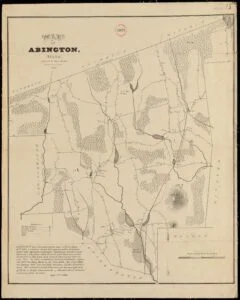
1830 Map of Abington, Massachusetts

Volume 2 of the Abington, Massachusetts vital records compiles marriage and death records up to 1850, complementing Volume 1, which contains birth records. Established in 1712, Abington’s boundaries have shifted, affecting historical jurisdiction. Extensive research from town records, cemeteries, and family Bibles ensured comprehensive documentation, including the identification of Black families recorded by given names. The volume is organized alphabetically by marriages and deaths.

History of Francestown New Hampshire

Map of Francestown New Hampshire

History of Francestown, New Hampshire is a historic and genealogical record of the town from its first settlement in 1758 through the beginning of 1891. It records Francestown’s settlement, civic growth, religious and educational institutions, military participation, industries, and social customs, followed by an extensive genealogical register of families associated with the town.

History of Littleton New Hampshire

1895 Map of Littleton New Hampshire

The History of Littleton New Hampshire is comprised of three volumes, two volumes of history, and a final volume of genealogies. Considered one of the best examples of local history written in the early 20th century, is your ancestors resided in Littleton then you need these books. Read and download for free!

Biographical Sketch of Thomas D. Bard Jr.

Thomas Dunn Bard Jr. was born on October 4, 1880, in Dalton, Georgia, to Thomas Dunn and Laura Rogers Bard. He received his education at Cherokee National Schools and Willie Halsell College. A veteran of the Rough Riders, he was mustered out due to vision issues. He married Elizabeth Belle Prather on January 2, 1910, and they had three children: Jennie May, Jackson Rogers, and Thomas Dunn Bard III. The couple were active Presbyterians, with Bard also involved in the Elks and Eagles organizations.

Biographies of the Cherokee Indians

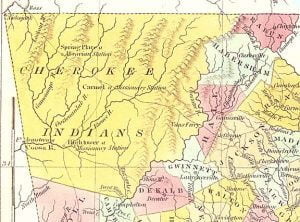
1830 Map of Cherokee Territory in Georgia

The Cherokee Indians, primarily from the Southeastern U.S., have a rich history marked by their early adoption of a written language and a government structure similar to that of the United States. Despite their forced relocation to Oklahoma in the 1830s, they maintained significant genealogical ties, often intermarrying with Whites. Emmet Starr’s “History of the Cherokee Indians and Their Legends and Folklore” emphasizes personal biographies and genealogies, providing insights into the lives and connections of many Cherokee families across generations, thereby enriching their cultural narrative.