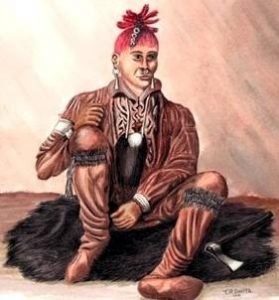
Chief Pontiac of the Ottawa’s

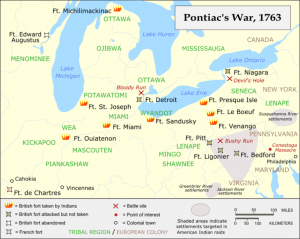
Map of Pontiacs War

Following the 1763 peace, English troops occupied former French forts, prompting widespread Indian apprehension of encroachment. Pontiac, the Ottawa chief, emerged as a pivotal leader advocating for resistance. He organized a council of tribes to unite against the English, inspired by a prophetic vision asserting divine support for their fight. Pontiac orchestrated a coordinated attack on English forts, aiming for liberation. Despite initial efforts, including a siege of Detroit, betrayal foiled his plans. Eventually, Pontiac was assassinated, symbolizing the decline of Indian resistance.

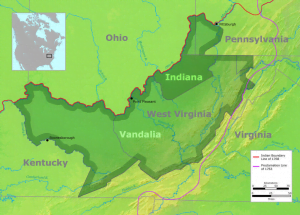
Lord Dunmore’s War

Vandalia Colony

The text details the events leading to and during Lord Dunmore’s War, sparked by illegal encroachments into the Vandalia Colony and violent acts against Native Americans by Virginians. It highlights the treaties made with various tribes and the resultant loss of their lands. The war began in response to brutal murders committed by settlers, leading to conflict with the Shawnees. Despite military advances by Virginia’s forces, Dunmore ultimately sought peace, yet tensions persisted as violence against Native Americans continued unabated.

Early Exploration and Native Americans

Ferdinand de Soto’s interactions with Native American tribes, specifically the Choctaws and Chickasaws, exemplify early European attempts to impose their ideologies of civilization and Christianity upon Indigenous populations. This approach set a precedent for further exploitation and oppression of Native Americans, as European settlers sought to acquire land and resources. Throughout history, tribes like the Chickasaws, known for their valor, remained steadfast allies rather than adversaries. This enduring alliance contrasts sharply with the overarching narrative of dispossession and extermination faced by Indigenous nations in North America.

The Discovery Of This Continent: It’s Results To The Natives

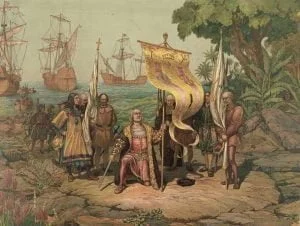
Columbus Landing on Hispaniola

In 1470, Christopher Columbus married Dona Felipa, daughter of a renowned navigator, and settled in Porto Santo, where they shared dreams of discovering lands to the West. Their ambitions fueled Columbus’s determination, leading to his 1492 voyage that resulted in the European discovery of the Americas. However, this event marked the beginning of devastation for native peoples, introducing warfare, disease, and colonization that would decimate their populations and cultures, ultimately transforming their rich, diverse societies into shadows of their former selves.

An Account of the Sufferings of Mercy Harbison – Indian Captivities

On the 4th of November, 1791, a force of Americans under General Arthur St. Clair was attacked, near the present Ohio-Indiana boundary line, by about the same number of Indians led by Blue Jacket, Little Turtle, and the white renegade Simon Girty. Their defeat was the most disastrous that ever has been suffered by our arms when engaged against a savage foe on anything like even terms. Out of 86 officers and about 1400 regular and militia soldiers, St. Clair lost 70 officers killed or wounded, and 845 men killed, wounded, or missing. The survivors fled in panic, throwing away their weapons and accoutrements. Such was “St. Clair’s defeat.”

The utter incompetency of the officers commanding this expedition may be judged from the single fact that a great number of women were allowed to accompany the troops into a wilderness known to be infested with the worst kind of savages. There were about 250 of these women with the “army” on the day of the battle. Of these, 56 were killed on the spot, many being pinned to the earth by stakes driven through their bodies. Few of the others escaped captivity.

After this unprecedented victory, the Indians became more troublesome than ever along the frontier. No settler’s home was safe, and many were destroyed in the year of terror that followed. The awful fate of one of those households is told in the following touching narrative of Mercy Harbison, wife of one of the survivors of St. Clair’s defeat. How two of her little children were slaughtered before her eyes, how she was dragged through the wilderness with a babe at her breast, how cruelly maltreated, and how she finally escaped, barefooted and carrying her infant through days and nights of almost superhuman exertion, she has left record in a deposition before the magistrates at Pittsburgh and in the statement here reprinted.

Life and travels of Colonel James Smith – Indian Captivities

An Artists rendition of James Smith

James Smith, pioneer, was born in Franklin county, Pennsylvania, in 1737. When he was eighteen years of age he was captured by the Indians, was adopted into one of their tribes, and lived with them as one of themselves until his escape in 1759. He became a lieutenant under General Bouquet during the expedition against the Ohio Indians in 1764, and was captain of a company of rangers in Lord Dunmore’s War. In 1775 he was promoted to major of militia. He served in the Pennsylvania convention in 1776, and in the assembly in 1776-77. In the latter year he was commissioned colonel in command on the frontiers, and performed distinguished services. Smith moved to Kentucky in 1788. He was a member of the Danville convention, and represented Bourbon county for many years in the legislature. He died in Washington county, Kentucky, in 1812. The following narrative of his experience as member of an Indian tribe is from his own book entitled “Remarkable Adventures in the Life and Travels of Colonel James Smith,” printed at Lexington, Kentucky, in 1799. It affords a striking contrast to the terrible experiences of the other captives whose stories are republished in this book; for he was well treated, and stayed so long with his red captors that he acquired expert knowledge of their arts and customs, and deep insight into their character.

Northwest Territorial War of 1812 – Indian Wars

Map of Northern Theatre of War of 1812

After the battle of Tippecanoe, tensions between Native Americans and white settlers escalated, fueled by British influence. Following the declaration of war against Great Britain in June 1812, the Northwest Territorial War erupted, marked by severe attacks on the western frontier. Notably, Tecumseh rallied many Native allies to the British cause. American forces, led by General Harrison, faced significant challenges, including the disastrous Frenchtown Massacre. However, victories at Fort Stephenson and the Thames ultimately shifted momentum, leading to a decline in Native American resistance.

War Between the Colonies and The Western Indians – From 1763 To 1765

Map of Pontiacs War

Pontiac, a prominent chief, led a coalition of Great Lakes tribes against British forces following the French defeat in 1760. His strategic prowess came to fruition in June 1763, when his forces captured Michilimakinak, demonstrating his tactical superiority and uniting various tribes against the English. The siege of Detroit, lasting twelve months, highlighted his leadership as the British prepared for retaliation. By late 1765, following Colonel Bouquet’s campaigns, peace discussions ensued, marking a significant moment in the conflict between the colonies and Native Americans.

Biographical Sketch of Rev. W. A. Brewer

Rev. W. A. Brewer played a pivotal role in the development of San Mateo County, serving as Hillsborough’s first mayor and rector of St. Matthews Military School. Known for his dedication, he was instrumental in establishing the San Mateo County Development Association and advancing the county’s interests. Under his leadership, Hillsborough achieved a progressive governance model. Born in Detroit in 1863 and married in San Francisco in 1895, he has two sons and currently pastors St. Paul’s Episcopal Church in Burlingame.

Biography of John Baptist Miege

John Baptist Miege, born in 1815 in France, became the first Catholic bishop of Kansas. After joining the Society of Jesus in 1836, he spent years studying, eventually becoming a priest in 1847. He arrived in St. Marys, Kansas, in 1851, where he established the first Catholic church in the region. Miege later constructed a cathedral in Leavenworth and worked to alleviate its debt through a trip to South America. He retired in 1874, later founding a Jesuit college in Detroit, before passing away in 1884.

Biography of Charles Wood Davis

Charles Wood Davis, born April 17, 1832, in Massachusetts, led a remarkable life contributing significantly to Kansas’s development. An 1849 gold rush argonaut, he became a railway executive and a pioneer in Kansas coal mining. Known as Cotton Wood Davis, he played a vital role in establishing railroad lines and initiating commercial salt production. A passionate abolitionist and active in the early Republican Party, he also authored numerous articles on agriculture. Davis passed away in 1910, leaving a lasting legacy as a productive worker and civic leader in Kansas.

Slave Narrative of Sam McAllum

Sam McAllum, born in 1842 in Mississippi, recounts his experiences as an ex-slave and his life during and after the Civil War. He describes his early life on the Stephenson Plantation, the challenges of wartime scarcity, and the complexities of post-war freedom. He details the violence and social upheaval in Kemper County, including the influence of the Chisolm family and the Ku Klux Klan. Ultimately, McAllum’s narrative highlights his resilience and the broader struggles for African Americans in the changing South.

Slave Narrative of John Cameron

John Cameron, born in 1842 in Jackson, Mississippi, recalls his experiences as a slave under Howell Magee. He describes a relatively comfortable life, with adequate food, care, and leisure time. Cameron appreciated his master and mistresses, noting they treated their slaves well. He worked as a gardener and was content with his life until the Civil War disrupted everything. After the war, he and other former slaves returned to Mississippi, but he faced difficulties reconnecting with his now-adult children. Cameron reflects on the changes in society since the war, expressing nostalgia for the past.

Biography of Bert R. Parrot

Bert R. Parrott, born in December 1873 in Mendon, Ohio, was a notable mechanical engineer and director at Dorris Motors Corporation in St. Louis. He received his education in Ohio and Michigan, later studying mechanical engineering. Parrott’s career included roles with various engineering firms, including the Buick Auto Company and the Parrott Tractor Company. He was married twice and had one son. Active in local politics, he was also a member of the Elks Lodge and remained dedicated to his engineering profession throughout his life.

Biography of J. F. Otto Reller

J. F. Otto Reller, born on July 7, 1864, in St. Louis, has been a prominent figure in the city’s real estate sector for over twelve years. The son of German immigrants, he educated himself in parochial schools and graduated from law school in 1907. Initially involved in his father’s grocery business, he transitioned to real estate in 1908. Reller has contributed actively to local organizations and civic duties, including river and harbor improvements, while also serving as vice president of Grace Evangelical Lutheran Church. He remains a respected member of the St. Louis business community.

Biographical Sketch of Charlie E. Amidon

Charlie E. Amidon, born on August 23, 1860, in Michigan, is a prominent farmer and stockman in Malheur County, residing five and a half miles southwest of Ontario. He operates a well-improved 180-acre farm and owns additional property. Raised on a farm and educated in common schools, Amidon moved to Nebraska and then to Michigan before settling in Oregon in 1884. He married Martha J. Steele in 1896, and they have one child. A respected community member, he is also a charter member of the A. O. U. W.

Slave Narrative of Ambrose Douglass

Ambrose Douglass, interviewed at 92 years old, reflects on his life as a former slave. Born free in Detroit in 1845, he was reenslaved during a visit to the South and endured 21 years of servitude, often being sold for disobedience. Despite the hardships, he recalls a relatively kind master in Suwannee County who provided food and care. After the Civil War, Douglass settled in Florida, where he worked in construction and had 38 children. Now living in poverty, he hopes for a pension to support his family.