
History of the town of Durham, New Hampshire

History of the town of Durham, New Hampshire

History of the town of Durham New Hampshire by Everett Stackpole is the primary source for genealogists with families who settled Oyster River New Hampshire, which later became Durham. Published in two volumes, the first contains a narrative history of Durham, while the second contains genealogies of most of the early families who settled in the town.
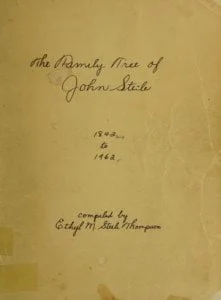
Genealogy of John Steele, 1842 to 1962

The family tree of John Steele, 1842 to 1962

Ethyl M. Steele Thompson’s purpose in penning this manuscript was to list by family all descendants of John Steele, who came from Scotland to Canada to reside until his death, in 1899, in Asphodel Township, Peterborough County, Province of Ontario, Canada. The genealogy begins with Robert Steel, who, with his wife and family, emigrated from Scotland to Canada. This manuscript is unsourced, and large portions may come from the personal knowledge of it’s author, especially those contemporaneous with it’s publication.

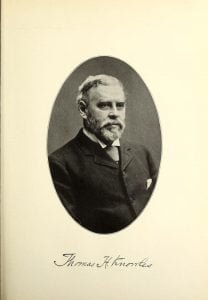
Knowles Family of New Bedford, MA

thomas knowles

The Knowles family, established in New Bedford for nearly a century, descends from the ancient lineage in Eastham, Massachusetts. Key figures include Thomas and James H. Knowles, whose firm was pivotal in the whaling industry. The family name was upheld by later generations engaged in diverse business and civic roles, greatly impacting local commerce and community welfare. Noteworthy individuals include Capt. John P. Knowles, a prominent whaling captain, and Joseph Knowles, influential in cotton manufacturing. The family’s legacy intertwines with New Bedford’s rich maritime history.

Biographical Sketch of George W. Dickie

George W. Dickie, born on July 17, 1844, in Scotland, is a renowned marine architect and naval designer from San Mateo County. His most notable achievements include designing the battleship Oregon and several notable vessels for the U.S. Navy, such as the Wisconsin, Ohio, and cruisers Olympia and Colorado. Additionally, he contributed to the design of large freighters and mining machinery. A respected figure in his field, Dickie is a fellow of the American Association for the Advancement of Science and vice president of the Society of Naval Architects and Marine Engineers.

Biographical Sketch of George Peery

George Peery, along with his brothers William and James, emigrated from Scotland and established themselves in Tazewell County, Virginia. He married Martha Davidson from Ireland, raising a large family of three sons and nine daughters. Their youngest son, Joseph, moved to Montgomery County, Missouri, in 1836 with his wife Elizabeth Hall. The Peerys were known for their warmth and hospitality, earning high regard in their community, particularly Dr. Thomas Peery, whose passing in 1875 was a significant loss.

Biographical Sketch of James Nowlin

James Nowlin and his wife, Martha Collins, emigrated from Scotland to America before the Revolution, initially settling in eastern Virginia and later moving to Pittsylvania County. Their son, Captain Bryan W. Nowlin, served in the Revolutionary War and had 15 children with Lucy Waide. The family expanded into Kentucky and Saline County, Missouri, with notable descendants including Samuel Nowlin, a law practitioner and Baptist preacher in Montgomery County, and his son, Samuel S. Nowlin, a respected attorney and Circuit Clerk.

Biographical Sketch of George Farrow

George Farrow, born in Fauquier County, Virginia to Scottish parents, served as a soldier in the War of 1812. He married Miss Massey and had several children, including George, Jr., Nimrod, John, and Benjamin. Benjamin later married Lucy Smith and had a large family. Some descendants, including John P., Sarah, and Margaret, moved to Missouri. John P. became a prominent figure, settling in St. Charles County and later serving as Judge of the County Court for two decades in Montgomery County, Missouri.

Biographical Sketch of George Gray

George Gray, a Scotsman who emigrated to America before the Revolution, served in the American army throughout the war, despite having brothers fighting for the British. He married Mary Stuart in Scotland, and after settling in Philadelphia, they moved to North Carolina and then to Bryans Station, Kentucky. Their son Joseph married Nary Finley and later moved to Missouri, where he died in 1830, leaving behind several children who spread across Montgomery County and beyond.

Alexander II English

Alexander II, known for his bravery at Bannockburn, commanded the Scottish army during significant battles, including Halidon Hill, where he ultimately fell in 1346 alongside his son William. His successor, Sir John Gordon, received royal confirmation of lands and led retaliatory campaigns against English incursions. Subsequent generations of the Gordon family continued to display military and political influence in Scotland, maintaining alliances with royalty and engaging in various battles throughout Scottish history, including during the tumultuous wars with England and internal conflicts.

Biography of William A. Phillips

William A. Phillips, born in Scotland on January 14, 1824, was a key figure in Kansas history, advocating for abolition and supporting the Union during the Civil War. After moving to Illinois and gaining legal expertise, he became an influential journalist with the New York Tribune. During the war, he rose to command significant military units, distinguishing himself in battle. Post-war, Phillips represented the Cherokee Indians and served multiple terms in Congress, where he authored the notable book “Labor, Land and Law.” He passed away on November 30, 1893.

Biography of Hector Ross

Hector Ross, born in 1811 in Greenock, Scotland, immigrated to the United States in 1837. After years of perseverance in various manufacturing roles, he established a successful cotton mill in Sherburne, Chenango County, in 1861. His initiative transformed the local economy, leading to the construction of multiple buildings and the mill, which became the largest manufacturing establishment in the region. Ross passed away in 1872, leaving his thriving business to his son, Alexander, who continued his father’s legacy of enterprise and community support.

Biography of Alexander Stalker

Alexander Stalker, born November 21, 1829, in Scotland, played a significant role in the early development of southeastern Idaho as a pioneer settler. He migrated to America in 1848 and contributed to various trades before arriving in Idaho in 1860. Here, he became a successful farmer and horticulturist, demonstrating the region’s agricultural potential. A prominent political figure, he served in the territorial legislature and was a loyal community member. Stalker and his wife, Ortencia, raised fourteen children, establishing a respected family legacy.

Biography of William Eccles

William Eccles, born in Scotland in 1860 and relocating to Ogden, Utah in 1864, has emerged as a significant figure in the northwest business landscape. His expansive career includes leadership roles in the lumber industry, the Sumpter Valley Railroad, and the Oregon Sugar Company, where his influence on sugar production is notable. A dedicated member of the Latter Day Saints church, he has contributed to community welfare and enterprise advancement. Married in 1884, he and his wife Marion have several children, reflecting his commitment to family and community.

Biography of David Bowie

David Bowie, born July 26, 1869, in Stirling, Scotland, played a crucial role in Topeka’s business landscape as vice president and treasurer of the Thomas Page Milling Company. Relocating to Kansas in 1892, he significantly contributed to the company’s prosperity through his extensive management skills. Beyond milling, Bowie was involved in various banking ventures, including the Shawnee State Bank. A Presbyterian and community-oriented individual, he remained unmarried and focused on philanthropy, establishing a reputation for integrity and generosity in both business and civic engagement.

Biography of Thomas G. Lowe

Thomas G. Lowe, born in Scotland in 1851, emigrated to America with his family in 1853. They settled in Idaho after a journey across the plains in 1861. Educated locally, Lowe learned carpentry and contributed to significant projects, including the Logan Temple and the Paris stake tabernacle. He later thrived in merchandising and the sheep industry. A devoted church member and educator, he served in various church leadership roles. Married to Elizabeth A. M. Pernell, they had nine children. Throughout his life, Lowe earned respect for his dedication and success.

Biography of Walter Hoge

Walter Hoge, born on November 18, 1844, in England, became a key figure in southeastern Idaho’s industrial landscape, particularly in the lumber business. Settling in Paris, he established sawmills and a planing mill, significantly contributing to local employment and prosperity. His early life included various trades, including butchering and mining, before he embraced the faith of the Church of Jesus Christ of Latter Day Saints. A community leader, Hoge served as sheriff and participated in public office while fostering a reputable family life and ranching endeavors.

Biographical Sketch of D. Heron

D. Heron, born in Scotland in 1842, immigrated to America as a child. He served in the Civil War with the Fifth Iowa Volunteer Infantry before returning to Iowa to study law, eventually being admitted to practice. Heron held the position of superintendent in Jefferson County, Iowa, and later moved to Jewell County, Kansas, where he was elected to the State Legislature. He is recognized as the third member of the firm Case, Bishop and Heron.

Biographical Sketch of Adam Graham

Adam Graham, born on April 17, 1840, in Scotland, was a prominent florist and businessman. He received his education in both Scotland and the United States. Graham married Janet Marshall in Philadelphia on October 19, 1863, and they had five children. He held leadership roles as president of the Adams Bag Company and the Society of American Florists in 1897, as well as active participation in various clubs and societies, including the Saint Andrews Scottish Benevolent Society and Cleveland Florists Clubs. Graham was also a member of Woodward Lodge, F. A. M.

Biographical Sketch of Ithiel Carter

Ithiel Carter, originally from Scotland, moved to Hartford, Connecticut, with his English wife, Louisa Deming. During the American Revolution, he served in the army to support his new homeland. They had two sons, Cyrus and Orion; Cyrus later became notable for selling the first patent clock west of the Mississippi in 1822. Ithiel married twice, first to Harriet Moore in 1838 and later to Martha Johnson, the widow of Samuel W. Williams.

Biography of Henry Clark

Henry Clark emigrated from Scotland to Kentucky, where he married Sarah Jones and had several children. His son Isaac, known for his talents, served in the Legislature and was an influential figure, bringing China ware to Montgomery County. Isaac’s marriages resulted in three children, while his brother John, a long-serving Clerk in Kentucky, had numerous descendants through multiple marriages. Both men were well-respected, with John recognized for his business acumen and community spirit. Their legacies reflect the strength of their family in early American society.