
Saginaw County MI
Biography of Frank Eugene Williams
Frank Eugene Williams, born on July 6, 1892, in Saginaw County, Michigan, is a prominent St. Louis attorney committed to civic improvement. He graduated from the University of Michigan Law School in 1917 and has been an active member of the Missouri and Michigan State Bar Associations. Williams served in various capacities during World War I, including on the legal advisory board. Married to Grace Ellen Edwards, they have one daughter, Shirley Ellen, and are involved in their community through church and social services.
Biographical Sketch of John G. W. Cowles
John G. W. Cowles, born in Oberlin, Ohio, on March 14, 1836, was a financier and minister. After graduating from Oberlin College and the Theological Seminary, he served as a pastor and army chaplain. Later, he shifted to real estate, managing interests for prominent figures like John D. Rockefeller. Cowles held leadership roles, including president of the Cleveland Trust Co. and the Chamber of Commerce. A trustee of Oberlin College since 1874, he was active in community service until his later years.
Biography of Herbert M. Howison, Prof.
Herbert M. Howison, born on November 21, 1888, in Michigan, has made significant contributions to Parsons, Kansas, as a professional musician and educator. With extensive training from esteemed institutions, he directed the Lake Charles Conservatory of Music and was active in local music organizations before settling in Parsons in 1915. His musical involvement extends to various church choirs and leadership roles in state music associations. Howison, married to Florence Kinnear, continues to impact the musical community in Parsons with his talent and expertise.
Erskine, Margaret F. – Obituary
Margaret F. Erskine, born July 2, 1918, in Saginaw County, Michigan, passed away on August 9, 1978, at Wallowa Memorial Hospital after five years of declining health. She married Ray Erskine on May 1, 1953, in Indiana and had recently moved to Wallowa County. Services were conducted at Riverside Cemetery in St. Charles, Michigan. Survived by her husband, a son, two daughters, and several siblings, her arrangements were managed by Bollman Funeral Home.
Condition of the Michigan Indians in 1890
By 1890, the Michigan Indians, primarily consisting of the Chippewas, Ottawas, and Pottawatomies, faced significant challenges following decades of conflict and forced displacement. Many were relocated to reservations, with a decline in population due to disease and assimilation pressures. Despite some improvements in education and living conditions, the majority struggled with poverty and a loss of cultural heritage. While a few remained self-supporting through labor and trade, widespread issues of substance abuse and discontent highlighted the adverse effects of their changing circumstances under U.S. governance.
Chippewa Indians
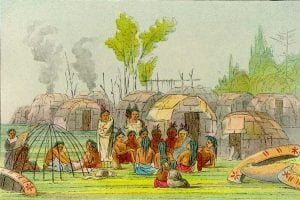
The Chippewa Indians, also known as Ojibwa, derive their name from a term meaning “to roast until puckered,” referencing their moose hide moccasins. They are a major subdivision of the Algonquian language family, originally located around Sault Sainte Marie but later expanding throughout northern Lake Huron and Lake Superior. Historically, they separated from a larger group of tribes and utilized firearms to push westward, ultimately forming numerous bands and villages across the United States and Canada. Their population has seen fluctuations, with estimates ranging significantly across centuries.