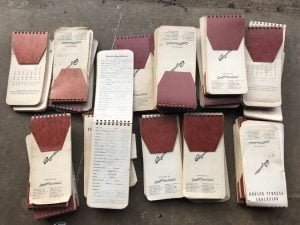
Arizona Funeral Home Records

Funeral Log Books

This page links to known Arizona Funeral Records whether they be available online or offline. Funeral records are an invaluable source of genealogical information that can provide insight into the lives and deaths of our ancestors. They offer a wealth of details on the deceased and their family, including their names, ages, dates of death, causes of death, and other key information. While funeral records can be found in a variety of places, genealogists must be careful when interpreting the information they contain, paying close attention to accuracy and cultural context. By using funeral records in their research, genealogists can gain a deeper understanding of their ancestors and build a more complete picture of their family history.

Biography of George W. Deitzler, Gen.

General George W. Deitzler, born on November 30, 1826, in Pennsylvania, emerged as a notable figure in the free-state movement in Kansas. He was arrested as a “treason prisoner” in 1856, later serving in the Kansas House and as mayor of Lawrence. At the onset of the Civil War, he led the First Kansas, sustaining serious injuries at Wilson’s Creek. Promoted to brigadier general and later major general of Kansas militia, he played a crucial role in border defense during Price’s raid. Deitzler died in a carriage accident on April 11, 1884.

Papago Indians

The Papago Indians, meaning “bean people,” belong to the Piman branch of the Uto-Aztecan language family, closely related to the Pima. They inhabit regions south and southeast of the Gila River, extending into Sonora, Mexico. Historically, they were first encountered by Father Eusebio Kino in 1694. Their population fluctuated over the centuries, with estimates ranging from about 6,000 in 1680 to over 6,300 by 1937. Their history has been similar to the Pima, though they faced less direct contact with European settlers.

Biography of Norman M. Ruick

Norman M. Ruick, born on October 4, 1854, in Granby, Connecticut, is a prominent Idaho attorney known for his dedication to law and public service. After initially working as a machinist, he pursued a legal career, being admitted to the bar in Indiana in 1877. Ruick practiced law in Idaho, serving as assistant district attorney and later as a state senator. He was instrumental in the Populist-Democratic coalition in 1896. Residing in Boise, he is celebrated for his criminal law expertise and has made significant contributions to Idaho’s legal and political landscape.

Biography of James Cyrus Preston, M. D.

Dr. James Cyrus Preston, born in 1863 in Illinois, became a prominent physician in Buffalo, Kansas, after his medical training in Illinois and Tennessee. He arrived in Buffalo in 1889 and played a crucial role in local medical practice and community development. Over the years, he held various leadership positions within medical societies and was actively involved in public health. Married in 1893 to Nellie Cowdery, they had three children. Dr. Preston was known for his surgical skills and dedication to the community throughout his career.

Fisher, Charles K. – Obituary

Charles K. Fisher, a 30-year-old former resident of Muddy Creek and son of C. K. and Lena Fisher, passed away in Tucson, Arizona, following a motor scooter accident. A graduate of Baker High School and a dedicated Air Force member, he was born on May 29, 1928. Fisher is survived by his wife Irene, two sons, and siblings. Funeral services are scheduled for Saturday in Tucson, attended by family members from Haines and McMinnville.

Hand, Douglas – Obituary

Douglas Hand, a former Haines schoolboy and notable citizen, passed away in Tucson in January 1990 after a distinguished military career. His family history is rooted in the west, beginning with his grandmother’s migration due to adversity. Doug attended local schools, worked on various farms, and graduated from Oregon State College in 1937. He served in the Army during World War II and the Korean War, retiring as a Colonel in 1964. He celebrated over 53 years of marriage before his death.

Biographical Sketch of William Toby Noyes

William Toby Noyes, born August 22, 1836, in Durham, Maine, was the son of English and Welsh immigrants. He migrated to California in 1863, initially working in various construction roles. Noyes settled in Highlands, San Bernardino County, where he focused on fruit and vine cultivation. Married to Harriet Randall in 1861, they had one daughter. An advocate of Prohibition, he was nominated for sheriff in 1888 and served as Justice of the Peace. He was also a charter member of the Orion Lodge of Odd Fellows in East Oakland.

Biographical Sketch of Hon. Frederic W. Gregg

Hon. Frederic W. Gregg, a Vermont native and Dartmouth College alumnus, embarked on a distinguished legal career after graduating in 1878. He initially practiced law in Tucson, Arizona, where he served as a United States Commissioner and County Judge of Pima County. In 1887, he migrated to San Bernardino, California, forming a successful partnership with William A. Harris. Gregg is recognized for his legal expertise, polished demeanor, and ability to foster strong relationships within the community.

C- Arizona Indian Villages, Towns and Settlements

This post provides a comprehensive list of Indian villages, towns, and settlements in Arizona, specifically those beginning with the letter C. It includes details on various groups such as the Maricopa, Papago, and Sobaipuri, with notable sites like Caborh, Cahuabi, and Casa Grande. The content documents historical populations, significant events, and notable visits by figures such as Father Kino and Father Sedelmair, reflecting the diverse indigenous heritage and settlements that have shaped Arizona’s history.

Papago Tribe

The Papago Tribe, also known as the O’odham or ‘bean people,’ is a Piman group related to the Pima, originally inhabiting areas in southern Arizona and northern Sonora, Mexico. Primarily agricultural, they cultivated crops like maize and beans using irrigation, while also relying on desert plants such as mesquite and saguaro for food. Known for their frugality and peaceable nature, the Papago faced challenges from Apache raids. Their traditional dwellings were dome-shaped huts, and by 1906, their population was recorded at nearly 5,000 in the United States.

Christensen, Joyce Mary “Joy” Mrs. – Obituary

Joyce Mary Christensen, 62, passed away on June 3, 2003, in Baker City, Oregon. Born on October 24, 1941, in Butte, Montana, she spent her life immersed in Western culture, raising horses and actively participating in 4-H programs. A talented musician and storyteller, Joy performed at various notable venues, preserving Western heritage. She was a supportive friend and family member, known for her positive spirit and dedication to her community. A memorial picnic is planned for July in her honor.

Biography of Hon. Theodore L. Stiles

Honorable Theodore L. Stiles, born July 12, 1848, in Medway, Ohio, was the only child of Daniel J. and Marie S. Stiles. After his mother’s death, the family moved to Indianapolis, where Stiles pursued higher education at Ohio University and later Amherst College, graduating in 1871. He studied law at Columbia Law School and was admitted to the bar in 1872. Moving west in search of better opportunities, he settled in Tacoma, Washington, where he became a delegate to the constitutional convention and was elected as a supreme court judge.

Cashmere, Donald Ray – Obituary

Donald Ray Cashmere, 40, passed away on April 9, 2006, at his home in Baker City, Oregon. A memorial service will be held at McEwen Bible Fellowship. Born in Tucson, Arizona, he later moved to Portland and then Baker City in 2002. Don, a passionate carpenter, enjoyed woodworking, fishing, and spending time with family. He is survived by his wife Tene, three sons, parents, siblings, and extended family. Memorial contributions may be made to Best Friends of Baker through Grays West Co.

Biography of John F. Stone

John F. Stone, a man of considerable means and notable physique, was instrumental in early Tucson’s development. He established a reduction mill after a gold discovery in Apache Pass and built the first house on Stone Avenue. Tragically, he was killed by Indians in Dragoon Pass while transporting gold. Previously, he served as Adjutant General of New Mexico under Governor Henry Connelly and co-owned the Union Hotel in Albuquerque before moving to Arizona. Stone’s legacy persists, notably through the naming of Stone Avenue.

Biography of Samuel Hughes

Samuel Hughes, born in Wales on August 28, 1829, immigrated to Pennsylvania before embarking on a life of exploration. After various roles, including a cabin boy and miner, he ultimately settled in Arizona in 1858 for health reasons. Despite initial struggles, he established a butcher shop and became a successful businessman and contractor, founding Tucson’s first bank. A prominent community member, Hughes had ten children with his wife Atanacia Santa Cruz and actively participated in local organizations, solidifying his legacy as a dedicated pioneer.

Biography of Henry Wickenburg

Henry Wickenburg, born in Austria in 1820, migrated to the United States, reaching Arizona in 1862. After working at Fort Yuma and traveling to La Paz, he pursued a group of explorers to Peeples Valley, where they discovered gold near Turkey Creek. Wickenburg then located the significant Vulture Mine and faced legal battles over its ownership. By 1864, he established a camp in what is now Wickenburg, developing ore processing methods and facilitating multiple milling operations by 1866, substantially contributing to the region’s mining industry.