
The Descendants of Franklin Mary Noyes Rowe of Humboldt County, Iowa

Home of Franklin and Mary Noyes Rowe 1887-1905

This book, “The Descendants of Franklin Mary Noyes Rowe of Humboldt County, Iowa, with Some Notes on Their Ancestors,” authored by Velma Rowe Coffin in Storm Lake, Iowa, in 1955, is a meticulously researched genealogical record spanning 87 pages. It traces the lineage of Franklin Rowe, born December 30, 1836, in Onondaga County, New York, and provides insights into his ancestry and descendants. Free to read or download.
Dwelly Family of Fall River, MA

The Dwelly family of Fall River, MA, traces its origins back to Richard Dwelly, who settled in Scituate in the mid-17th century. Notably, Dr. Jerome Dwelly, a well-respected physician, significantly contributed to the community for over sixty years. His son, Frank H. Dwelly, excelled in mill management, serving as treasurer for Tecumseh and Ancona companies. The family’s story weaves through generations, marked by professional accomplishment and community service, with both Jerome’s medical innovations and Frank’s business acumen shaping Fall River’s landscape.

Antiquities of Pompey and Adjacent Parts of Onondaga County

The town of Pompey, part of Onondaga County, is notable for its significant antiquarian remains, first documented by De Witt Clinton in the early 19th century. Excavations reveal evidence of early European interactions, particularly by the Dutch and French involved in fur trading with the Iroquois. Additionally, artifacts from the Ante-Columbian period, including stone tools and burial items, highlight the area’s rich Native American history. The archaeological findings in this region serve as vital records of both European and Indigenous cultural exchanges.

List of Occupants of the Onondaga Reservation, Onondaga County, New York

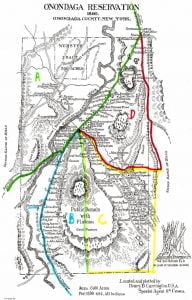
Onondaga Reservation Map, 1890

The Onondaga Reservation in Onondaga County, New York, spans approximately 6,100 acres and features essential facilities such as a hotel, store, and post office at Onondaga Castle. The reservation is characterized by limestone quarries, though cultivation is limited, with only about half of the land actively farmed. Much of the cultivated land is leased to white individuals, providing income to Native owners. The varied terrain includes stony hills and fertile lands, impacting agricultural productivity and community livelihoods.

Reservations of the Six Nations in New York and Pennsylvania, 1723-1890

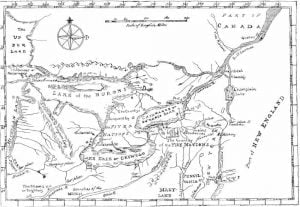
Map of the Country of the Five Nations

In 1771, Governor William Tryon prepared a map delineating the recognized boundaries of the Six Nations, later referenced by Lewis H. Morgan in 1851 to depict the villages and trails of the Five Nations. By 1890, the Oneida and Cayuga tribes had lost their ancestral lands in New York, retaining only small remnants. Various treaties led to significant land reductions for the Oneidas. The Six Nations’ reservations were organized under New York law, reflecting both traditional customs and modern governance challenges faced by their communities.

Biography of Elder John G. Hook

Elder John G. Hook was born on February 13, 1820, in Chichester, New Hampshire. He was raised in a farming family and was the only surviving child after the death of a sister. His conversion to Christianity occurred during a journey to the West, leading him to embrace Adventist beliefs passionately. Over his 55-year ministry, he traveled extensively, holding revivals and baptizing about 2,000 people, including 150 in a significant Concord revival. Married to Celinda H. Ingersoll, he has two daughters and devoted his life to preaching without financial compensation.

Biography of George S. Bond

George S. Bond, born in Charlestown on March 2, 1837, was the son of Silas and Alice Bond. After his father’s death, he worked various jobs, eventually learning the tinsmith and shoe finishing trades. In 1865, he purchased a tin store, later transitioning to a successful violin case manufacturing business, noted for its extensive capacity and equipment. Bond served on the School Board, participated in the 1889 Constitutional Convention, and was a prominent Mason. He married Mary M. Way and had a son, Herbert, and became a respected figure in Charlestown through diligent effort.

Biography of Rev. Josiah Lamberson Parrish

Rev. Josiah Lamberson Parrish, born on October 14, 1806, in New York, was a key figure in Oregon’s early missionary efforts. After working as a blacksmith and saddle-maker, he devoted himself to preaching in 1835 and became blacksmith for the Methodist Mission in Oregon in 1839. He served as an Indian agent from 1849 and was instrumental in establishing reservations. Retiring in 1856, he continued his ministry, notably as chaplain of the Oregon Penitentiary. Parrish, now an octogenarian, resides in Salem, Oregon, noted for his integrity and vast knowledge of early Oregon history.

Biographical Sketch of Simon Ralph Walkingstick Jr.

Simon Ralph Walkingstick Jr. was born on August 17, 1896, in Tahlequah, the son of Simon Ridge and Viola Walkingstick. He graduated with a B.S. from Dartmouth College after studying at Bacone College. On December 15, 1917, he married Margaret E. McKaig and they had one son, Syvertsen. A Presbyterian, he held various leadership roles at Dartmouth, including president of the Y. M. C. A. He served as a captain in the Army Y. M. C. A. during World War I and later worked with the Oklahoma Y. M. C. A.

Biography of James F. Mahon

James F. Mahon, born on April 29, 1855, in Syracuse, New York, emerged as a prominent figure in Harney County, Oregon. After gaining experience as a superintendent in California, he moved to Oregon in 1879, becoming the county’s largest grain farmer and a leading breeder of horses and mules. Mahon’s integrity, financial acumen, and tireless work ethic have greatly advanced the county’s agriculture. He is also a devoted family man, with four children from his second marriage, and maintains active involvement in various civic organizations.

Biographical Sketch of Matthew Neeves

Matthew Neeves, born in 1830 near Syracuse, New York, pursued an education before moving west to Illinois, where he worked as a schoolmaster. In 1852, he joined pioneer Joab Powell and moved to Oregon, initially mining on Rogue River. He spent years in Douglas County before engaging in mining and freighting in Florence until 1867. Eventually, he settled in Umatilla County, raising stock and farming until 1880. He later moved to Pendleton, where he enjoyed a comfortable life with his daughter and stepson.

Biography of General Edward McConville

General Edward McConville, born June 25, 1846, in New York, served with distinction throughout his military career, notably in the Civil War and later conflicts with Native Americans. As a revered leader of the Idaho troops during the Spanish-American War, he exemplified valor, ultimately sacrificing his life on February 5, 1899, while leading a charge in the Philippines. Known for his dedication to both military duty and education of Native American children, McConville’s legacy endures as a testament to patriotism and bravery, earning him a prominent place among America’s heroes.

Biography of Milton Kelly

Judge Milton Kelly, born in 1818 in New York, became a notable figure in Idaho’s early history. He practiced law in Wisconsin before moving to California and then Oregon, where he engaged in business and contributed to Idaho’s legislative framework as a member of the first territorial legislature. Appointed by President Lincoln as a territorial supreme court judge, he later became the owner and editor of the Idaho Statesman, influencing public opinion and governance. Kelly passed away in 1892, remembered for his integrity and dedication to the state.

Biography of Edwin R. Sherwin

Edwin R. Sherwin, born on January 26, 1821, in New York, was a significant figure in Idaho’s early business landscape after arriving when Lewiston was a mere tent settlement. Educated in blacksmithing, he worked in various places before traveling to California and then mining in Idaho. Sherwin pioneered quartz mining, discovered rich ore deposits, and faced hardships during the Nez Perces War. He later established a successful ranch and is recognized as a respected pioneer, living a quiet life in Grangeville with his family.

Biography of George H. North

George H. North, a prominent clothing merchant in Pocatello, Idaho, was born on July 14, 1858, in Springwater, New York. He received his education at the Geneseo Western Seminary before working on his father’s farm and then clerking in Wyoming. In 1890, he established a clothing business in Pocatello, which grew successfully, partnering with Richard Douglass in 1898. North is married to Peronne Church and has one child. A dedicated businessman and Republican, he contributes significantly to his community through his entrepreneurial efforts.

Biography of John Hallenbeck

John Hallenbeck, born on October 24, 1830, in Albany, New York, moved to Silver City, Idaho, in March 1864, where he significantly contributed to its development until his death in 1899. His background included a lineage of early American settlers and Revolutionary War heroes. After various occupations in canal construction, he pursued gold mining in Colorado and subsequently in Idaho. Hallenbeck eventually established a successful grain and feed business, becoming a respected figure in the community and a dedicated member of the Republican Party and Masonic Lodge.

Biography of John Frawley

John Frawley, born on May 29, 1850, in Syracuse, New York, has had a distinguished career in public service. He is currently serving his third term as treasurer of Union County after a varied professional background, which includes railroading and farming. Frawley’s early career saw him operating the first freight trains in the Grande Ronde Valley. After a serious accident in 1889, he transitioned into county governance. A devoted family man, he married Millie Collins in 1887, and they have one son, Harry.

Biography of Henry G. Weston

Henry G. Weston, a veteran of the Mexican War, was born on July 21, 1827, in Skaneateles, New York. He served with an Iowa regiment and participated in key battles, later witnessing America’s growth through subsequent conflicts. After moving to Illinois and then to Nevada, he became a successful farmer in Idaho’s Salubria Valley. He married Annis S. Adams and raised six children. An active Democratic citizen and member of the Independent Order of Odd Fellows, Weston remains dedicated to public welfare throughout his life.

Biographical Sketch of Leon Brooks Bacon

Leon Brooks Bacon, born on July 24, 1870, in Taberg, New York, was a notable lawyer and legal professional. He graduated from Williams College in 1893 and earned his LL.B. from Syracuse University in 1899. Bacon held various roles, including editor and director in multiple organizations, and was involved in women’s suffrage and municipal law reform. He authored historical genealogies and was an active member of several professional and historical societies. Bacon married Anna Osborne Anthony in 1900 and had three children.

Biographical Sketch of Michall F. Donovan

Michall F. Donovan was born in Corning, New York, in 1863 to John and Mary Leary Donovan. He received his education locally and married Margaret Holmes in 1905. Beginning his career at age 14, he trained as a printer and worked in various New York cities. In 1885, he shifted focus to typewriting machines and founded a company in Cleveland in 1892, producing typewriter ribbons and carbon papers. He served as secretary and treasurer of the Buckeye Ribbon and Carbon Company and was a member of the Cleveland Credit Men’s Association.