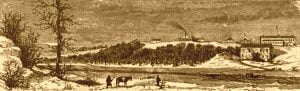
Establishment of Fort Gibson in 1824

Fort Gibson in 1875

The Arkansas Territory was established by Congress in 1819, encompassing parts of present-day Arkansas and Oklahoma, with governance limited to the eastern section. James Miller became its first governor in 1819, tasked with overseeing relations with Native tribes. Efforts to broker peace between the Osage and Cherokee tribes were largely unsuccessful, leading to military reinforcements at Fort Smith. In 1824, troops were moved to a new post, Cantonment Gibson, established to enhance security and regulate tensions, which would eventually evolve into Fort Gibson, founded in 1824.

Biographical Sketch of Mrs. Henry J. Hamilton

Neppie, born on July 9, 1881, in Muskogee to Pleasant Napoleon Blackstone and Mary Barr, was educated at Bacone College. She married Henry J. Hamilton on March 8, 1906, and together they had eight children: Ollie, Maude, Lillian, Henry J., Nellie, George, Jacob Clark, and Neppie Leona. Her Cherokee name is Utiya.

Biographical Sketch of Isaac Johnson

Isaac Johnson, born in 1883 to Milo and Adeline Payne Johnson, was educated in Tahlequah. He married in Muskogee in 1913 and raised three children: Jessie, Maxine, and Willard. Known for his diligence, Johnson served as a state enforcement officer, contributing significantly to public safety and law enforcement in his community.

Biographical Sketch of William Custis Harnage

William Curtis Harnage, born on April 15, 1884, was educated at the Male Seminary and Henry Kendall College in Muskogee. He married Rose B. Nye in 1905, and they had three children: William Halleck, Griffith Scott, and Lawrence Nye. Active in his community, Harnage was involved in the Presbyterian Church and the Knights of Pythias. His lineage traces back to William Thomas Harnage, who was born in 1847 and served as a Senator for the Tahlequah District starting in 1899.

Biographical Sketch of Mrs. Hubert Ambrister

Julia Theresa Patton, daughter of William and Jane Patton, wed Dr. Francis Bartow Fite, with their daughter Frances born in Muskogee in 1893. She attended National Cathedral School and graduated from Vassar College before marrying Hubert Ambrister in 1920. Hubert, son of Samuel A. Ambrister, is a law practitioner in Oklahoma City and served in the Aviation Corps during World War I. The Adair family, linked to Thomas James Adair, has deep roots in Tahlequah, with their accomplished daughter Emily a graduate of Northeastern Oklahoma State Normal.

Biographical Sketch of Mrs. Lola M. Rambo

Lola M. Rambo, born on September 6, 1885, in Vinita, Oklahoma, is the daughter of Marshall and Pauline Mann. She graduated from Willie Halsell College and married Walter A. Rambo in 1907. Together, they had four children. Mrs. Rambo serves as the private secretary for the Superintendent of the Five Civilized Tribes and is active in her community, belonging to the Saint Paul Methodist Church and several fraternal organizations. Her family’s roots trace back to Ohio and the Cherokee Nation.

Biographical Sketch of Mrs. Augustus W. Aldrich

Ara Thomas, born on June 23, 1886, in Kentucky to Goren and Eliza Wheatley Thomas, received her education there. She married Augustus William Aldrich in Muskogee on October 22, 1905. Together, they had two sons, John Harley and Roger Arthur. The Aldrich family is actively involved in the Apostolic church, and Augustus is a farmer residing near Ketchum.

Biographical Sketch of Albert Brown

Albert Brown, born in 1887 in Muskogee to John T. and Lou (Griggs) Brown, received his education in local public schools. In 1908, he wed Mary, daughter of Frederick Carter, in Claremore. The couple had two children, Juanita and Gabriel. A dedicated farmer, Albert is also an active member of the A. H. T. A., contributing to both his family and community.

Biographical Sketch of Mrs. William A. Lamon

Martha Evaline Clingan, born March 21, 1874, in Gibson Station, Cherokee Nation, was educated at the Female Seminary and later taught at Harrell Institute in Muskogee. On February 1, 1899, she married William Archibald Lamon, a businessman in realty and cotton. They had six children. Martha was active in her community, participating in the Methodist church and organizations like the Eastern Star and the Twentieth Century Club. Her lineage traces back to William Davidson Clingan, a Confederate officer.

Biography of Frank J. Boudinot

Frank Josiah Boudinot, born August 20, 1866, in the Cherokee Nation, was a prominent leader and legal advocate for the Cherokee people. Educated at Bacone College and the University of Michigan, he became an attorney for the Kee-too-wah Society in 1899 and was elected Principal Chief of the Cherokee Nation in 1895. Boudinot played a pivotal role in organizing Eastern Cherokees and successfully pursuing claims against the U.S. government. He married Annie Stapler, and they had two sons, continuing the Boudinot legacy in Cherokee leadership.

Biographical Sketch of Hall Mayes

Hall Mayes, born on September 26, 1891, near Pryor, was the son of Walter Adair and Nannie Riley (McCoy) Mayes. He pursued his education at Male Seminary, Bacone University, and Agricultural College at Stillwater. On September 1, 1915, he wed Sallie Pearl Cochran, with whom he had three daughters: Virginia Lee, Mary Hall, and Lucile Cochran. Hall’s lineage traces back to Samuel Mayes and Nancy Adair, emphasizing a rich family history intertwined with prominent local figures.

Biographical Sketch of Judge A. E. Robertson

Arthur Evans Robertson, born on September 18, 1888, in Hulbert, Cherokee Nation, was educated at various institutions including the University of Tulsa and University of Paris. A member of the Bird Clan, he served in the 143rd Infantry during World War I. His lineage includes Reverend Evans Price and Wade Hampton Robertson, a veteran who died in the Civil War. A Presbyterian and member of the Knights of Pythias, Robertson became County Judge of Cherokee County in 1920.

Biographical Sketch of Mrs. A. R. Matheron

Maudie Eiffert, born on January 1, 1872, in Fort Gibson, was the daughter of Henry and Susan F. Thompson Eiffert. She received her education in Vinita and at the Female Seminary. On October 1, 1889, she married Alexander Ross Mathewson, who was born on March 28, 1867, in St. Louis. Together, they had four children: Floyd, Richard Thomson, Ross, and Helen, each of whom later married. This union marked the beginning of a notable family lineage.

Slave Narrative of Sweetie Ivery Wagoner

Sweetie Ivery Wagoner recounts her early life as the daughter of Betty and Louis Ivery on a large Arkansas plantation owned by Newt Titsworth. Her father, a Creek Indian, was enslaved and married to a slave woman. Sweetie describes the good treatment of slaves by Titsworth, who employed them in various tasks, and the abundance of food provided. Post-war hardships followed, leading to separation from her siblings. She reflects on her family’s Indian heritage and her mother’s education in reading, alongside a strong devotion to religion.

Slave Narrative of J. W. Stinnett

J. W. Stinnett, born in 1863 in Prairie Grove, Texas, shares his memories of slavery, albeit limited due to the passage of time. His parents, George and Mary Stinnett, were enslaved by a Creek Indian named Frank Stinnett. They moved to Texas during the Civil War, where his mother managed household and farming duties after his father fled. Stinnett reflects on his upbringing and the challenges faced by his family, including the care of his nine grandchildren after his mother’s passing.

Slave Narrative of William W. Watson

William W. Watson reflects on his memories of slavery, detailing the physical and emotional scars it left on him, including lash marks and harsh treatment from masters. He recounts his upbringing on plantations owned by Henry Watson and Tom Davis, his family history, and the hardships of daily life as a slave. Following emancipation, he and his wife faced challenges in building a life together, raising thirteen children, and overcoming adversity. Despite his trials, Watson expresses gratitude for his freedom and devotion to his faith.

Slave Narrative of Acemey Wofford

Acemey Wofford, born on June 13, recalls his life as a slave when he was brought from Mississippi to Texas by Doctor Hayes and his harsh mistress, Malissa. He describes the physical hardships and the constant fear of punishment, especially from his mistress. Wofford worked in the fields and served the household, often feeling exhausted. After the Civil War, he reunited with his husband and had two sons, though one died during the war. Wofford reflects on his past with pain, struggling to recall more details.

Slave Narrative of Annie Groves Scott

Annie Groves Scott, born March 18, 1845, in Lyonsville, South Carolina, recounts her early life as a slave. Her father was sold when she was a baby, and she describes the painful separation and the longing for family. Raised by Mistress Emma Grant, Annie was educated and sheltered from the harsh realities of slavery. Throughout the Civil War, she witnessed the fears of her master and the arrival of Union soldiers. After emancipation, she worked hard on her own farm, eventually marrying Abraham Scott and raising a family in Muskogee.

Slave Narrative of Liza Smith

Liza Smith, a 91-year-old former slave from Muskogee, Oklahoma, recounts her family’s history, tracing her roots to her parents, Jane Mason and Frank Smith, who were brought from Africa to Virginia. She recalls life under her master, Frank Mason, who treated his slaves well, providing food, care, and a relatively comfortable existence. Smith describes the hardships during the Civil War, the eventual announcement of their freedom, and the struggles to adapt afterward. Despite the challenges, she expresses hope of reconnecting with her family’s origins.

Slave Narrative of Hal Hutson

Hal Hutson, born in Galveston, Tennessee, in 1847, recounts his childhood as a slave on Master Brown’s plantation. He lived in one-room log huts with his family, endured harsh labor, and faced the overseer’s brutality. Despite restrictions, he learned to read and write, sharing knowledge with white children. After the Civil War, Hutson celebrated his newfound freedom but continued working for wages. A devout Christian and community member, he reflects on his life and family, emphasizing the importance of education and gratitude for emancipation.