
Houses of the Hidatsa Tribe

Bull-boat and paddle, obtained from the Hidatsa. Marked "Fort Buford, Dak. Ter. Grosventres Tribe. Drs. Gray and Matthews." (U.S.N.M. 9785)

The Hidatsa, also known as the Minnetaree, inhabited villages near the Knife and Missouri Rivers in present-day North Dakota. Their settlements, consisting primarily of earth-covered lodges, remained largely unchanged from early European encounters. Notable visitors, including Catlin and Maximilian, documented these villages, noting their layout, social practices, and ceremonies. Over time, the Hidatsa adopted log cabins alongside traditional lodges. Their culture included agricultural practices and seasonal migrations in pursuit of buffalo, with caches used for storing food and valuables during hunting trips.
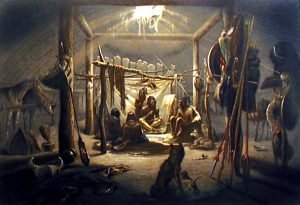
Houses of the Mandan Tribe

"The interior of the hut of a Mandan chief" - Karl Bodmer, 1833

In November 1738, a French expedition led by La Verendrye became the first known Europeans to visit the Mandan Tribe, documenting their six fortified villages, each encircled by tall palisades. The Mandans lived in spacious earth lodges and cultivated crops, showcasing a prosperous way of life. Descriptions by explorers Lewis and Clark in 1804 and later accounts by Catlin and Maximilian reveal significant changes over time, including the decline of the population due to smallpox and conflicts, leading to the eventual abandonment of many settlements.