
Vital Records of Mansfield Connecticut 1703-1850

Mansfield Connecticut Vital Records 1703-1850, title page

This volume contains a carefully prepared transcription of the vital records of Mansfield, Connecticut, covering the years 1703 to 1850. Compiled by Susan W. Dimock, its purpose is to preserve and make accessible the town’s early historical data. That information includes lists of births, baptisms, marriages, and deaths drawn from both town and church records. The introductory section outlines Mansfield’s early history, beginning with its origins in land once held by a Mohegan chief. The main body of the work arranges the records alphabetically by surname, listing names, dates, and family relationships, with occasional notes on illegitimacy, prior residence, or military service.
The Storrs Family

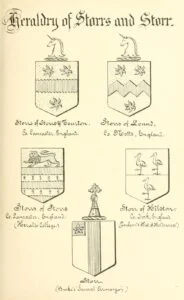
Heraldry of Storrs and Storr

Charles Storrs of Brooklyn, New York, dedicated over 20 years to compiling “The Storrs Family: Genealogical and Other Memoranda,” which traces his family lineage from the immigrant ancestor Samuel Storrs in Connecticut. Although it includes some limitations regarding early history and distant branches, the 1886 publication remains a valuable resource for descendants and researchers interested in the Storrs family. Organized by generations, it serves as a guide for validating genealogical information rather than absolute proof.

Abbe-Abbey Genealogy

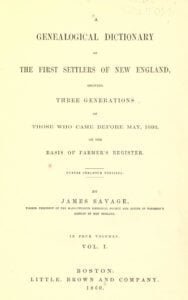
A genealogical dictionary of the first settlers of New England vol 1

The “Abbe-Abbey Genealogy” serves as a comprehensive and meticulously compiled homage to the heritage of the Abbe and Abbey families, tracing its roots back to John Abbe and his descendants. Initiated by the life-long passion of Professor Cleveland Abbe, this genealogical exploration began in his youth and expanded throughout his illustrious career, despite numerous challenges. It encapsulates the collaborative efforts of numerous family members and researchers, including significant contributions from individuals such as Charles E. Abbe, Norah D. Abbe, and many others, each bringing invaluable insights and data to enrich the family’s narrative.

Johnson Family of Norwich Vermont

The Johnson Family played a pivotal role in the early history of Norwich, Vermont. Captain Hezekiah Johnson, born in 1724 in Woburn, Massachusetts, was an original proprietor and early settler, established near the Pompanoosuc River. He held numerous offices, including selectman, and contributed to the town’s development and safety during the Revolutionary War. Johnson was also generous to Dartmouth College. He passed away in 1806, leaving a legacy through his children, including Samuel Slafter Johnson and Dorothy, who married Jeremiah Hedges, further intertwining family connections in the community.

First Settlements in Norwich Vermont

The early settlement of Norwich, Vermont, began in 1762 when Samuel Slafter’s son, John, explored the area, reporting its fertile land and water sources. In 1763, after receiving his father’s rights, he commenced clearing lots but faced challenges, as his initial choice proved unsuitable. By 1765-66, a few families settled permanently, including the Hutchinsons and Manns, establishing homes and farms. Pioneers endured various hardships, yet they built foundations for a thriving community, characterized by a homogeneous population primarily from Connecticut.

The Proprietors of Norwich Vermont

The early proprietors of Norwich, Vermont, largely hailed from Connecticut towns such as Mansfield and Tolland, with some from New Hampshire and Massachusetts. While many grantees did not settle personally, they transferred their rights to their sons or younger acquaintances. Key early settlers included Captain Hezekiah Johnson and Jacob Fenton. The proprietors diligently organized land surveys, established roadways, and incentivized settlement through financial support, ultimately fostering rapid growth in the new township. Meetings continued until 1770, addressing land divisions and mill constructions.

The Founding of Norwich Vermont

In August 1761, the proprietors of the newly chartered township of Norwich, Vermont, convened in Mansfield, Connecticut, to initiate settlement in a largely uninhabited wilderness. They aimed to cultivate a six-square-mile tract along the Connecticut River, supported by the post-French and Indian War boom in population and security. The proprietors received their charter from New Hampshire’s Governor Wentworth and established conditions for land cultivation, including provisions for education and religion, while also reserving land for the governor.

Norwich Vermont an Independent Township

The political organization of America began with the Township, particularly in New England, where towns emerged as independent entities with self-governing rights in the mid-17th century. Town meetings served as foundational democratic institutions, allowing citizens to elect officials and manage local affairs. Norwich, Vermont, exemplified this tradition, organizing its town government in 1761 before any settlers arrived. Its early record-keeping and governance practices reflect a commitment to law, order, and community engagement, which have shaped its ongoing civic structure.

Biographical Sketch of J. Dwight Chaffee

The Chaffee family has deep roots in Mansfield, Connecticut, with J. Dwight Chaffee’s grandfather, Frederick, established as a prosperous farmer. His father, Orwell S. Chaffee, transitioned from silk manufacturing in Northampton to becoming a prominent figure in Mansfield, serving in the state legislature. Born in 1847, J. Dwight mastered the family silk business, relocating it to Willimantic in 1872, where it flourished. A Republican politician, he served in the state legislature and as state senator, while also leading the Natchaug Silk Company. J. Dwight married Martha Armstrong, and they had three children.