The Cox family in America

The Cox family in America

Two volumes of Cox family genealogy combined as one. The first volume contains information about the various early Cox families across America. The second volume deals specifically with the descendants of James and Sarah Cock of Killingworth upon Matinecock, in the township of Oysterbay, Long Island, New York.
Sketch of the Town of Huntington, Long Island

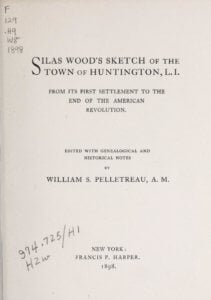
Silas Wood's sketch of the town of Huntington

Silas Wood’s sketch of the town of Huntington, L.I. is a small manuscript of 63 pages which provides an authoritative look at the early history of Huntington New York, from its first settlement to the end of the American revolution. Particularly fascinating to our Native American researchers is the history of the early interaction with the Matinecoes, the Massapeags, and the Secataugs.

Descendants of Isaac Benjamin of New Bedford, MA

The Benjamin family of New Bedford traces its lineage back to John Benjamin, who arrived in Massachusetts in 1632. His descendant, Isaac W. Benjamin, became a significant figure in New Bedford, serving for over three decades at the New Bedford Cordage Company and holding various public offices, including a long tenure on the school committee. His dedication to education led to a school being named in his honor. Isaac W. married Olive Lane Moulton and had one child, Lucy E., ensuring the family’s legacy continued.

John Gyles Captivity Narrative – Indian Captivities

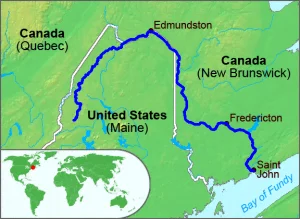
St John River Map

John Gyles captivity narrative provides a stunning display of Abenaki culture and lifestyle, as it was in the 1690’s. John was 10 years old when he was taken captive in the attack on Pemaquid (Bristol Maine) and his narrative provides an accounting of his harrowing treatment by his Indian captors, as well as the three years exile with his French owners at Jemseg New Bruswick. His faith in Christ remains central in the well-being of his mind throughout his ordeal.

Biography of Col. Thomas W. Scudder

Col. Thomas W. Scudder, born in 1834 on Long Island, is one of the last surviving pioneers of Kansas. He served valiantly in the First Kansas Cavalry during the Civil War and participated in significant border warfare prior to the conflict. Scudder’s Kansas journey began in 1855 when he moved there to work in a store in Topeka. After the war, he engaged in agriculture and lived on a pre-empted 103-acre farm near the capitol, remaining a prominent figure in local politics and veterans’ organizations.

Biography of Henry Knight Brooks

Henry Knight Brooks, born in England in 1869, became an influential figure in Kansas as an inventor and engineer. His work with the Capital Iron Works in Topeka significantly contributed to the city’s industrial growth. Brooks played a key role in developing electric car lighting for the Santa Fe Railway, revolutionizing safety and efficiency in railroads. His leadership established the Capital Iron Works as a cornerstone of Kansas industry, while his innovations extended to the creation of new manufacturing companies, enhancing the state’s reputation in mechanical engineering.

Poospatuck Tribe

The Poospatuck Tribe, also known as the Poospatuck Indians or Uncachogee, is one of the thirteen tribes of Long Island, New York, likely subordinate to the Montauk. They traditionally inhabited the south shore from Patchogue Island to Shinnecock Country. In 1666, a reservation was granted to their sachem, Tobaccus. Today, a few mixed-blood descendants reside on a 50-acre state reservation, lacking knowledge of their ancestral language and customs. The last chief, Elizabeth Joe, passed in 1832, leaving a significantly diminished community.

Patchoag Tribe

The Patchoag Tribe, located on Long Island’s south coast, spanned from Patchogue to Westhampton and included several villages such as Fireplace, Mastic, and Moriches. The Connetquot Indians, considered a sub-group, inhabited the region near the Connetquot River. Historically noted by Thompson in 1683, they were integrated within the larger Patchoag community. Today, the descendants of this tribe are recognized as the Poosepatuck. The name Patchoag reflects the area’s geographical features, meaning “where they divide in two.

Biography of William W. Rose

William W. Rose, born on March 12, 1864, in Oyster Bay, New York, has established himself as a prominent architect in Kansas City over three decades. He led the architectural firm Rose & Peterson and significantly contributed to civic life, notably serving as mayor during tumultuous times. His tenure saw initiatives to municipalize waterworks and lighting, alongside challenges in enforcing liquor laws. Renowned for designing key Kansas City structures, Rose balanced a successful architectural career with active civic engagement and community leadership until his death.

Alcock, Percy Hunt – Obituary

Percy H. Alcock, a resident of San Carlos for 24 years, passed away on September 19, 1967, in San Francisco after a brief illness. Born in Grantham, England, in 1886, he immigrated to the U.S. in 1910 and served in World War I. Alcock worked as a public accountant and was also a Christian Science Practitioner. He is survived by his wife Augusta, two sons, and a grandson. Private family services are scheduled, with inurnment at Alta Mesa Cemetery. Memorial contributions are requested for Valentine Haven.

Cooke, Robert – Obituary

Robert Cooke, aged 72, passed away at the Gold Leaf Care Center in Ellensburg. Born on January 1, 1917, in Long Island, New York, he married Gwen Ferguson Davis in Seattle on September 20, 1951, and moved to Ellensburg in 1957. A merchant seaman until 1965, he is survived by his wife, two stepsons, two stepdaughters, seven grandchildren, nine great grandchildren, and siblings. A memorial service will be scheduled, with inurnment to take place at the graveside.

Biography of George F. Licht

George F. Licht, born August 18, 1860, in Long Island, New York, served as mayor of Geneva, New York, and has held various public offices, including roles on the purchasing committee and fire commission. A prominent figure in local business, he is superintendent and assistant treasurer of the Patent Cereals Company, which he co-founded. Married to Anna J. K. Stahmann in 1884, they had two children. Licht remains involved in community service and has retired from public office as of 1910.

Pequot Tribe

Pequot Fort

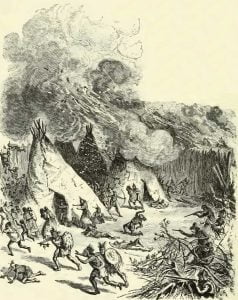
The Pequot Tribe, an Algonquian group in southeastern Connecticut, was a dominant force in the early 17th century, controlling vast territories and instilling fear in neighboring tribes. Under chief Sassacus, they faced significant conflict with colonial forces, culminating in the 1637 Pequot War, which devastated their population and led to their dispersal. Many Pequots were enslaved or merged with other tribes, but a distinct identity persisted. Over the centuries, their numbers dwindled, yet remnants continued to maintain cultural ties into the 19th and 20th centuries.

Shinnecock Tribe

The Shinnecock Tribe, an Algonquian group from Long Island, New York, formerly occupied the southern coast from Shinnecock Bay to Montauk Point. Today, around 150 members reside on a 750-acre reservation near Southampton, having largely intermarried and lost many traditional customs. Historically led by chiefs like Nowedonah, the tribe experienced tragedy in 1876 when 28 men died attempting to rescue a stranded ship. Their current livelihoods mainly involve manual labor, with few engaging in traditional arts or agriculture, and their native language is nearly extinct.