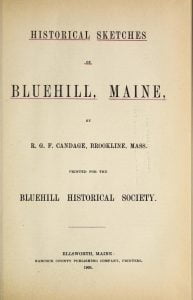
Candage Genealogy of Blue Hill, Maine

Historical Sketches of Bluehill Maine

The Candage family, descendants of James Candage who settled in Blue Hill, Maine in 1766, have a rich history. James, born in 1753, and his wife Hannah had several children, including Azor and Samuel Roundy Candage. Their lives were intertwined with maritime occupations, agriculture, and community service. James built a house around 1800, which later served various family members. The family endured hardships, with many sons lost at sea. Over time, the estate changed hands, reflecting the family’s evolving legacy in the region.

Biographical Sketch of Frank L. Eksward

Frank L. Eksward, born in 1870 in Brooklyn, New York, serves as the Secretary Manager of the San Mateo County Development Association, playing a vital role in the county’s development. With seven years in San Mateo County, five dedicated to promotion, he has led numerous successful projects, especially advocating for good roads. Prior to his focus on community development, Eksward practiced law in various eastern cities, showcasing his diverse background and commitment to enhancing San Mateo County.

Biography of Frank H. Chapman

Frank H. Chapman, born on May 29, 1848, in Lowell, Massachusetts, became a prominent druggist in Franklin Falls after training with various druggists. In 1875, he purchased E. H. Sturtevant’s drug store, later partnering with Charles Eddy. Chapman was actively involved in community service, serving as a legislative representative and town clerk, and held a leadership role in the New Hampshire Pharmaceutical Association. He married Ella F. James and had five children, while his successful career and community engagement made him a respected citizen of Franklin Falls.

Biographical Sketch of Albert H. Horton, Judge

Judge Albert H. Horton played a pivotal role in Kansas’s legal and civil evolution for over fifty years, from the state’s inception in 1861 until his death in 1902. Born in New York in 1837, he pursued law at the University of Michigan before relocating to Kansas. He served as city attorney, judge of the Second Judicial District, and for nearly two decades as chief justice of the Supreme Court. Active in various political roles, he was also a significant figure in the University of Michigan alumni community, earning an honorary LL.D. degree.

Will of Cornelius Beackman – 1668

In his will dated March 4, 1668, Cornelis Beackman of New Utrecht, while gravely ill, annulled his marriage contract with his wife Marihe, dividing their estate equally between them. He appointed Lucas Dirckse and John the Cooper, Jr. as guardians for their daughter Mellitie should Marihe pass before Mellitie’s twelfth birthday. The will includes an inventory of property, including a house and 50 acres in Canarsie, along with a list of debts owed to various individuals. It was proved on April 3, 1669.

Will of Jean Le Telier – 1671

In his will, Jean Le Telier of New Utrecht appointed his wife, Christina, as the sole executrix of his estate. This appointment was officially confirmed on September 12, 1671. The details of this bequest can be found in LIBER 1-2, page 68.

Will of Charles Morgan – 1668

In his will dated July 13, 1668, Charles Morgan of Gravesend appoints his wife, Katharine, as the sole executrix. He bequeaths his son Charles the plantations recorded to him and divides his current land and barn among his three sons, Thomas, John, and Daniel, while providing for his wife’s residence as long as she remains a widow. He also mentions his daughters, Mary, Rachel, and Susannah, and the inventory includes various domestic items and several acres of crops. The will was proved on October 7, 1668.

Slave Narrative of Margaret E. Dickens

Margaret E. Dickens, born on June 5, 1861, in Raleigh, North Carolina, recounts her family history, noting her mother, Mary Ann Hews, was free-born and her father, Henry Byrd, endured hardships. Dickens shares her parents’ occupations—her grandfather as a cabinet maker and her father as a carpenter. After living briefly in the North with her first husband, a preacher, she returned to the South, where she values her home and family legacy. She expresses a deep preference for Southern life despite her time in the North.

Biographical Sketch of William Parks

William Parks, a distinguished pioneer of Malheur County, Oregon, was born in Brooklyn, New York, in 1845. After moving west in 1859, he farmed in California and then mined in Idaho before establishing a prosperous homestead in Jordan Valley. A successful businessman, Parks ventured into mercantile in 1895, co-founding the Jordan Valley Mercantile Company. He held significant interests in local finance, including the Ontario Bank. Married in 1879 to Julia West, they had five children. Parks is recognized as a key figure in the county’s development and a respected community leader.

Biography of Charles May

Charles May, born in England in 1833, was a prominent pioneer in Boise, Idaho. He began his career in brick manufacturing and laid the first brick house in Junction City, Kansas. After traveling westward in 1862, he built the first brick stores in Walla Walla and contributed to various construction projects in Boise, including brick manufacturing and notable local buildings. In 1871, he married Elizabeth Williams, and they had two daughters. May also visited Australia, where he oversaw significant construction projects before returning to Boise.

Biography of A. Sidney Chase

A. Sidney Chase, born February 5, 1842, in Boston, served as probate judge of Ellsworth County, Kansas, for 24 years. He came from a distinguished lineage and served in the Civil War, rising to captain. After farming for a decade, he transitioned to a successful career in real estate before his long judicial tenure, marked by integrity and dedication. A prominent Mason and Republican, he married Maria R. Simonds; they had two children, both of whom continued the family’s educational legacy. Chase’s contributions remain a credit to Kansas.

Biographical Sketch of George P. Comey

George P. Comey, born on April 21, 1858, in Brooklyn, New York, was a prominent manufacturer in the ladies’ hat and straw goods industry. After his education at the Brooklyn Polytechnic Institute and Connecticut Literary Institute, he moved to Cleveland in 1880. Comey initially partnered with J. G. Pettee before establishing the Comey Johnson Company, which became a leading manufacturer of women’s hats. He also held positions as a director at The First National Bank and vice president of The American Artificial Silk Company. Comey and his wife, Nannie J. Gill, had seven children.

Biographical Sketch of Horace Arthur Fuller

Horace Arthur Fuller, born on September 23, 1864, in Cleveland, was a prominent manufacturer and business leader. He attended Cleveland public schools and briefly studied at Western Reserve University. Married in 1886, Fuller began his career in 1883 with Condit, Fuller & Co. He later joined The Union Rolling Mill Co., rising to president by 1911. Additionally, he held leadership roles in several companies, including The Bourne-Fuller Co. and The Upson Nut Co., and served on various boards and clubs. His hobbies included golf and fishing.

Biography of William Elliott Barnhart

William Elliott Barnhart, born December 8, 1857, in Ohio, has significantly impacted Kansas City, Kansas, since 1887, particularly in transportation and public service. His career began in law before transitioning to a postal clerk and ultimately various roles in railway companies, including the Kansas City Southern and the Kansas City, Mexico Orient Railway. Active in local governance, he served on the Board of Education and led the Wyandotte County Republican Central Committee. Barnhart married Mattie Lake Johnston, and they had four children.

Biographical Sketch of Rollin Henry White

Rollin Henry White was an automobile manufacturer, born to Thomas H. and Almira Greenleaf White. He graduated from Cornell University in 1894 with degrees in mechanical and electrical engineering. On September 2, 1896, he married Katharine King in Brooklyn, New York. The couple had three children: Elizabeth, William King, and Rollin Henry Jr. White was also a member of the Union, Country, and Chagrin Valley Hunt Clubs.

Biographical Sketch of Samuel Rockwell

Samuel Rockwell, a civil engineer born in Brooklyn, New York, on February 20, 1847, was educated at Yale College and Sheffield Scientific School, graduating in 1873. He married Cordelia Ann Geiger in 1881, and they had five children. His career spanned various engineering roles, including resident engineer for D. L. W. R. R., assistant city engineer in Kansas City, and chief engineer for several railroads. Rockwell was active in professional societies and enjoyed hunting and fishing.

Biography of John Lumbard

John Lumbard, born in Sweden on May 21, 1862, played a vital role in the development of Muskogee until his death on October 5, 1918. He immigrated to the U.S. in 1891, working initially in the tire industry and eventually establishing the John Lumbard Tire Supply Company in Muskogee. A progressive businessman and community supporter, Lumbard envisioned a major tire factory for the city. His commitment to the community earned him widespread respect, and his legacy continues through his family and business ventures in the region.

Biographical Sketch of William Andrew Leonard, Rt. Rev. D. D.

William Andrew Leonard, Rt. Rev. D. D., was born on July 15, 1848, in Southport, Connecticut. He attended Philips Academy, St. Stephens College, and Berkley Divinity School. Ordained in 1871, he served as Rector in Brooklyn and Washington, D.C., before becoming the Bishop of Ohio in 1889. Leonard was also a significant figure in the American Episcopal Church in Europe and held various leadership roles in educational and civic organizations, including being a trustee of Kenyon College.

Biography of Herbert Andrew Browne, M. D.

Herbert Andrew Browne, M.D., a prominent physician and surgeon in Galena since 1899, gained acclaim for his professional expertise. Born on March 11, 1878, in Brooklyn, New York, he graduated from the Homeopathic Medical College in Kansas City in 1898. He actively participates in various medical societies and fraternal organizations, reflecting his community involvement. Browne has two children from his first marriage and later married Henrietta Powell in 1914. His family has a rich history in the U.S., with roots tracing back to Ireland.

Biography of Charles Purdy Ives

Charles Purdy Ives, born January 27, 1840, in West Plains, New York, was a prominent businessman and civic leader in Baldwin City, Kansas. He served as a captain during the Civil War and later became a leading lumber merchant. Deeply involved in community welfare, Ives supported education, served on the city council, and played a key role in the good roads movement. A dedicated churchman, he was honored for his contributions upon his death on October 29, 1913, leaving a legacy of respect and gratitude in Baldwin.