
Collections of the New Hampshire Historical Society

1892 Map of New Hampshire

The Collections of the New Hampshire Historical Society is a 15 publication series documenting the state’s history through various primary sources, including manuscripts, letters, and public records. It collates valuable narratives that were previously difficult to access, providing insight into events, individuals, and communities in New Hampshire. Each volume offers focused topics and historical analyses, and most volumes contain individual indexes.
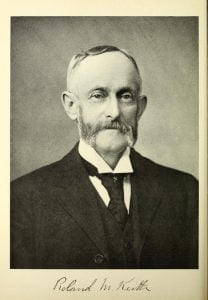
Descendants of Rev. James Keith in Bridgewater, Massachusetts

Roland Keith

The Keith family is one of the oldest of southeastern Massachusetts. Its founder in America was Rev. James Keith, born in 1644, who came to America, landing in Boston in 1662. He became minister of the Bridgewater Church, where he administered to the spiritual needs of the people for half a century. He died July 23, 1719. He was twice married. His first wife was Susannah Edson, daughter of Deacon Samuel Edson.

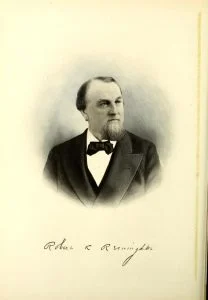
Descendancts of John Remington of Haverhill, MA

Robert Knight Remington

Robert Knight Remington, born in 1826 in Grafton, MA, was a prominent philanthropist and businessman in Fall River, known for his integrity and dedication to community service. His ancestors, including John Remington, settled in Haverhill, MA, in 1661 before establishing roots in Rhode Island. Throughout his life, Remington championed temperance and youth education, contributing significantly to local missions and religious efforts. He was married twice and left behind a legacy through his children, influencing business and civic life in Fall River.

Biography of William Hall

William Hall, born on March 23, 1850, in Claremont, N.H., is the owner of Langdon Creamery and deals in various farm and dairy products. He hails from a prominent family with deep local roots. His father, Jonathan Hall, was a skilled craftsman and influential figure. William’s education led to careers in wood-turning and carpentry before he focused on farming and managing the creamery. He is active in local governance and is married to Mamie L. Johnson, with whom he has five children, reflecting a legacy of hard work and community service.

Biography of Henri G. Blaisdell

Henri G. Blaisdell, born in 1850 in Dorchester, N.H., emerged as a notable musician and violinist. He was educated locally and developed his musical talent under esteemed instructors. By age fourteen, he began a professional career that included conducting orchestras and establishing an efficient orchestra in New Hampshire for high-class performances. An accomplished teacher, he contributed to music literature and led prominent music groups, including the Handel and Haydn Society. Blaisdell married Lilly D. Leonard and had two sons, while enjoying life at his lakeside home.

Genealogy of Cephas Clark

The history of Cephas Clark’s sons—Silas, Samuel, and Cephas—centers on their settlement in Glover, Vermont. Silas, born in 1777, established Clark’s Tavern and played a pivotal role in a dramatic water diversion event in 1810, leading to the creation of Runaway Pond. Samuel, born in 1781, married Betsey Fisk and settled in Glover, while Cephas, born in 1784, moved with his family to a 160-acre farm in 1818. Their descendants continue to inhabit the area, preserving their legacy in this northern Vermont township.

Fair Grounds And Trotting Park of Keene, NH

The Cheshire County Agricultural Society operates a 26-acre exhibition ground in Keene, NH, established in 1850. The site features shaded avenues for viewing livestock and is situated about a mile and a half from city hall. In 1875, the Keene Driving Park Association was created, leading to the establishment of a half-mile track. The Agricultural Society discontinued its annual fair in 1883, allowing the park to host successful exhibitions, which continue annually under the current leadership.

History of Education in Keene, New Hampshire

Keene, New Hampshire features eleven school districts, with the Union district serving as the metropolitan area. The city has various school facilities, including a notable High School completed in 1876. The Keene Public Library, established in 1859, transitioned to a free public resource in 1875 and has since expanded. Additionally, the Keene Natural History Society, founded in 1870, enhances educational studies through a diverse collection. These institutions reflect Keene’s commitment to education and community resource development over the years.

Military History of Keene, New Hampshire

During the American Revolution, Keene contributed significantly to the war effort, organizing a militia and purchasing supplies for conflict. The town’s citizens rallied after the battles of Lexington and Concord, sending volunteers to support the cause. In 1776, Keene citizens signed a Declaration of Resistance, and by 1777, local militia participated in the Battle of Bennington. Similarly, in the Civil War, Keene enlisted over 600 soldiers, many of whom were involved in key battles. A memorial honoring their service was established in 1870.

Early Settlement of Keene, New Hampshire

In the winter of 1736, Nathan Blake and Seth Heaton became the first settlers to endure the harsh conditions in Keene, New Hampshire. They erected a fort in 1738 for protection against potential Indian attacks, which proved vital during subsequent conflicts. The settlement faced challenges, including disease and raids, leading to its abandonment in 1747. After a peace treaty in 1749, settlers returned and rebuilt the fort in 1754. By 1767, Keene’s population had grown to 427, marking the beginning of its steady development.

Keene New Hampshire Proprietor List

In March 1732, a committee was charged with laying out house-lots in what would become Keene, New Hampshire. By June, they outlined 54 lots in the Upper township, each measuring eight acres. A meeting in Concord on June 26, 1734, formalized the admission of 60 settlers as proprietors. They paid their fees, selected officials, and planned the township’s development. Their first visit occurred on September 18, when several proprietors journeyed to the township, marking the beginning of settlement in the area.