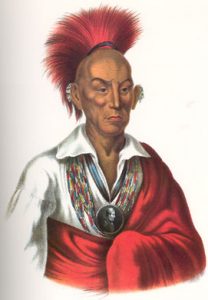
Black Hawk’s War – Indian Wars

Black Hawk

The events of Black Hawk’s War brought the esteemed Sauk leader, Black Hawk, into the national spotlight. Born around 1767, he became a renowned warrior, leading successful campaigns against rival tribes. Tensions escalated after a controversial treaty in 1804 led to increased violence against the Sacs and Foxes. In 1832, after a series of conflicts following the death of several Indians, Black Hawk led his people in resistance, but ultimately faced defeat. Following his surrender, he was taken to Washington, gaining respect and recognition before his death in 1838.

Biography of Joseph G. Waters, Capt.

Captain Joseph G. Waters, born October 18, 1837, in Kentucky, served with distinction in the Civil War, earning five wounds in battle. A prominent lawyer in Kansas for nearly fifty years, he was also a noted public speaker and author, although his writings remained largely private due to his modesty. Waters gave a celebrated address for Queen Victoria’s jubilee, recognized among thousands. He practiced law actively until well into his later years, leaving behind a legacy of service to both his country and community.

Biography of Reinhard E. Wobus, M.D.

Dr. Reinhard E. Wobus, born July 20, 1879, in Fort Madison, Iowa, is an accomplished surgeon specializing in surgery and obstetrics. He graduated from Washington University in 1905 and has continuously practiced in St. Louis, contributing to medical journals and serving on the faculty of Washington University Medical School. A veteran of the Medical Reserve Corps, he served during World War I in various capacities. In addition to his medical career, Dr. Wobus is active in civic organizations and is committed to lifelong learning. He resides in St. Louis with his wife and two children.

Biography of Thomas K. Tomson

Thomas K. Tomson, an esteemed ante-bellum settler of Kansas, passed away on November 2, 1910, at eighty-five. Born in Ohio in 1826, he initially trained as a tinsmith but became a successful farmer and stockman in Kansas. After moving westward in 1860 due to tensions surrounding slavery, he settled in Dover and significantly contributed to livestock improvement in the region. A community-oriented individual with a deep compassion for others, his legacy endures through his children and the positive influence he had on those around him.

Biography of H. J. Huiskamp

H. J. Huiskamp, born on October 19, 1873, in Keokuk, Iowa, has played a pivotal role in the success of the Buffalo Brick Company in Buffalo, Kansas, serving as its general manager and secretary. Under his leadership, the company became the largest of its kind in Kansas, with a capacity of 100,000 bricks daily. Huiskamp, an independent voter and active community member, has a diverse background, including work in manufacturing, finance, and mining, before joining the brick industry in 1905. He remains unmarried and is involved in various civic organizations.

War between the British and Americans

Amid rising tensions of war between the British and Americans, Native tribes received conflicting messages about neutrality. While some chiefs were advised by their Great Father in Washington to avoid involvement, many were swayed by British traders offering goods and support. The arrival of a British trader, La Gutrie, further ignited hopes of joining the British cause after promises of supplies. The allure of better relations and support led many to ultimately abandon their neutral stance, rallying to fight alongside the British.

Biography of Julius Junge

Julius Junge, born in Prussia on March 23, 1848, emigrated to America with his family in 1854, settling in Iowa. He became a prominent businessman in Rock Island, serving as vice-president of the Rock Island Brewing Company after his ventures as a bookkeeper and store owner. Married in 1878, he raised three daughters and earned a reputation as a sportsman and horse breeder. Known for his integrity and sociability, Junge remains a respected figure in the community, contributing to various local enterprises.