Hough Family of New Bedford, Massachusetts

The Hough family of New Bedford, Massachusetts, traces its roots to William Hough, an English carpenter who settled in Gloucester before moving to New London, Connecticut, in the mid-17th century. Notable descendants include Dr. George T. Hough, a distinguished physician and city physician in New Bedford, and his son, Garry de Neuville Hough, who continued the medical legacy. George Anthony Hough, another descendant, made his mark in journalism and public service. The family’s contributions to medicine and local governance highlight their significant role in the community’s history.

The Osage Massacre

Kiowa Calender

In the summer of 1833, following a treaty council breakdown, Osage warriors attacked a Kiowa village, resulting in a brutal massacre where many women, children, and elderly were killed, and the heads of the victims displayed in brass buckets. Among the captives were two children, Gunpä´ñdamä and Tunkahtohye, later purchased by Colonel Hugh Love for potential diplomatic gains. The ensuing U.S. military expeditions aimed to restore order and negotiate peace, but many faced logistical challenges and poor preparation, resulting in numerous setbacks and casualties.

Kelley Family of New Bedford, MA

The Kelley family of New Bedford, descended from William and Abigail (Cannon) Kelley of Haverhill, has deep historical roots tracing back to early English settlers. Their lineage includes prominent figures such as Henry C. Kelley, a merchant who made significant contributions to the city, and his son, Charles Sampson Kelley, who became a notable banker and community leader in New Bedford. The family’s legacy reflects a blend of industrious spirit and dedication to civic development within the region, with ties extending back to the Norman times.

An Historical Sketch of the Tionontates or Dinondadies, now called Wyandots

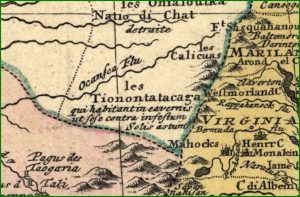
les Tionontatacaga

The tribe which, from the time of Washington’s visit to the Ohio, in 1753, down to their removal to the West, played so important a part under the name of Wyandots, but who were previously known by a name which French write Tionontates; and Dutch, Dinondadies, have a history not uneventful, and worthy of being traced clearly to distinguish them from the Hurons or Wyandots proper, of whom they absorbed one remnant, leaving what were later only a few families near Quebec, to represent the more powerful nation.

Chief Pontiac of the Ottawa’s

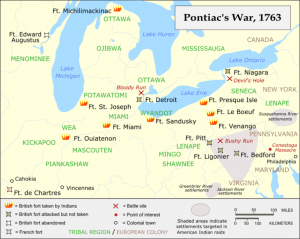
Map of Pontiacs War

Following the 1763 peace, English troops occupied former French forts, prompting widespread Indian apprehension of encroachment. Pontiac, the Ottawa chief, emerged as a pivotal leader advocating for resistance. He organized a council of tribes to unite against the English, inspired by a prophetic vision asserting divine support for their fight. Pontiac orchestrated a coordinated attack on English forts, aiming for liberation. Despite initial efforts, including a siege of Detroit, betrayal foiled his plans. Eventually, Pontiac was assassinated, symbolizing the decline of Indian resistance.

Migration of Families out of Norwich VT

In the late 18th and early 19th centuries, Norwich, Vermont, experienced significant emigration, leading to a notable decline in its population. Initially home to 40 families in 1771, the town saw many residents relocate to newer settlements, such as Royalton and Randolph, during and after the Revolutionary War. Prominent families, including the Hibbards and Carpenters, contributed to the establishment of towns in northern Vermont and beyond. By the 1800s, the trend of outmigration intensified, marking a long-term shift in the region’s demographic landscape.

Lord Dunmore’s War

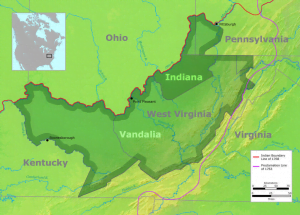
Vandalia Colony

The text details the events leading to and during Lord Dunmore’s War, sparked by illegal encroachments into the Vandalia Colony and violent acts against Native Americans by Virginians. It highlights the treaties made with various tribes and the resultant loss of their lands. The war began in response to brutal murders committed by settlers, leading to conflict with the Shawnees. Despite military advances by Virginia’s forces, Dunmore ultimately sought peace, yet tensions persisted as violence against Native Americans continued unabated.

Early Exploration and Native Americans

Ferdinand de Soto’s interactions with Native American tribes, specifically the Choctaws and Chickasaws, exemplify early European attempts to impose their ideologies of civilization and Christianity upon Indigenous populations. This approach set a precedent for further exploitation and oppression of Native Americans, as European settlers sought to acquire land and resources. Throughout history, tribes like the Chickasaws, known for their valor, remained steadfast allies rather than adversaries. This enduring alliance contrasts sharply with the overarching narrative of dispossession and extermination faced by Indigenous nations in North America.

The Discovery Of This Continent: It’s Results To The Natives

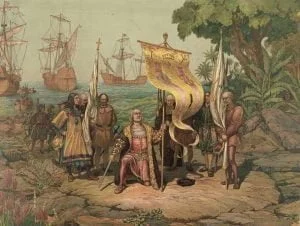
Columbus Landing on Hispaniola

In 1470, Christopher Columbus married Dona Felipa, daughter of a renowned navigator, and settled in Porto Santo, where they shared dreams of discovering lands to the West. Their ambitions fueled Columbus’s determination, leading to his 1492 voyage that resulted in the European discovery of the Americas. However, this event marked the beginning of devastation for native peoples, introducing warfare, disease, and colonization that would decimate their populations and cultures, ultimately transforming their rich, diverse societies into shadows of their former selves.

An Account of the Sufferings of Mercy Harbison – Indian Captivities

On the 4th of November, 1791, a force of Americans under General Arthur St. Clair was attacked, near the present Ohio-Indiana boundary line, by about the same number of Indians led by Blue Jacket, Little Turtle, and the white renegade Simon Girty. Their defeat was the most disastrous that ever has been suffered by our arms when engaged against a savage foe on anything like even terms. Out of 86 officers and about 1400 regular and militia soldiers, St. Clair lost 70 officers killed or wounded, and 845 men killed, wounded, or missing. The survivors fled in panic, throwing away their weapons and accoutrements. Such was “St. Clair’s defeat.”

The utter incompetency of the officers commanding this expedition may be judged from the single fact that a great number of women were allowed to accompany the troops into a wilderness known to be infested with the worst kind of savages. There were about 250 of these women with the “army” on the day of the battle. Of these, 56 were killed on the spot, many being pinned to the earth by stakes driven through their bodies. Few of the others escaped captivity.

After this unprecedented victory, the Indians became more troublesome than ever along the frontier. No settler’s home was safe, and many were destroyed in the year of terror that followed. The awful fate of one of those households is told in the following touching narrative of Mercy Harbison, wife of one of the survivors of St. Clair’s defeat. How two of her little children were slaughtered before her eyes, how she was dragged through the wilderness with a babe at her breast, how cruelly maltreated, and how she finally escaped, barefooted and carrying her infant through days and nights of almost superhuman exertion, she has left record in a deposition before the magistrates at Pittsburgh and in the statement here reprinted.

Life and travels of Colonel James Smith – Indian Captivities

An Artists rendition of James Smith

James Smith, pioneer, was born in Franklin county, Pennsylvania, in 1737. When he was eighteen years of age he was captured by the Indians, was adopted into one of their tribes, and lived with them as one of themselves until his escape in 1759. He became a lieutenant under General Bouquet during the expedition against the Ohio Indians in 1764, and was captain of a company of rangers in Lord Dunmore’s War. In 1775 he was promoted to major of militia. He served in the Pennsylvania convention in 1776, and in the assembly in 1776-77. In the latter year he was commissioned colonel in command on the frontiers, and performed distinguished services. Smith moved to Kentucky in 1788. He was a member of the Danville convention, and represented Bourbon county for many years in the legislature. He died in Washington county, Kentucky, in 1812. The following narrative of his experience as member of an Indian tribe is from his own book entitled “Remarkable Adventures in the Life and Travels of Colonel James Smith,” printed at Lexington, Kentucky, in 1799. It affords a striking contrast to the terrible experiences of the other captives whose stories are republished in this book; for he was well treated, and stayed so long with his red captors that he acquired expert knowledge of their arts and customs, and deep insight into their character.

Northwest Territorial War of 1812 – Indian Wars

Map of Northern Theatre of War of 1812

After the battle of Tippecanoe, tensions between Native Americans and white settlers escalated, fueled by British influence. Following the declaration of war against Great Britain in June 1812, the Northwest Territorial War erupted, marked by severe attacks on the western frontier. Notably, Tecumseh rallied many Native allies to the British cause. American forces, led by General Harrison, faced significant challenges, including the disastrous Frenchtown Massacre. However, victories at Fort Stephenson and the Thames ultimately shifted momentum, leading to a decline in Native American resistance.

War Between the Colonies and The Western Indians – From 1763 To 1765

Map of Pontiacs War

Pontiac, a prominent chief, led a coalition of Great Lakes tribes against British forces following the French defeat in 1760. His strategic prowess came to fruition in June 1763, when his forces captured Michilimakinak, demonstrating his tactical superiority and uniting various tribes against the English. The siege of Detroit, lasting twelve months, highlighted his leadership as the British prepared for retaliation. By late 1765, following Colonel Bouquet’s campaigns, peace discussions ensued, marking a significant moment in the conflict between the colonies and Native Americans.

Detroit’s Original Colonists

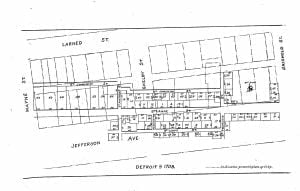
Map of Detroit in 1708

The document outlines land transactions in Detroit between 1707 and 1710, as reported by Cadillac. Landowners often changed names, complicating historical records. Owners paid a fixed annual rent and additional fees for trade privileges from Cadillac, who retained ownership rights. The records identify influential early settlers, many of whom are ancestors of Detroit’s current French-descended families. Various parcels were conveyed, sometimes reverting to Cadillac if abandoned. Notable names include Pierre Chesne and Antoine Beauregard, reflecting a rich tapestry of early Detroit’s community.

Biographical Sketch of Rev. W. A. Brewer

Rev. W. A. Brewer played a pivotal role in the development of San Mateo County, serving as Hillsborough’s first mayor and rector of St. Matthews Military School. Known for his dedication, he was instrumental in establishing the San Mateo County Development Association and advancing the county’s interests. Under his leadership, Hillsborough achieved a progressive governance model. Born in Detroit in 1863 and married in San Francisco in 1895, he has two sons and currently pastors St. Paul’s Episcopal Church in Burlingame.

Biography of John Baptist Miege

John Baptist Miege, born in 1815 in France, became the first Catholic bishop of Kansas. After joining the Society of Jesus in 1836, he spent years studying, eventually becoming a priest in 1847. He arrived in St. Marys, Kansas, in 1851, where he established the first Catholic church in the region. Miege later constructed a cathedral in Leavenworth and worked to alleviate its debt through a trip to South America. He retired in 1874, later founding a Jesuit college in Detroit, before passing away in 1884.

Biography of Charles Wood Davis

Charles Wood Davis, born April 17, 1832, in Massachusetts, led a remarkable life contributing significantly to Kansas’s development. An 1849 gold rush argonaut, he became a railway executive and a pioneer in Kansas coal mining. Known as Cotton Wood Davis, he played a vital role in establishing railroad lines and initiating commercial salt production. A passionate abolitionist and active in the early Republican Party, he also authored numerous articles on agriculture. Davis passed away in 1910, leaving a lasting legacy as a productive worker and civic leader in Kansas.

Slave Narrative of Sam McAllum

Sam McAllum, born in 1842 in Mississippi, recounts his experiences as an ex-slave and his life during and after the Civil War. He describes his early life on the Stephenson Plantation, the challenges of wartime scarcity, and the complexities of post-war freedom. He details the violence and social upheaval in Kemper County, including the influence of the Chisolm family and the Ku Klux Klan. Ultimately, McAllum’s narrative highlights his resilience and the broader struggles for African Americans in the changing South.