Narrative of the Captivity of Nehemiah How

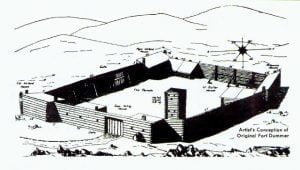
Fort Dummer

A Narrative of the captivity of Nehemiah How, who was taken by the Indians at the Great Meadow Fort above Fort Dummer, where he was an inhabitant, October 11th, 1745. Giving an account of what he met with in his traveling to Canada, and while he was in prison there. Together with an account of Mr. How’s death at Canada. Exceedingly valuable for the many items of exact intelligence therein recorded, relative to so many of the present inhabitants of New England, through those friends who endured the hardships of captivity in the mountain deserts and the damps of loathsome prisons. Had the author lived to have returned, and published his narrative himself, he doubtless would have made it far more valuable, but he was cut off while a prisoner, by the prison fever, in the fifty-fifth year of his age, after a captivity of one year, seven months, and fifteen days. He died May 25th, 1747, in the hospital at Quebec, after a sickness of about ten days. He was a husband and father, and greatly beloved by all who knew him.

Biography of James Madison Jones

James Madison Jones, born April 26, 1833, in Deerfield, N.H., was a prominent station agent for the Concord Montreal Railroad. He hailed from a family of skilled mechanics, with his grandfather Jacob successfully running a clock and gunsmith shop. After working in various roles, including stage driver and railroad brakeman, Jones became a conductor and eventually station agent in 1869. Known for his dedication and efficiency, he oversaw the new Concord station built in 1885. Jones was a Democrat, active in local organizations, and had two children with his first wife, Jane Maria Swan.

Biography of James Yeaton

James Yeaton, born January 11, 1832, in Epsom, comes from a lineage of successful farmers, with roots tracing back to pioneer settler John Yeaton. Educated locally and trained as a shoemaker, James shifted to agriculture, acquiring a sixty-acre farm in 1878. He was married three times: first to Martha A. Randall, then to Ella M. Eastman, and lastly to Annie R. Crockett, with whom he had several children. Politically active as a Democrat, Yeaton served as Town Clerk and on the Board of Selectmen, earning respect in his community.

Biography of Samuel N. Simpson

Samuel N. Simpson, who passed away on November 27, 1915, was a pivotal figure in the early history of Kansas, particularly during its tumultuous territorial years. His contributions included founding a Sunday school in Lawrence and helping organize a vigilance committee to protect free state settlers against pro-slavery aggression. Simpson documented his experiences with remarkable humility, revealing the fierce struggles for Kansas’ future. Beyond his historical role, he was instrumental in the development of Lawrence and Kansas City, engaging in business and civic affairs that shaped the region’s identity.

Biography of Andrew J. Silver

Andrew J. Silver, born on May 9, 1835, in Deerfield, New Hampshire, was a prominent figure in local business and politics. Following an education at Pittsfield Academy, he clerked in various stores before establishing a successful partnership in Epsom. Silver served as a state legislator in 1878-1879, representing Epsom as its first Republican member. He has been the Postmaster of Gossville since 1881, and is affiliated with key fraternal organizations. He married Juliette E. James and has one son, Harry.