1851 Siler Roll: Eastern Cherokee

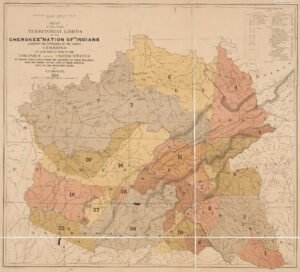
Map of Cherokee Land Cessions

The 1851 Siler Roll is a key genealogy resource for tracing Eastern Cherokee families who remained east of the Mississippi after the Trail of Tears. Compiled to identify those eligible for a federal per-capita payment, it lists households, family groupings, residences, ages, and relationships, but it is incomplete and should be used with the later Chapman Roll.

Biographical Sketch of W. T. Whitaker

Elizabeth Taylor, born in Cherokee County, North Carolina in 1819, married Stephen Whitaker in 1834. They had William Thomas Whitaker, who moved to Indian Territory in 1871 and later settled in Pryor, Oklahoma. William and his wife, Stacy, had eight children. Notable descendants include James Edward and William Jerry, both educated and active in community service. William Thomas founded the Whitaker Orphans Home in 1897, which later became the East Oklahoma State School. The family has a lasting legacy in the region.

Biographical Sketch of Mrs. John M. Carroll

Mary C. Raper, born June 5, 1876, in Georgia to Thomas Martin and Marcella Fernandas Raper, was educated across several states. She married John M. Carroll on January 8, 1893. The couple had eleven children, including Myrtle, Clem, and Gillie May. They lived as farmers and were active in the Church of God. Mary’s family background traces back to Georgia, where her grandparents immigrated in 1881, before she returned to North Carolina and settled in Indian Territory.

Biography of Hon. Charles P. Brooks

Hon. Charles P. Brooks, born on July 12, 1848, in Murphy, North Carolina, is a respected circuit clerk in Cleburne County, Arkansas. He received his education at Mt. Pleasant Academy and Holston College, supporting himself by teaching. Brooks moved to Arkansas in 1875 and held various public offices, including tax assessor. Elected circuit clerk in 1886, he is a member of the Peoples party and has served publicly for eight consecutive years. He married Lulu Hamby, with whom he has seven children.

Biography of William T. Whitaker

William T. Whitaker, born on February 14, 1854, in North Carolina, became a prominent citizen of Pryor, Oklahoma, after moving to Indian Territory. He established a successful mercantile business and owned the Pryor Bottling Works. Known for his philanthropic efforts, Whitaker founded an orphanage which he managed until it became a state institution in 1908. A devoted family man, he had eight children with his wife Stacy, who passed away in 1919. Whitaker was an active supporter of community development and the C.P. church.

Biography of Dumont D. Howell, M. D.

Dr. Dumont D. Howell was a prominent physician in Nowata for sixteen years before his passing on December 6, 1919. Born in Murphy, North Carolina, in 1874, he received his M.D. from the University of Nashville in 1903 and furthered his education at the Chicago Postgraduate Medical School. He built a substantial medical practice and served on the city’s board of health, while also contributing to local oil development. He married Lucile G. Harris and had five children, leaving a lasting legacy in his community.

Tamali Tribe

The town of Tamałi is likely associated with the historical Toa from De Soto’s chronicles and corresponds with Spanish documents naming Tama in the late 16th century. The area was fertile, yielding plentiful crops and potential minerals. Missionary efforts began in the late 17th century, leading to Tama’s integration into the larger Apalachee nation. By the 18th century, the tribe became associated with the Lower Creek and eventually the Seminole Nation, with references diminishing in the early 19th century as it was absorbed into larger groups.

Cherokee Indians

The Cherokee Indians, whose name origins are uncertain, are historically significant Native Americans predominantly residing in the southern Appalachian region. They speak an Iroquoian language and were divided into three dialect groups linked to separate settlements in Tennessee and neighboring states. The tribe has a complex history marked by early contact with European settlers, significant migrations, and cultural adaptations, such as the creation of a written language by Sequoya. Over time, they faced numerous challenges, including disease and forced removal, yet they have maintained a notable cultural and historical presence.