Cattaraugus Indian Reservation Map and Occupants, 1890

Theodore F. Jimerson (De-hah-teh), Cattaraugus Seneca

The Cattaraugus Indian Reservation, established in 1890, spans parts of Cattaraugus, Chautauqua, and Erie Counties, New York. It is primarily occupied by the Seneca Nation, claiming rights over land where white settlers reside. The area, a result of treaties in the late 18th and early 19th centuries, is characterized by fertile land, waterways, and a network of roads connecting it to nearby towns. Despite rich resources, the region struggles with legal disputes regarding land ownership and infrastructure inadequacies affecting transport and communication.
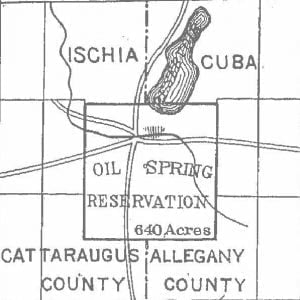
Oil Spring Reservation Map

Oil Spring Reservation Map, 1890

The Oil Spring reservation in Cattaraugus County, New York, spans 640 acres and was inadvertently included in the 1797 treaty at Big Tree, during the sale of land by the Seneca Nation to Robert Morris. Following a lawsuit in 1856, the land was reaffirmed as belonging to the Seneca Nation, supported by Governor Blacksnake’s testimony. He provided crucial evidence of ownership, including a map marking the reservation. An 1877 report by Judge D. Sherman confirmed the Seneca’s unencumbered title to the land, now under lease.

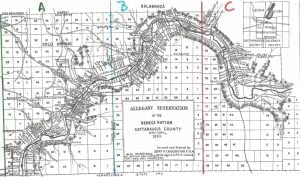
Allegany Reservation Map and Occupants, 1890

Allegany Reservation Map, 1890

The Allegany Reservation in Cattaraugus County, NY, spans approximately 30,469 acres, historically significant for its land disputes and varying occupancy patterns. The Ogden Land Company’s pre-emption rights complicate ownership, as numerous white settlers hold leases expiring in 1892. Legal rulings have declared some leases invalid, while Congress confirmed others for railroad purposes. Despite its agricultural potential, the land suffers from poor fertility and flooding, resulting in many vacated homes. The accompanying map details the occupants of the reservation, valuable for genealogical research.

Reservations of the Six Nations in New York and Pennsylvania, 1723-1890

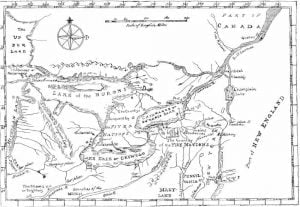
Map of the Country of the Five Nations

In 1771, Governor William Tryon prepared a map delineating the recognized boundaries of the Six Nations, later referenced by Lewis H. Morgan in 1851 to depict the villages and trails of the Five Nations. By 1890, the Oneida and Cayuga tribes had lost their ancestral lands in New York, retaining only small remnants. Various treaties led to significant land reductions for the Oneidas. The Six Nations’ reservations were organized under New York law, reflecting both traditional customs and modern governance challenges faced by their communities.

Biographical Sketch of Albert H. Horton, Judge

Judge Albert H. Horton played a pivotal role in Kansas’s legal and civil evolution for over fifty years, from the state’s inception in 1861 until his death in 1902. Born in New York in 1837, he pursued law at the University of Michigan before relocating to Kansas. He served as city attorney, judge of the Second Judicial District, and for nearly two decades as chief justice of the Supreme Court. Active in various political roles, he was also a significant figure in the University of Michigan alumni community, earning an honorary LL.D. degree.

Biography of Michael Dougherty

Michael Dougherty, born in County Donegal, Ireland, in 1860, has been a significant figure in the oil and gas industry in Independence, where he serves as superintendent of tankage construction for the Prairie Oil and Gas Company. After emigrating to America at a young age, Dougherty honed his craft as a boilermaker across various states. He is a committed Democrat and active in his community with memberships in the Catholic Church and the Knights of Columbus. He married Mary Dougherty, and together they raised nine children, contributing to the local workforce.

Biographical Sketch of William Parks

William Parks, a distinguished pioneer of Malheur County, Oregon, was born in Brooklyn, New York, in 1845. After moving west in 1859, he farmed in California and then mined in Idaho before establishing a prosperous homestead in Jordan Valley. A successful businessman, Parks ventured into mercantile in 1895, co-founding the Jordan Valley Mercantile Company. He held significant interests in local finance, including the Ontario Bank. Married in 1879 to Julia West, they had five children. Parks is recognized as a key figure in the county’s development and a respected community leader.

Biography of Collins Perryman

Collins Perryman, a notable resident of Juliaetta, is a Civil War veteran who significantly contributed to the town’s development. Born in Cattaraugus County, New York, in 1847, he served in the Fourth New York Heavy Artillery and battled severe injuries during the war. After moving to Juliaetta in 1883, he became the pioneer hotelier and a key real estate dealer, enhancing local infrastructure and community welfare. A dedicated husband and father, Perryman remains an influential and respected figure in the region.

Biography of A. Sidney Chase

A. Sidney Chase, born February 5, 1842, in Boston, served as probate judge of Ellsworth County, Kansas, for 24 years. He came from a distinguished lineage and served in the Civil War, rising to captain. After farming for a decade, he transitioned to a successful career in real estate before his long judicial tenure, marked by integrity and dedication. A prominent Mason and Republican, he married Maria R. Simonds; they had two children, both of whom continued the family’s educational legacy. Chase’s contributions remain a credit to Kansas.

Biography of Samuel Wayne Mather

Samuel Wayne Mather, born on July 27, 1849, in Schuyler, New York, faced early adversity after his father’s injury limited his education. He worked various jobs, including in the woods and on his father’s farm, before moving to Cleveland at age 22. Mather attempted a grocery business, later transitioned to manufacturing fire lighters, and established the Union Ladder Washboard Works. He innovated in the casket industry, founding The Funeral Reform Association, and later patented an automobile for funerals. He married twice and had five children.

Biography of William Elliott Barnhart

William Elliott Barnhart, born December 8, 1857, in Ohio, has significantly impacted Kansas City, Kansas, since 1887, particularly in transportation and public service. His career began in law before transitioning to a postal clerk and ultimately various roles in railway companies, including the Kansas City Southern and the Kansas City, Mexico Orient Railway. Active in local governance, he served on the Board of Education and led the Wyandotte County Republican Central Committee. Barnhart married Mattie Lake Johnston, and they had four children.

Biographical Sketch of Emmett Ellsworth Hart

Emmett Ellsworth Hart, born on September 18, 1861, in Little Valley, New York, was a civil engineer. He studied at Cornell University, graduating with a degree in Civil Engineering. Hart married Rachel Joy Sprague in 1891 and had seven children. His career began with the C., B. Q. R. R., progressing to division engineer by 1899. He later became chief engineer of the New York, Chicago and St. Louis Railroad Company, a position he holds as of 1906. He was also a member of the American Railway Engineering Association.

Biography of Henry R. Ransom

The Pittsburg Sash Door Company, founded by L.N. Mosteller, gained prominence under the leadership of Henry R. Ransom, who purchased it in 1902. Originally a modest operation, it has grown significantly, providing employment and contributing to the wealth of Pittsburg. Ransom, born in 1870 in New York, began his career as a carpenter and contractor before heading west. He is married to Gertie N. Kilbourn, and they have three children, with two actively involved in the family business. His family’s background reflects a rich legacy of entrepreneurship and community involvement.

Biography of Harry C. Weible

Harry C. Weible, born on January 16, 1858, in Allegheny City, Pennsylvania, emerged from a family deeply connected to the oil industry. After gaining experience in Pennsylvania oil fields, he relocated to Coffeyville, Kansas, where he established himself as a significant oil producer, overseeing operations across Kansas, Oklahoma, and Texas. In addition to his oil ventures, Weible is involved in various enterprises, including the Texas Central Gas Company and the Peoples State Bank. He is a family man, married to Paula Hazzard, with two children who continue his legacy.

Biography of W. W. Kaney

W. W. Kaney, born June 4, 1867, in New York, exemplifies success through hard work and determination. With minimal formal education, he left home at thirteen, initially working in a barrel factory before entering the oil industry. His career spanned from pumper to leading oil producer in Kansas, where he managed substantial leases. A respected businessman, he also cultivated a distinctive collection of pond lilies and goldfish at his Chanute home. Married in 1887, he and his wife have one daughter, Laura May, who is a skilled bookkeeper.

Biography of Herbert Andrew Browne, M. D.

Herbert Andrew Browne, M.D., a prominent physician and surgeon in Galena since 1899, gained acclaim for his professional expertise. Born on March 11, 1878, in Brooklyn, New York, he graduated from the Homeopathic Medical College in Kansas City in 1898. He actively participates in various medical societies and fraternal organizations, reflecting his community involvement. Browne has two children from his first marriage and later married Henrietta Powell in 1914. His family has a rich history in the U.S., with roots tracing back to Ireland.

Biography of Miss Neva M. Scott

Miss Neva M. Scott, a prominent self-supporting woman from Bartlesville, Oklahoma, was born in Cattaraugus County, New York. She earned her education in Ohio and gained experience as a teacher before transitioning into public service. After serving as deputy county clerk for seven years, she was elected county clerk in 1920. An active community leader, she holds multiple memberships including the Chamber of Commerce and the Oklahoma State Federation of Business and Professional Women’s Clubs. She advocates for women’s welfare and contributes to her community through various organizations.

Biography of John J. Griffin

John J. Griffin, born on October 28, 1883, in Salamanca, New York, rose to prominence as the superintendent of the Iola Wichita Pipe Line Company due to his energy, systematic approach, and practical knowledge. Despite early adversity, losing his father at four, he pursued a diverse career, including baseball, before committing to the gas industry in Kansas. Griffin contributed significantly to the establishment of natural gas systems in various cities. He married Margaret Griffith in 1906, and they had two children, Bess and Jack.

Potter, Douglas H. – Obituary

Douglas H. Potter, a retired postal clerk and former Baker resident, passed away at 75. Born on September 5, 1889, in Olean, NY, he moved to Baker with his family and had a diverse career, including work in banking and electrical services. He was married twice, first to Cornelia Jackson, who died in 1937, and then to Myrtle H. Jackson in 1939. Potter was active in the Haines Baptist Church and is survived by his wife, daughters, grandchildren, and other family members. Services are held today at Haines Baptist Church.