
Descendants of William Eddy in New Bedford, Massachusetts

p. 102 of the 1877-8 Greenough's Directory of the City of New Bedford, Massachusetts

The Eddy family of New Bedford, Massachusetts, traces its roots to William Eddy, an English vicar who emigrated from Kent in the early 17th century. His son, Samuel, arrived in Plymouth in 1630 and established a prosperous lineage. Later descendants, like Job Eddy, became successful merchants and founders of the Eddy dry goods business. George M. Eddy further expanded the family enterprise into a prominent retail establishment in New Bedford, while also contributing to local organizations like the Y.M.C.A. and St. Luke’s Hospital.
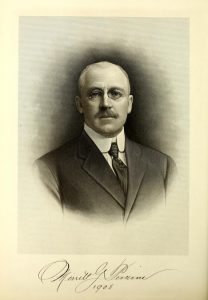
Ancestors of Mereitt G. Perkins of Bridgewater, MA

perkins

The Perkins family has deep roots in New England, tracing its lineage to Abraham Perkins, who arrived in Hampton in 1638. His descendants included influential figures in various fields, particularly in iron manufacturing. Notably, John Perkins of Bridgewater was a prominent machinist and manager at several iron works. His youngest son, Mereitt G. Perkins, born in 1864, became a successful banker in Newark, NJ, expanding the family’s legacy in business and finance while maintaining historical ties to their ancestral roots in Massachusetts.

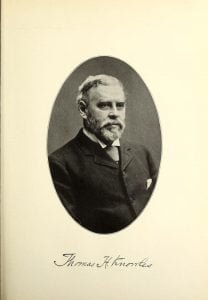
Knowles Family of New Bedford, MA

thomas knowles

The Knowles family, established in New Bedford for nearly a century, descends from the ancient lineage in Eastham, Massachusetts. Key figures include Thomas and James H. Knowles, whose firm was pivotal in the whaling industry. The family name was upheld by later generations engaged in diverse business and civic roles, greatly impacting local commerce and community welfare. Noteworthy individuals include Capt. John P. Knowles, a prominent whaling captain, and Joseph Knowles, influential in cotton manufacturing. The family’s legacy intertwines with New Bedford’s rich maritime history.

Biographical Sketch of George Neil Stewart

George Neil Stewart was a prominent university professor born on April 18, 1860, in London, Canada. He received multiple degrees from the University of Edinburgh and the University of Cambridge. His academic career included roles as a demonstrator and professor of physiology at various institutions, including Owens College and Harvard Medical School. Since 1907, he served as a professor of experimental medicine at Western Reserve University. Stewart contributed to the field of physiology through his authorship, notably of the “Manual of Physiology.