Chief Pontiac of the Ottawa’s

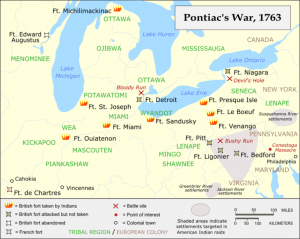
Map of Pontiacs War

Following the 1763 peace, English troops occupied former French forts, prompting widespread Indian apprehension of encroachment. Pontiac, the Ottawa chief, emerged as a pivotal leader advocating for resistance. He organized a council of tribes to unite against the English, inspired by a prophetic vision asserting divine support for their fight. Pontiac orchestrated a coordinated attack on English forts, aiming for liberation. Despite initial efforts, including a siege of Detroit, betrayal foiled his plans. Eventually, Pontiac was assassinated, symbolizing the decline of Indian resistance.

Philadelphia To Steubenville

On October 4, 1819, Dr. Hall and the author departed Philadelphia, traveling through fine weather and well-cultivated lands. They stopped in West Chester, where they noted the plight of a man imprisoned for debt. The journey continued to Strasburg and Lancaster, with observations on the industrious German residents and the notable Susquehanna bridge. As they passed through various towns, they encountered trials such as rough terrain, bad hospitality, and even a violent election incident. The travelers reached Pittsburgh, a smoky industrial town, on October 12, and left for Steubenville, where they took a restful day amidst the bustling village.

Biography of William H. Reed

William H. Reed, born on January 30, 1830, in Bedford, Pennsylvania, moved to Kansas in 1869. A self-made man, he progressed through various trades, building a successful furniture business in Topeka with his son B. F. Reed. Known for his integrity and public spirit, he contributed to community development, holding a brief stint as a constable. Now in retirement, Reed is respected for his business acumen and civic involvement. His wife, Elizabeth, also played a significant role in their ventures and community engagements.

Biography of James Howard Beegle

James Howard Beegle, born December 13, 1867, in Bedford, Pennsylvania, became a notable oil well contractor and producer in Neodesha, Kansas. Raised on a farm, he shifted from agriculture to the oil industry, working across various states before establishing profitable wells around Neodesha. Married in 1914 to Elsie Cowdery, Beegle is recognized as an authority in the Kansas oil fields and has contributed to the community as a public utilities commissioner. His fraternal affiliations include prominent organizations like the Masons and the Elks.

Biography of Deacon John A. Boyer

Deacon John A. Boyer, born October 16, 1809, in Pennsylvania, settled in Rock Island County in 1837 and married Zeruiah Phillips in 1838. The couple, childless but devoted, raised Thomas Campbell as their own. Baptized in the Mississippi River, Boyer became a foundational figure in the First Baptist Church, serving as deacon and trustee for over thirty years. He contributed significantly to the church’s growth and stability. A Republican turned Democrat, he also held local political positions and was active in Masonic and community organizations. Boyer died on December 5, 1891, in Los Angeles.