Choctaw Tradition of the Flood

The Choctaw tradition recounts a prolonged night that instilled fear among the people, followed by the appearance of wildlife seeking refuge, which they initially hunted. Eventually, they discovered the light signaling an approaching flood rather than the sun rising from the north. In desperation, they constructed rafts that ultimately failed, drowning many. Only a skilled boat builder, the Penikbi, survived, guided by a dove’s message. This flood narrative echoes Biblical accounts, suggesting shared ancient experiences among cultures, including a drought that preceded the flood, reminiscent of the Prophet Elijah’s time.
Ancient Choctaw Courtship

In ancient Choctaw courtship, a young man would test his suitability by playfully throwing small sticks or pebbles at his intended bride during family gatherings. If she reciprocated, it indicated approval; if not, she would leave in disapproval. Following mutual consent, the groom would seek the parents’ approval and arrange the wedding. The ceremony involved a playful chase to a pole, culminating in the bride sitting surrounded by women who tossed gifts, while the couple shared a simple meal afterward, highlighting their humble, communal lifestyle.

Choctaw Mesmerism, Eclipses, and Dances

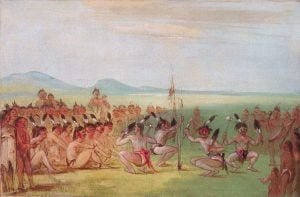
Eagle Dance, Choctaw, George Catlin, 1835-7

The Choctaw possessed a complex relationship with mesmerism, viewing it with awe and fear, often resulting in dire consequences for practitioners. Their superstitions extended to natural phenomena, such as eclipses, which they believed were caused by squirrels attempting to consume the sun. To avert this, they would make noise to drive the creatures away. Additionally, the Choctaw engaged in various dances, with significant emphasis on war, hunting, and ball playing for young men, while women focused on domestic roles, reflecting a distinct societal division.

Family of Peter Folsom

Peter Folsom, a prominent Choctaw missionary and leader, passed away on April 9, 1885, after a brief illness. Known for his moral integrity and dedication, he was the first Choctaw to join a Baptist church in 1829 and played a pivotal role in the development of Baptist missions among the Choctaws. A beloved figure, he served his community with charity and integrity throughout his life, even representing his nation in Washington. Despite dying in poverty, Folsom’s legacy of faith and service endures.

Biographical Sketch of Judge Loring Folsom

Judge Loring Folsom, the last surviving child of Colonel David Folsom, was a prominent figure in the Choctaw Nation and served as Circuit Judge for nearly two decades. After retiring from public life, he resides peacefully on his farm near Caddo, a site of historical significance for the Choctaws. Known for his amiable disposition and unwavering integrity, Judge Folsom is well-versed in both local and national affairs. His life exemplifies the principles of truth and justice, reflecting the noble character of the Choctaw people.

Choctaw Religion

Eagle Dance, Choctaw, George Catlin, 1835-7

The Choctaw religion emphasized a Great Spirit, believed to be omnipresent and powerful, yet not requiring worship. Their concept of the afterlife included a “happy hunting ground” for the virtuous, contrasting with a painful realm for wrongdoers. Rituals around death included preparing journeys for the spirit and prolonged mourning, with specific burial practices that reflected their beliefs in the spirit’s continued existence. Healing practices by Choctaw doctors, both male and female, utilized herbal remedies and traditional methods, demonstrating their deep understanding of natural medicine.

Choctaw Law Forbidding White-Indian Marriage

The Choctaw Nation implemented stringent laws regulating the marriage of white men to Choctaw women, citing detrimental effects on their community. Applicants for marriage licenses must prove good moral character, affirm adherence to Choctaw laws, and pay a fee. Unauthorized marriages are deemed illegal, leading to fines for involved parties. Historical context reveals that an ancient council once sought to prevent such unions, fearing the erosion of tribal identity. Ultimately, a compromise allowed for intermarriage under specific regulations, reflecting complex relations between the Choctaw and white settlers.

Mound Builders

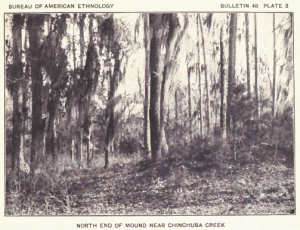
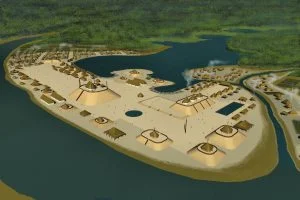
Bottle Creek Mounds

The post discusses the connection between ancient mounds in North America and the indigenous tribes, refuting the notion that these structures were built by a distinct race known as the Mound Builders. Evidence presented includes similarities in skull structure among various tribes and the fortified nature of their towns. Early European explorers observed these communities engaged in agriculture and crafting, challenging the idea of indigenous nomadism. The author argues that the mounds are the work of Native Americans, the true ancestors of today’s tribes, and emphasizes the importance of understanding their legacy.

Choctaw Indian Mounds

Bayou Lacomb Choctaw Mound

H. F. Buckner references Mr. Maxwell’s historical address, discussing the advanced military engineering of the Mound Builders in Carthage, Alabama, contrasting it with the warfare strategies of tribes encountered by De Soto. The mounds are suggested to have served as sepulchers for ancient leaders, drawing connections to traditions of the Choctaw and other tribes. Buckner emphasizes the need for further archaeological investigation to establish the Mound Builders’ link to North American Indians, particularly the Choctaws, who practiced distinct burial customs.

Indian Mounds throughout North America

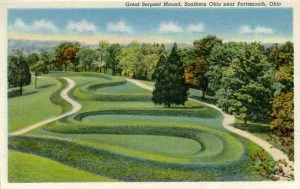
Great Serpent Mound Postcard

The region surrounding Lake Michigan was historically inhabited by skilled mound builders, including the Wyandots and Six Nations, who buried their deceased with treasures beneath earthen mounds. Excavations across North America, from Tennessee to Georgia, have uncovered European artifacts, suggesting cultural exchanges with early explorers. Similarities in mound structures and burial practices link the mound builders to contemporary Native American tribes. Mounds served varied purposes, including memorials and fortifications, reflecting the complex social practices of these ancient communities throughout the continent.

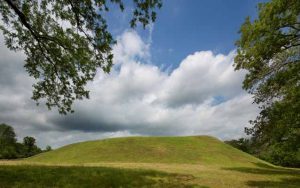
Indian Mounds in Natchez, Mississippi

Emerald Mound, Natchez Trace Parkway

On May 18, 1838, a group from Natchez, Mississippi, explored two square mounds near the Mississippi River, measuring up to 16 feet high. Excavations revealed human bones and various pottery artifacts. Later, a larger mound east of Natchez was examined, showcasing impressive dimensions and architectural design, likely crafted by ancestral Native Americans. This massive structure, featuring a significant tower, underscored the sophisticated construction techniques of prehistoric cultures, while artifacts unearthed hinted at a rich, albeit unrecorded, history.

Castine Indian Mounds

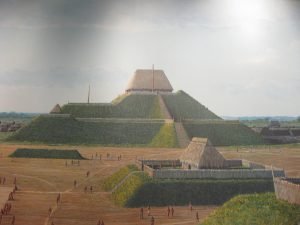
Monks Mound

The Castine Mounds in Illinois, particularly Monk Mound, are immense earthen structures revealing human craftsmanship rather than natural formations. Monk Mound, nearly 100 feet high and 600 yards in circumference, features a broad terrace and has yielded artifacts like pottery and corn, indicating its artificial origin. Various purposes for the mounds are suggested, including cemeteries and religious sites. These ancient structures invite speculation about the cultures that built them, much like the enduring mysteries of the pyramids of Egypt.

The Creation of an Indian Mound

Luthor List Mound

Garcellasso de la Vega notes that American Indian communities began town planning with the construction of mounds for chiefs and warriors, creating a social hierarchy. Mounds served both as living quarters and defensive structures, with evidence of such constructions spanning centuries. The Natchez Indians, for example, built extensive mounds in Louisiana for protection against the French. Excavations of these mounds reveal human remains alongside artifacts, illustrating the cultural practices surrounding death and memorialization among Native American tribes, such as the Choctaws, who honored their deceased with intricate burial customs.

Choctaw Culture

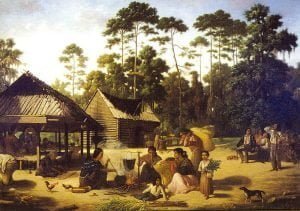
Choctaw Village near the Chefuncte, The women appear to be making dye to color the strips of cane beside them, by François Bernard, 1869

The Choctaw people historically relied on unwritten customs for governance, engaging in barter without contracts or money, resulting in a society free of lawyers and prisons. Their beliefs emphasized respect for the dead and a connection to nature. Despite a lack of written language, they conveyed knowledge through symbols and oral traditions. The Choctaws demonstrated remarkable advancements in agriculture and intellectual capacity, sustaining social equality without established hierarchies. Their governance reflected communal interests, prioritizing the well-being of their tribe above individual gain.

Choctaw Warpath & Dress

The Choctaw people, revered for their natural oratory, engaged in dignified deliberations regarding national affairs, often symbolized by the ceremonial smoking of the peace pipe. Warfare was considered a noble pursuit, marked by the Hoyopa-hihla war dance. Celebrations followed victories, featuring music, trophies, and mourning for the fallen. Choctaw warriors adorned themselves with elaborate ornaments while maintaining a strong belief in witches and supernatural beings. Their creation myths reflected connections to nature, attributing humanity’s origins to the Great Spirit.

Choctaw Beliefs About the Sun and Moon

Various cultures, including North American Indian tribes, have myths explaining celestial events like solar and lunar eclipses. The Choctaws believed a little black squirrel aimed to swallow the sun, prompting people to make noise to scare it away. Similar interpretations exist across different cultures: the Chinese envision a dragon devouring the sun, while the Polynesians recount Maui capturing the sun. These myths reflect humanity’s early attempts to understand nature, revealing that even the most primitive societies sought to explain celestial mysteries, akin to the beliefs of the Choctaws.

The Choctaw Rainmaker

The Choctaw people held various revered dignitaries, including Medicine Men, Doctors, and Rainmakers, who fulfilled essential roles in their communities. They relied on natural remedies from local herbs and performed unique healing practices, such as dry-cupping. The Rainmaker, an esteemed figure, was believed to possess the power to summon rain during droughts. However, the arrival of missionaries brought changes, as illustrated by an incident involving a widow whose simple prayer led to rain, diminishing the mystique surrounding the Rainmaker’s abilities.

The Story of Hohtak Lahba and his Choctaw Mother

The Choctaw people had laws rooted in blood revenge, compelling relatives to avenge murders. This harsh system, however, had a sobering effect on their society, as individuals refrained from violence to avoid retribution. A poignant story is that of Toh-to Pe-hah, a mother who sacrificed her life for her son, Hohtak Lahba, condemned for murder. Her selfless act was accepted as atonement, reflecting profound maternal love. Tragically, Hohtak Lahba, feeling branded a coward, ultimately took his own life to reclaim his honor. This tale highlights the complexities of honor, love, and cultural law among the Choctaw.

Charles Montezuma

The story of Charles Montezuma illustrates the intellectual potential and moral integrity present among North American Indians. Rescued from an Apache camp and adopted by a Chicago photographer, Montezuma thrived as a scholar and gentleman, graduating high school with distinction. He is pursuing a medical career, showcasing a rejection of savage stereotypes imposed by white society. The post emphasizes that Native Americans have produced notable figures in history, challenging the perception of their inferiority with examples of their capability and resilience.

Mohawk Warrior Uncas

Uncas, the young Mohawk warrior from Cooper’s *Last of the Mohicans*, also known by the name Tschoop, is remembered for his valor and eloquence among the once-mighty Mohawk Nation. In 1741, he engaged with Moravian missionary Christian Rauch, ultimately leading to his conversion to Christianity. Uncas spoke candidly about his past and expressed a desire for redemption, turning into a fervent preacher of the Gospel, sharing his message with neighboring tribes, amidst the broader decline of Native cultures in the face of colonial expansion.