
You remember the great peace meeting near Camp Grant, where the Indian children were given back, and how old Santos put the white stone down and said that as long as it lasted there would be no war. After this the Indians were very friendly to the white man, and so it seemed a good time for some of the Indian chiefs to go East and visit the great Chief in Washington.
Just about one month after the great peace meeting the young Pima chief, Antonito, his friend Louis, who spoke some English, and Mr. Cook, the good Indian teacher, joined old Santos of the Aravipa Apaches, who came with his interpreter, Conception, to meet them near the crossing of the Aravipa River. Then they all rode on horseback to a field just south of Camp Grant, and here I met them. Captain Wilkinson, my aide, was with me, and we had a mounted escort of a sergeant and six soldiers. We were to go one hundred miles over a very rough, steep mountain trail to Camp Apache near the eastern border of Arizona, but we could take no wagons, so all our luggage was on four strong pack-mules. When we started I rode a large gray horse named Frank. He looked very fine indeed, but one of the officers at Camp Grant told me to be careful and not trust too much to appearances, for Frank was not used to long journeys as the mules were, and he was likely to grow lame on the stony road, or fag out. I patted the beautiful creature and we started off, but I had hardly ridden twenty miles before Frank, beautiful as he was, gave out entirely. He was too weak for me to ride him any further, so I left him with a soldier to be slowly led to the nearest army station, and was glad indeed to take the soldier’s mule for the rest of the journey.
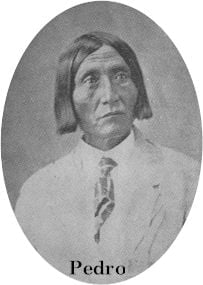
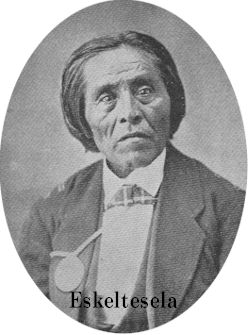
We camped two nights beside good water, and found plenty of wood near by, and on the third morning our queer-looking cavalcade rode out of the surrounding forest into a beautiful mountain glade. A small river tumbled over the rocks and then cut its way through a deep and peaceful channel. The dark green of spruce- and pine-trees was around us, making a delightful spot in the great wilderness, which, toward the north and east, seemed endless. Among these surroundings we found a regular frontier army post, large enough for six companies of soldiers and their officers. This was Camp warmly welcomed, and every one tried to make us comfortable. When we were rested Major Dallas, the commanding officer, told me about the Indian tribes here. There were three bands, all Apaches. The nearest band, about one thousand strong, was only a few miles to the east. Pedro was their chief. Eskeltesela was the chief of another band. He was old and easy-going, but a good soul. His people quarreled some with their neighbors , Major Dallas said, but on the whole gave little trouble. About twelve miles away to the south was still another band, eight hundred strong. This was under a chief whom the white men called ” One-Eyed Miguel, ” be cause he had only one eye. These chiefs, the Major said, were formal and ceremonious, and had plenty of complaints to make, so I might expect to have a visit from them as soon as they knew I was at Camp Apache. And it was not long before they came. Pedro looked like a spare-boned, hard-working Yankee farmer, and tried to dress like a white man, for he had one white man in his band. Eskeltesela was handsome, with fine features and large, clear eyes. He dressed like a Mexican. After he had paid the usual compliments, he told me that his children had tried always to do good, but they were often hungry and wanted bread and some meat.

Last came One-Eyed Miguel. He was the biggest chief of all, and indeed was worth seeing. He was very tall, his hair hanging loose, long, and upbraided. He seemed to be watching all the time with his one eye, and he was always smiling. Evidently, come what might, he intended to be agreeable. Conception interpreted and told me that Miguel was glad to see “Washington Big Chief”; did I know that the Sierra Apaches came to the good Major now for food, but they had been hungry so long that if you touched them their sharp bones hurt you. They had good corn on their farms, too, only it was not ripe yet. I listened to what Miguel had to say, and then I asked him if he would go East with me. He thought about it for some time and then said that he would go. At, this time, as Miguel had told me, all the Indians came once in two weeks to Camp Apache for food, and when they came Miguel took me to see his family. His wife and children crowded around me and smilingly begged me to take good care of Miguel and bring him back safely, and his wife said to me: “Whisky bad for Miguel, no let him drink.” It was a good suggestion, and I pledged all the Indians who went with me not to drink any liquor while they were gone. Indians are very careful always to keep a promise, and every one kept the pledge faithfully.
Eskeltesela’s wife shed tears at the prospect of his going so far away, but old Santos told her I was a great chief and would bring Eskelt back safely, so she was comforted.
Pedro would not promise to go at first, but he brought the white man who lived with his band to see me. This man was well educated, but he suffered from a fearful disease, so he left his own people to live among the Indians, and carefully taught the tribe and Pedro many useful things. He could act as interpreter, and after we had spoken together he told Pedro to go to Washington with me, and quieted the family who were afraid, till they said: “Go with the Tatah (Father) and come again.”
About noon on the day of departure we drew out of Camp Apache. There were eight Indian chiefs beside Louis, Conception, Captain Wilkinson, Mr. Cook, and myself, who, with the soldiers, made twenty-six in all. We had two army wagons and one spring wagon, the latter driven by a man called Jeems. Nearly all of us rode horses or mules, but any one who was tired could ride in the spring wagon.
The first day we made ten miles in woods all the way over a good, level road, and at night camped by a stream where I saw plenty of nice dry wood. When we were settled I proposed to the chiefs that we have a good fire, and asked them to help me gather some wood. Then how Miguel laughed ! He told Conception to tell me that no big chiefs hauled wood, and sat down, still smiling at what he thought a great joke. Then I told Conception to tell me that no big chiefs chief as he was, and, calling Captain Wilkinson, we began to draw the dry branches. Laughing all the time, Miguel told the other Indians to come and help. They helped us draw large branches for the fire and never again refused to work when it was necessary. The next day we traveled thirty miles and left the forest behind us, but at night our camp was beside some cottonwood trees. The Indians led us to a good spring and as the next day was Sunday I decided to spend it here. When Miguel heard this, he rode to me on his Indian pony, and laughing, said “I go to my house.” Louis told me that the chief wanted something, but added, as he saw him ride off across the broad prairie: “No more Miguel.” Two days passed! On Tuesday when we had about given him up, I spied a single horseman loping along toward us from the northwest. It was Miguel! He had kept his word to the Tatah, and was ready to go on.
The next Sunday we encamped beside a small river, but the water clay was so mixed with and sand that we could not make it clear. The animals would not drink, and every one begged to go a few miles further to the Rio Grande and cross to the town of Albuquerque. I was about to do this when Captain Wilkinson, who had been roaming about, found a spring of good, clear water, so we remained. It was here that Louis became very angry over something and Mr. Cook told him that he was no Christian. Louis felt so badly about this remark that he came to me and asked if he might go back home, but I explained to him that Mr. Cook only wanted to help him to act as a Christian, and he was happy again. After this I often rode beside Deems in the spring wagon. He talked all the time, and his local knowledge of robberies and massacres was wonderful; but it was very sorrowful, for while he told me the most thrilling stories of highwaymen, all the tales were very sad. I never heard him tell one cheerful story.
He would wait till we were passing some lonely place and then would tell the sorrowful story of a robbery which had taken place there, till I almost expected to see the robbers rush out. For this reason we called him “Dismal Jeems.” He had a hard time with his mules, for he could not reach those ahead with his whip, and one of them, “Lucy,” would sway back in the harness and refuse to pull, just as if she knew. I gathered a handful of pebbles and, whenever she lagged, tossed one and hit her on the back. Then she would start up and was as smart as the rest. I believe Lucy thought the driver did this, and made up her mind to have revenge.
When we reached the Rio Grande the water was high and rushed along. We pulled the raft ferry-boat a mile up the stream and loaded it so as to shoot across diagonally with the current to an island near the Albuquerque shore. All of us were aboard except Dismal Jeems and the Indians. Jeems jumped on the raft and landed just about three feet behind Lucy’s slender tail. Her time had come! Quick as a flash her small hind feet struck him in the chest and with such force that he turned a back somersault into the river and disappeared beneath the water. We caught him when he came to the surface and brought him aboard, but he was wet and groaning. I confess I was frightened myself, for the river was rushing along very rapidly, but the Indians could hardly contain themselves as they sat on the bank. They were doubling up and rolling on the ground with laughter, crying out: “Jondaisie no bueno, “-” That mule no good.”
At Santa Fe we left our escort horses and wagons to the Indian Agent and garrison, and now, dressed in good civilian clothes, took the four-horse stage for Pueblo. On the way I happened to speak of the earth as round, and when the Indians heard me they begged that I would not say so, for people would think I was troubled with bad spirits; no one with sense could think the earth was round. They hardly knew what to say when I told them I knew a white man once who sailed in a ship all the way around it. How surprised they were over all the new things they saw. I watched when they first saw a railway, a train of cars, a telegraph line, a tunnel or a bridge; sometimes they were breathless and full of fear, at other times they showed great joy.
Once Eskeltesela said to me: “You think Indians all bad; look in my eyes and see if you see any bad. ” And indeed I did not as I looked into his frank, open face and bright, clear eyes.
Miguel carefully counted all the mountain peaks as we traveled, that he might surely be able to find his way back, but as the train rushed on he became more and more discouraged and at last he told me he had given it up. He had trusted me to come and would trust me altogether now. In New York I bought Miguel a glass eye. It was so much like his other eye that it was hard to tell which was which. The doctor told him to take it out and wash it now and then, but Miguel said no. Whoever heard of a man taking out his eye. He was very proud of this new eye, and had Louis write a his people that when he came home he would have two eyes instead of one. In Philadelphia I took the Indians through the large prison, and they saw the warden shut a cells and close the bolts from a central station. They Went along the halls and looked through the gratings. At last Miguel took me aside and said : “Do you think there is one innocent man in here?”
“Why?” I asked.
“Because I was once in prison for a whole year, and I had done no wrong. If there is one man here who is innocent I want to speak to him.”
I told him that every man had had a fair trial, and then he was satisfied.
In Washington we went to see the home where children who are deaf and dumb are taught to read and write, and to speak. Here the Indians were very happy. Miguel began by making rabbits with his hands and was delighted when the children understood what he meant. One after another the chiefs began to tell stories in the sign language, and although they could not make the white man understand in English, they could, strange to say, tell wonderful stories of animals and forests, streams and prairies, to the deaf and dumb children.
Here in Washington these “American chiefs” saw the “Great American Chief,” our President and then we started back once more for the West. At Camp Apache all the Indians gathered to greet Pedro, Eskeltesela, and One-Eyed Miguel, and to rejoice over their safe return. I never saw more sites of real joy as they flocked around them, but One-Eyed Miguel was One-Eyed Miguel no longer, and all were curious to catch a glimpse of this ever-smiling Indian chief who came back from the white man’s country with a new eye.