
Choctaw Trade and Coexistence in the Nation
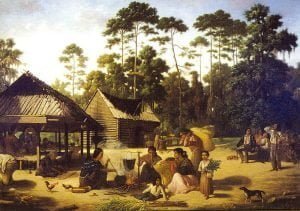
Choctaw Village near the Chefuncte, The women appear to be making dye to color the strips of cane beside them, by François Bernard, 1869

Trade significantly shaped the interactions between the Choctaw tribe and European colonists following the discovery of the New World. This exchange extended existing inter-tribal barter practices, enabling the Choctaw and other southeastern tribes to establish vital relationships with European traders. The Choctaw developed a lingua franca for trade, negotiating not only goods but also allegiances, particularly in a competitive landscape of European powers. While trade brought manufactured goods, it also introduced alcohol, leading to complex social consequences. Ultimately, these interactions fostered a unique coexistence and exchange of cultures in the region.

Trade Routes in the Lower Southeast

The Great White Path, an essential trade route for the Creek Indians, ran through Track Rock Gap and connected significant towns. French explorer René Goulaine de Laudonniére noted that trade in the late 1500s predominantly flowed north-south, exchanging valuable resources from the Southern Highlands for goods from lower altitudes. While Track Rock Gap was important, other routes through the Appalachian Valley and Savannah River Basin were even more crucial for trade. The pathway began near Etowah Mounds, extending towards the Blue Ridge Mountains and the Smoky Mountains.

Indian Trade

The moral condition of Native Americans heavily relies on the nature of trade with them, as outlined in a report addressing the Indian trade system. The current mixed approach, involving both government and private traders, has led to widespread exploitation, particularly through the introduction of liquor and predatory credit practices. Experts suggest that a complete government takeover of trade could eradicate British influence, reduce costs for Native Americans, and improve their moral standing by preventing harmful practices. Establishing localized trading posts could facilitate better relations and education for tribal communities.

United States Government Trade with the Indians

In 1786, the U.S. government initiated a trade program with Native Americans through Congress, establishing factories on the frontier to provide goods without profit. The Superintendent of Indian Trade oversaw these operations, which aimed to regulate transactions and curb illegal trading. The program included various trading posts and the government invested approximately $300,000. This system was eventually abolished in 1822 in favor of private trading companies. Further reforms occurred under President Grant, who aimed to improve Indian policy and management, moving away from the superintendency system and engaging religious organizations in the process.