
Choctaw Beliefs About the Sun and Moon

Various cultures, including North American Indian tribes, have myths explaining celestial events like solar and lunar eclipses. The Choctaws believed a little black squirrel aimed to swallow the sun, prompting people to make noise to scare it away. Similar interpretations exist across different cultures: the Chinese envision a dragon devouring the sun, while the Polynesians recount Maui capturing the sun. These myths reflect humanity’s early attempts to understand nature, revealing that even the most primitive societies sought to explain celestial mysteries, akin to the beliefs of the Choctaws.
The Story of Hohtak Lahba and his Choctaw Mother

The Choctaw people had laws rooted in blood revenge, compelling relatives to avenge murders. This harsh system, however, had a sobering effect on their society, as individuals refrained from violence to avoid retribution. A poignant story is that of Toh-to Pe-hah, a mother who sacrificed her life for her son, Hohtak Lahba, condemned for murder. Her selfless act was accepted as atonement, reflecting profound maternal love. Tragically, Hohtak Lahba, feeling branded a coward, ultimately took his own life to reclaim his honor. This tale highlights the complexities of honor, love, and cultural law among the Choctaw.

Choctaw War Against the Osage and other Legends

The Choctaw legends reveal deep connections to nature and profound emotions. One tradition recounts the tale of Ohoyo Osh Chisba, where two hunters, after a disappointing day of hunting, encounter a beautiful spirit who offers them guidance. Through acts of kindness, they are rewarded with corn, a staple for their people. Similarly, the story of Chahtah Osh Hochifoh Keyu illustrates the tragic effects of war. The nameless warrior, separated from his betrothed, faces sorrow and loss, culminating in his untimely return to a mourning village. Such narratives emphasize love, sacrifice, and spiritual reverence.

Traditions of the Great Flood by the Choctaw

The Choctaw traditions regarding the Oka Falama tell of a time when humanity was deemed wicked, prompting the Great Spirit to send a prophet warning of impending destruction. Ignored, the people faced a catastrophic flood that covered the earth, leaving only the prophet alive on a raft. After weeks adrift, he found land, married a beautiful bird transformed into a woman, and repopulated the world. The stories share striking similarities with Biblical accounts, suggesting deeper historical connections or shared origins of the flood narrative.

The Biloxi and Pascagoulas

In 1712, French explorer Iberville anchored near what is now Ship Island and discovered a peculiar island animal, naming it Cat Island. They then encountered the Biloxi tribe, a Choctaw clan, which led to the establishment of Biloxi, the oldest town in Mississippi. Eastward, they found the Pascagoulas, also a Choctaw clan. The name Pascagoula means “Bread People.” Local traditions among the Pascagoulas recount a legendary encounter with a mysterious white man who, alongside the tribe, was entranced by a siren, leading to their demise.

Micmac Customs And Traditions

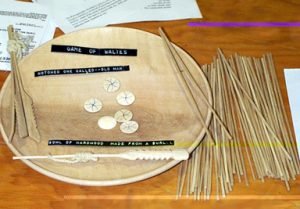
Waltes Bowl and Sticks

The Micmac Indians of Nova Scotia possess rich customs and traditions, primarily documented through the Glode brothers, who are esteemed for their knowledge of native lore. Their communication methods in the woods utilize symbolic sticks, and traditional games, such as altestakun, reflect their cultural values and complexities. Notably, the serpent dance, once common, symbolizes transformation and seasonal cycles, while folktales, like those of water fairies and the culloo, illustrate their deep mythological roots. However, much of this heritage is fading as fewer individuals retain knowledge of these legends and practices.

Traditions of their Wars with Monsters, Giants and Supernatural Phenomena

The post recounts the early wars of the Iroquois with mythical beings such as the Flying Heads, Lake Serpent, and Stonish Giants, showcasing a blend of history and myth. The narrative reflects the Iroquois belief system, where supernatural phenomena were intertwined with their experiences, leading to a worldview steeped in fear and superstition. The Iroquois faced these formidable adversaries through various means, from incantations to fortifications, and ultimately sought divine intervention to secure their safety, illustrating their resilience in the face of formidable challenges.

The Graveyard Serpent and Corn Giant

According to Seneca tradition, the tribe once lived near Niagara Falls but faced a devastating illness and crop failure. A prophet dreamed of a serpent beneath their fields, causing the sickness by consuming buried bodies, and a giant that devoured their corn. Acting on the dreams, the chiefs relocated to Buffalo Creek, where lightning, sent by the Great Spirit, ultimately destroyed the serpent. Upon returning to their old site, they found the giant, now emaciated, hanging from a lodge pole, symbolizing the hardships of sickness and famine.

Yuchi Religion

The Yuchi’s rich religious beliefs center around a complex mythology involving supernatural beings, creation, and an intricate relationship with the natural world. In primordial times, the universe was inhabited by anthropomorphic entities and animals, leading to the creation of Earth through the efforts of Crawfish and other beings. The Sun, or Tso, is a central deity who guided the Yuchi through rituals and ceremonies, imparting knowledge of sacred practices. Their mythology also includes the origins of fire, thunder, and human existence, highlighting their deep spiritual connections and cultural identity.

Yuchi Mythology

Yuchi mythology, aligned with Southeastern tribes, is characterized by a creational cosmogony. Central to their mythos is the Sun as the culture hero, responsible for tribal existence and ceremonies, while the Rabbit serves as a distinct trickster figure. These myths often share elements with other tribes, highlighting themes of transformation, heroism, and moral lessons through tales of cunning animals. Additionally, Yuchi stories reveal influences from both indigenous and Afro-American traditions, demonstrating a complex cultural intermingling over time.

The Magic Circle In The Prairie

In a remote prairie, a young hunter named Algon discovered a mysterious circular path where beautiful girls danced to enchanting music. Enamored by one of them, he attempted to capture her but was thwarted as they ascended back into the sky. Transforming into various animals to try again, he ultimately succeeded in securing the youngest sister as his bride. Their life flourished until she longed to return to the stars, leading to Algon’s profound sorrow. Eventually, they reunited, and upon bringing gifts from earth, became transformed into white hawks, returning to their celestial home together.

The Island of the Blessed – or the Hunter’s Dream

A young hunter, mourning the sudden death of his fiancée, neglects his former passions and embarks on a journey to the land of souls, guided by tradition. As he traverses a changing landscape from snow to a vibrant realm, he encounters an old man who reveals the entrance to this afterlife. Upon crossing a mystical lake, he reunites momentarily with his love on a blissful island devoid of sorrow. However, a voice urges him to return to his earthly duties, promising a future reunion.

Origin of Men of Mana-Bozho

At a pivotal moment, a great Manito descended to Earth, marrying a woman who birthed four sons before dying. The eldest, Manabozho, became humanity’s ally, and after a fierce conflict with his brother Chokanipok, he created flint stones and fire for mankind. Manabozho and his brother Chibiabos, who presided over the dead, were conspired against by jealous Manitos. Following Chibiabos’ tragic death, Manabozho’s sorrow led to the introduction of the Grand Medicine Dance and the birth of healing practices. Legends suggest he resides on a vast Arctic ice flake, awaiting the end of the world.

Origin of the Osages

According to Osage tradition recorded by the St. Louis Superintendency, the first Osage man emerged from a shell and was guided by the Great Spirit. After receiving a bow, arrows, and fire to sustain himself, he encountered a beaver near a river. The beaver invited him to stay and later offered one of his daughters in marriage. Their union is believed to have led to the Osage people, creating a cultural bond that prevents the Osages from harming beavers, whom they regard as kin.

Iroquois Cosmogony

The Iroquois view their origins through a cosmogony centered on celestial entities. The Great Spirit, Neo, and Atahocan, the master of heaven, set the stage for creation. Atahentsic, the heavenly woman, falls to earth after a celestial romance, landing on a turtle that becomes the earth. She bears twins representing the dualities of good and evil. Her lineage continues with sons YOS-KE-KA, linked to the sun, and THO-IT-SA-RON, whom YOS-KE-KA ultimately kills. This narrative reflects a blend of ancient beliefs, including sun worship.

The Cherokee Origin of Disease and Medicine

In ancient times, animals could speak and coexisted harmoniously with humans. However, as human populations grew, they began to harm animals for food and sport. In response, animals convened councils to plot retaliation. They devised various means to inflict suffering on humans, including diseases and nightmares. Ultimately, plants allied with humans, vowing to provide remedies for the ailments caused by the animals’ wrath, thus establishing the foundation of medicine. This narrative illustrates the complex relationship between humans, animals, and the natural world in Cherokee traditions.

The Siouan Mythology

The Siouan Indians’ mythology, shaped by their cultural practices and beliefs, is centered on the term “wakanda,” which signifies a blend of power, sacredness, and mystery rather than a singular “Great Spirit.” Key figures include the sun, thunder, and significant natural elements, often embodying both good and bad traits in a polytheistic framework. The mythology reflects their environment and social structure, with elaborate ceremonies serving as expressions of their devotion. Overall, Siouan mythology straddles the realms of zootheism and physitheism, capturing the essence of their worldview amidst evolving beliefs.

The Development of Mythology

Powell identifies four stages in the development of belief: hecastotheism, zootheism, physitheism, and psychotheism. He castotheism attributes mysterious powers to all objects, while zootheism elevates certain animals into deities reflecting human traits. Physitheism personifies natural forces, transforming them into anthropomorphic figures, and psychotheism acknowledges spiritual concepts. Throughout these stages, a pervasive sense of mystery persists, suggesting a slow cultural evolution where beliefs often overlap and coexist. This evolution represents not just a shift in belief but also a qualitative refinement of abstract understanding in mythology.

Character of the Indian Race

The mental character of North American aborigines is vividly expressed through their languages and oratory, particularly in their imaginative mythologies and symbolic communication. Their rich oral traditions reveal elaborate cosmogonies involving spiritual beings and fantastical narratives. The unique pictorial representations they create, known as Ke-ké-win, signify their beliefs about life, death, and the afterlife. These traits illustrate a complex intellectual culture, combining creativity with deeper philosophical inquiries, beyond the often simplistic judgments they face.