
Treaty of June 19, 1858 – Mdwekakanton

On June 19, 1858, a treaty was established between the United States and the Mendawakanton and Wahpakoota bands of the Dakota Sioux, led by their chiefs in Washington, D.C. The agreement included provisions for land allotments, financial compensation for ceded territories, and the establishment of regulations governing the reservation. The treaty emphasized the preservation of peace, the management of the bands’ affairs by the U.S. government, and the importance of avoiding intemperance among the tribes. Provisions for military and agricultural improvements were also included.
Treaty of August 5, 1851

On August 5, 1851, a treaty was signed at Mendota between the United States and the Med-ay-wa-kan-toan and Wah-pay-koo-tay bands of Dakota Sioux Indians. It established perpetual peace and friendship while the bands ceded all land rights in Minnesota and Iowa to the U.S. In return, the U.S. agreed to pay $1,410,000 for their relocation and provide funds for education and agriculture. It also enforced laws against alcohol in the ceded territory and included provisions for the protection of the Indians’ rights.

Treaty of September 29, 1837

On September 29, 1837, a treaty was signed in Washington between U.S. Secretary Joel R. Poinsett and the Sioux chiefs, wherein the Sioux ceded their lands east of the Mississippi River to the United States. In return, the government committed to invest $300,000 for the tribe’s benefit, pay annual annuities, assist with debts, and provide agricultural support over twenty years. This agreement aimed to facilitate the Sioux’s transition to farming and improve their living conditions as part of broader U.S. policies toward Native Americans.

Treaty of November 30, 1836

On November 30, 1836, representatives of the Wahpaakootah, Susseton, and Upper Medawakanton Sioux tribes convened with Lawrence Taliaferro, Indian Agent, to discuss the cession of lands between Missouri and the Missouri River. The tribes, recognizing the land’s unsuitability for Indian habitation and the potential for conflict, willingly relinquished their claims. In return, the U.S. promised to provide goods valued at $550, reinforcing their ongoing relationship. This treaty illustrates the complexities of land negotiations and the tribes’ desire for peaceful coexistence.

Houses of the Mdewakanton Tribe

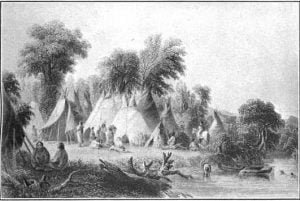
"Dakotah Encampment" - Seth Eastman

The Mdewakanton Tribe’s historical villages, particularly noted in 1680 when Father Hennepin was captured, were primarily located near Mille Lac, Minnesota. It is believed that their settlements consisted of bark-covered structures, similar to those of the neighboring Ojibway. Archaeological evidence, including pottery fragments, suggests a significant, permanent community at a site later identified in 1900. The Mdewakanton’s housing likely evolved over time, showcasing both traditional bark lodges and log structures influenced by earlier interactions with Europeans, reflecting their adaptability in a changing environment.

Mdewakanton Sioux Tribe

The Mdewakanton Sioux Tribe, part of the Santee Dakota division, is historically significant as it may represent the original branch from which other subtribes emerged. Traditionally based at Mille Lac, they migrated toward the Mississippi River, influenced by European traders. The tribe engaged in treaties with the United States, leading to land cessions and eventual relocation to reservations. Their customs align closely with other eastern Sioux divisions, and they played a notable role during the 1862 conflict, ultimately experiencing significant changes in their societal structure and land ownership.

Plains Indian Culture

Fig. 34. The Cheyenne Camp Circle. (Dorsey).

Museum collections often lack comprehensive representations of Plains Indian social organization, which is complex and varies among tribes. While tribes like the Crow and Blackfoot have distinct political units, they often unite culturally. Clans and gentes play significant roles in regulating marriage, predominantly favoring exogamy. The camp circle, a notable aspect of Plains culture, showcases organized living arrangements. Marriage customs prioritize sister marriages, and child-rearing practices include unique naming ceremonies. Death rituals typically involve scaffolding rather than burial, reflecting deep cultural beliefs about the afterlife.