
Skenandoah’s Grave, Hamilton College, Clinton, New York
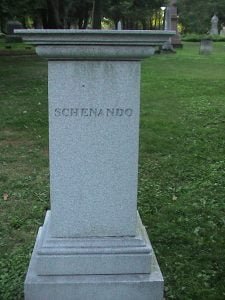
Grave of Oneida Chief Skenandoah

The grave of Oneida Chief Skenandoah, located at Hamilton College in Clinton, New York, marks the resting place of a significant figure in Iroquois and American history. Skenandoah, known for his alliance with American forces during the Revolutionary War, was a vocal advocate for his people, warning them against the dangers of alcohol and advocating for their rights. He died in 1816 at the age of 110, and his remains were reinterred in 1856 beside his friend, Samuel Kirkland, with a monument dedicated in 1873.

Red Jacket Monument, Forest Lawn Cemetery, Buffalo, New York

Red Jacket, Sagoyewatha, or Keeper Awake

The Red Jacket monument at Forest Lawn Cemetery in Buffalo, New York, commemorates a prominent Seneca leader known for his powerful oratory. His notable speech to missionary Cram in 1805 highlighted the plight of Native Americans, criticizing the encroachment of white settlers who sought to impose their religion and values. Red Jacket eloquently articulated the changes inflicted upon his people and the loss of their land, emphasizing the importance of their own beliefs. He passed away in 1830, later interred in the cemetery with other notable Senecas.

Monument to Kaniatario, Handsome Lake, at Onondago Reservation

Handsome Lake, born Kaniatario in 1735 in Conawagus, became a significant Iroquois prophet after a transformative near-death experience. Initially a heavy drinker, he fell ill and, following a profound vision, dedicated his life to teaching morality and sobriety to his people, condemning alcohol as destructive. His teachings fostered harmony and industriousness among the Seneca. He died on August 10, 1815, at Onondaga, where a monument now honors his legacy as a pivotal figure in the spiritual and moral rejuvenation of the Iroquois.

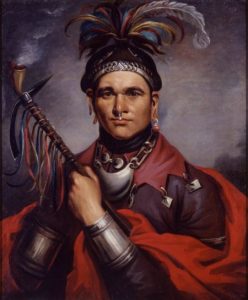
Kaiiontwa-Ken, Cornplanter

Chief Cornplanter

Cornplanter, born John OBail around 1732 in Conewaugus, was a significant chief of the Seneca tribe. His leadership was crucial in preventing a Seneca attack on General Wayne’s forces during the American Revolution, which historians credit as a service to the United States. Representing his people in Philadelphia in 1790, he confronted President Washington about injustices faced by the Senecas. Although he signed treaties viewed as betrayals by his tribe, he later returned to traditional ways. Cornplanter passed away in 1836, honored by a state-erected marker acknowledging his contributions.