History of Blaine Washington, 1884-1959
Pioneers of peace - diamond jubilee anniversary, Blaine, Washington, 1884-1959

“History of Blaine Washington, 1884-1959” offers a comprehensive and engaging exploration of Blaine, Washington’s rich history and cultural heritage. Published in 1959 to commemorate the diamond jubilee of Blaine, this book captures the essence of a community that has thrived on the principles of peace and cooperation. Situated in Whatcom County, Blaine’s unique geographical location near the Canadian border plays a pivotal role in its identity, an aspect vividly illustrated through the symbol of the International Peace Arch.

St. Charles County’s Participation in the World War

St. Charles County's Participation in the World War

Soon after World War 1 localities across the country wished to honor the men and women who had served the Nation from their locality. St. Charles County, Missouri, is one of these counties. This manuscript isn’t limited to just the men who fought overseas, it also includes the women who had participated via Red Cross and the men who had actively served in the various campaigns backing the War here at home.

Kansas Registrations of Enemy Aliens, 1917 – 1921

Enemy Alien Registration Affidavit for Bernhardt Vick - Cropped Photo

The series contains original affidavits of registration that record personal information about each registrant, their photograph affixed to the majority of documents, and the registrants fingerprints. All of these are specific to Kansas, and most have the actual documents attached.

The Mudd Family of Prairie du Rocher Illinois

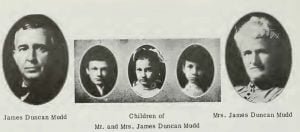
Family of James Duncan Mudd

James Duncan Mudd, a notable farmer in Prairie du Rocher, descends from one of Randolph County’s oldest settler families, whose roots trace back to 1633 in Maryland. The Mudds migrated through Kentucky, where his great-grandfather, Francis Mudd, served in the War of 1812 before settling in Illinois. James T. Mudd, his father, expanded the family farm, ultimately cultivating 380 acres. James Duncan Mudd, born in 1862, has continued this legacy, now owning 440 acres and contributing significantly to his community and Church.

The Eichenseer Family of Prairie du Rocher Illinois

Mr. and Mrs. Joseph Eichenseer

The Eichenseer family, originally from Madonnaville, Monroe County, Illinois, has deep roots in agriculture. John Eichenseer, born in 1863, married Mary Wierschem in 1890 and raised ten children on their 80-acre farm. His brother, Joseph, born in 1870, married Mary Vogt, having three sons on a 100-acre farm. Meanwhile, George Eichenseer, born in 1878, also managed a farm and married Mary Anna Hoef, with one son. The family is recognized for their contributions to local farming and community life.

History of St. Joseph Church Prairie du Rocher Illinois

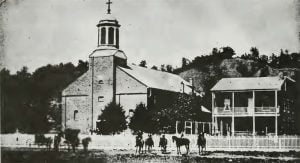
St. Joseph's Church and Rectory as originally built in 1858 and 1868 respectively

St. Joseph Church in Prairie du Rocher, Illinois, was established in 1722 as a chapel linked to the church of Ste. Anne at Fort Chartres. Following the founding of Fort Chartres in 1718 by Pierre Duque Boisbriant, the local community built a log chapel for the French settlers. Over time, the church gained prominence as Ste. Anne fell into disrepair, becoming a key parish for the French in the region. The current Romanesque church structure dates from 1858, embodying the parish’s rich history and cultural heritage.

Biography of William H. Vogt, M. D.

Dr. William H. Vogt, born on September 9, has practiced medicine in St. Louis for over 40 years. A graduate of Missouri Medical College in 1878, he specialized in women’s diseases after completing postgraduate studies in Europe. He has held positions in various medical associations and universities, authored articles, and contributed to medical texts. Married to Edna Jeanette Nichols, they have one son. Dr. Vogt is actively involved in the community and holds memberships in several organizations, maintaining a focus on his medical practice.