History of Rindge New Hampshire

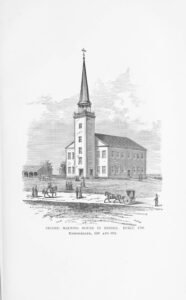
Second Meeting House in Rindge New Hampshire

The History of the Town of Rindge, New Hampshire by Ezra S. Stearns, was published in 1875, and covers the period from the original Rowley Canada grant or Massachusetts charter through the year 1874. Stearns traces the legal, territorial, and institutional development of Rindge, beginning with colonial land grants and boundary disputes and proceeding through settlement, incorporation into a town and development into a small manufacturing hub. More than half the volume is devoted to genealogical material. The genealogical register of Rindge families includes thousands of names compiled from a wide range of sources and assisted by contributions from residents and researchers beyond the town.
Abbot Family of New England

A genealogical dictionary of the first settlers of New England vol 1

The Abbot family of New England, traced in James Savage’s genealogical work, includes notable figures such as Arthur Abbot, who settled in Marblehead around 1634 and had a son, Philip. Several generations followed, with families established in towns such as Ipswich, Andover, and Cambridge. Many Abbots contributed to early colonial life, engaging in various trades and civic duties. The family’s legacy persists, with descendants continuing to thrive across New England into the 19th century.

Charlton Massachusetts Warnings 1737-1788

Worcester County MA Warnings

The document lists names and details of individuals warned out of Charlton, Massachusetts, from 1737 to 1788, as recorded by the Court of Quarter Sessions. The practice originated from a 1692-3 act aimed at preventing dependence on towns for support from newcomers not warned out. The entries, organized by date, include families and individuals regardless of their economic status, indicating that warnings were not exclusively for the impoverished. Notable entries span decades, featuring numerous families and diverse circumstances.