
Guion Miller Miscellaneous Testimony, Pages 31-40
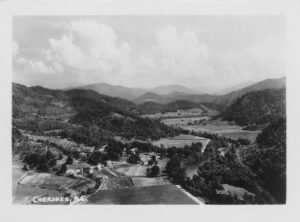
1930s Valley of the Eastern Cherokee Reservation in North Carolina

Pages 31–40 of Guion Miller miscellaneous testimony document sworn statements from Eastern Cherokee applicants and witnesses in North Carolina and Virginia. The records cover claimed Cherokee ancestry, family lines, residences, prior enrollment attempts, and community recognition, with testimony from William P. Doby, Charley Doby, Edmond E. Kingsbury, Edward W. Stanly, Thena C. Holinsworth, John W. White, Joseph B. White, Charles Greenwood, Hanna Moore, Easter Stuart, Anna Reeves, John W. Booth, and Ben Booth.
Guion Miller Miscellaneous Testimony, Pages 21-30

1930s Valley of the Eastern Cherokee Reservation in North Carolina

Pages 21–30 of Guion Miller miscellaneous testimony document sworn statements from Eastern Cherokee applicants and witnesses in North Carolina and Virginia. The records cover claimed Cherokee ancestry, family lines, residences, prior enrollment attempts, and community recognition, with testimony from Lulu Clark, Benjamin Baker, William Whit, William Coleman Revels, Mickey Ann Hanks, Robert D. Harris, John A. Poore, George W. Thore, and Roxey J. Wall.

Guion Miller Miscellaneous Testimony, Pages 11–20

1930s Valley of the Eastern Cherokee Reservation in North Carolina

Pages 11–20 of the Guion Miller miscellaneous testimony record sworn statements from Eastern Cherokee applicants and relatives in North Carolina and South Carolina. The pages document claimed Cherokee ancestry, family connections, slavery, residences, and prior enrollment history for applicants including the Scales, Garrett, Jennings, Stafford, Hastings, Sawyer, Lash, Hauser, and Bitting families.

Guion Miller Miscellaneous Testimony, Pages 1-10

1930s Valley of the Eastern Cherokee Reservation in North Carolina

Transcriptions of Guion Miller miscellaneous testimony pages 1–10 from the 1906–1908 Eastern Cherokee payment applications, featuring sworn statements on claimed Cherokee ancestry, family connections, residences, slavery status, and prior enrollment attempts. Includes testimony from applicants in North Carolina communities such as Winston-Salem, Tobaccoville, Donnaha, Bethania, and East Bend, with original images and transcriptions.

Meadows High School, Meadows North Carolina, Yearbooks

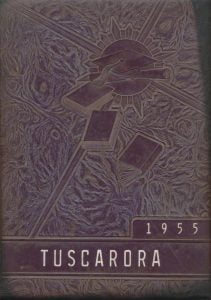
1955 Tuscarora Yearbook

These are high school yearbooks for Meadows, Stokes County, North Carolina. If your ancestor attended Meadows High School during the years of 1941-1966 then the following yearbooks may have a photograph of them. This is part of a collection of yearbooks being placed online by the Benson Museum of Local History.

Biography of James Moore

James Moore, born on August 13, 1844, in Stokes County, North Carolina, is a prominent farmer and influential figure in Reynolds County, Missouri. He owns 284 acres of land, earned through diligent management and industry. A Union Army veteran, he served as a bugler during the Civil War before marrying Catherine Copeland in 1869, with whom he had six children. Known for his charitable contributions and active participation in politics as a Republican, Moore is also a Mason and helped establish the Barnesville Masonic Lodge.

Harvey N. Wilkins

Private M. G. Wilkins, of the 30th Division, 119th Regiment, hailing from Stokes County, enlisted on September 20, 1917. After training at various camps, he sailed for France on May 28, 1918. He served on the Ypres Front and participated in key battles such as Bellicourt and Busigny. Wilkins returned to the United States on April 2, 1919, and was mustered out at Camp Jackson on April 7, 1919.

Rufus C. Solomon

Sergt. Rufus C. Solomon served in the Engineers, Co. E, 30th Division, beginning his military career in June 1916. After various transfers, he sailed to Europe in June 1917 and participated in significant battles in Belgium and France throughout 1918. Solomon endured constant shelling and was slightly gassed, requiring hospitalization for eight weeks. He returned to the United States in April 1919 and was mustered out at Camp Jackson, South Carolina, later that month.

Manon S. Nunn

Corporal Manon S. Nunn, of Company E, 118th Infantry in the 30th Division from Stokes County, served during World War I. He entered military service on June 5, 1917, at High Point, North Carolina, and was sent to Camp Sevier before deploying to France on May 24, 1918. He was wounded on October 9, 1918, at the Hindenburg Line and subsequently treated in England. Nunn returned to the U.S. and was mustered out at Camp Jackson on March 31, 1919.

William J. McAnally

1st Lt. William J. McAnally, born April 16, 1873, in Stokes County, served in the Medical Corps during World War I. He entered service on June 1, 1917, at Ft. Oglethorpe, Georgia, and was transferred to Camp Greene’s Base Hospital. Due to family illness, he resigned in December 1917 but later sought reinstatement and was recommissioned as Captain on October 12, 1918.

W. D. Lemons

Wagoner W. D. Lemons served in the Medical Corps as part of the Ambulance Company 321 with the 81st Division during World War I. Hailing from Stokes County, he entered service in 1918 and trained at various camps before deploying to France in July of that year. He participated in combat at Meuse-Argonne and St. Die, and later spent four months at a university in Clermont, France. Lemons returned to the United States on July 23, 1919, and was mustered out at Camp Lee on July 28.

Herbert R. Jones

Sergt. A. G. D., a native of Stokes County and son of G. A. Jones, enlisted in the military on August 25, 1918, at Walnut Cove, North Carolina. He served initially at Camp Jackson, South Carolina, before being transferred to Camp Sevier, South Carolina. His service concluded with his muster out at Camp Sevier on March 25, 1919.

N. F. Hall

Corporal N. F. Hall, a member of Co. F, 81st Division, 322nd Regiment from Stokes County, entered military service on September 20, 1917. He trained at Camp Jackson and Camp Sevier before being sent to France on July 31, 1918. Promoted to corporal in June, he fought at the Meuse-Argonne offensive and was wounded on November 9, 1918. Hall was hospitalized before returning to the United States on February 12, 1919, and was mustered out at Camp Lee, Virginia, on March 3, 1919.

Winfred O. Carroll

Winfred O. Carroll served as a mechanic in Company A of the 322nd Infantry Regiment, 81st Division. The son of Mr. and Mrs. J. T. Carroll from Stokes County, he entered military service on October 5, 1917. He trained in South Carolina before deploying to France on August 11, 1918. Carroll participated in the Meuse-Argonne offensive and was gassed near Verdun, requiring treatment at a field hospital. He returned to the U.S. on June 18, 1919, and was discharged on June 25, 1919.

The Sara Indians

The Sara Indians, likely of Siouan origin, were known to inhabit areas between South Carolina and North Carolina during early European exploration. Their name possibly derives from the Catawba term for tall grass. Documented encounters with Spaniards began in 1540, leading to their eventual integration with the Catawba tribe. By the 18th century, they were known as the Cheraw, primarily residing along the upper Pedee River in South Carolina, before declining in number due to conflict and disease.