The Natchez

On February 11, 1700, explorers led by De Iberville reached Natchez, welcomed by a chief and his warriors. The Natchez were known for their sacred practices, including a temple that housed a perpetual fire and involved ritual sacrifices in times of crisis. Their society was structured around the Great Sun, a pivotal figure in their worship and governance. As they traversed the Mississippi, explorers documented their customs, including festivals aligned with lunar cycles and the poignant traditions of life and death, marking the Natchez as a significant nation in early American history.
Mound Builders

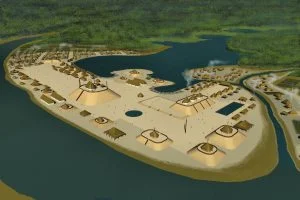
Bottle Creek Mounds

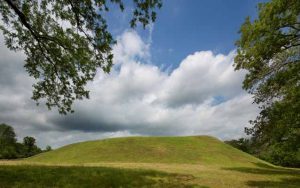
The post discusses the connection between ancient mounds in North America and the indigenous tribes, refuting the notion that these structures were built by a distinct race known as the Mound Builders. Evidence presented includes similarities in skull structure among various tribes and the fortified nature of their towns. Early European explorers observed these communities engaged in agriculture and crafting, challenging the idea of indigenous nomadism. The author argues that the mounds are the work of Native Americans, the true ancestors of today’s tribes, and emphasizes the importance of understanding their legacy.

Indian Mounds in Natchez, Mississippi

Emerald Mound, Natchez Trace Parkway

On May 18, 1838, a group from Natchez, Mississippi, explored two square mounds near the Mississippi River, measuring up to 16 feet high. Excavations revealed human bones and various pottery artifacts. Later, a larger mound east of Natchez was examined, showcasing impressive dimensions and architectural design, likely crafted by ancestral Native Americans. This massive structure, featuring a significant tower, underscored the sophisticated construction techniques of prehistoric cultures, while artifacts unearthed hinted at a rich, albeit unrecorded, history.

The Creation of an Indian Mound

Luthor List Mound

Garcellasso de la Vega notes that American Indian communities began town planning with the construction of mounds for chiefs and warriors, creating a social hierarchy. Mounds served both as living quarters and defensive structures, with evidence of such constructions spanning centuries. The Natchez Indians, for example, built extensive mounds in Louisiana for protection against the French. Excavations of these mounds reveal human remains alongside artifacts, illustrating the cultural practices surrounding death and memorialization among Native American tribes, such as the Choctaws, who honored their deceased with intricate burial customs.

Natchez Trace

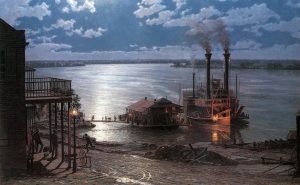
Natchez Under the Hill

In 1792, a treaty with the Chickasaw at Chickasaw Bluffs established the Natchez Trace, a significant route connecting Nashville to Natchez. Initially a thoroughfare for emigrants, it soon became infamous for outlaws like Mason and Murrell, who preyed on travelers. Despite efforts to capture these bandits, they eluded authorities until betrayal led to Mason’s demise. The Trace witnessed both lawlessness and camaraderie among its diverse users, ultimately fading from memory as it transformed into farmland, overshadowed by the bustling growth of nearby settlements.

The French In Alabama And Mississippi

History of Alabama and incidentally of Georgia and Mississippi, from the earliest period

Following nearly a century and a half of European absence after De Soto’s invasion, French explorers, including Father Marquette and La Salle, began to navigate and document the Mississippi River. Their efforts established ties to France’s colonial ambitions, leading to the founding of Louisiana in honor of Louis XIV. As Iberville and his brothers pursued further colonization in the early 18th century, they faced challenges such as famine, conflicts with Indigenous tribes, and political strife among settlers. Ultimately, these factors severely impacted the colony’s stability and growth in Alabama and Mississippi.

Slave Narrative of James Lucas

James Lucas, an ex-slave born in 1833, recounts his life under various masters, including Jefferson Davis. He describes his experiences in slavery, the roles of both kind and cruel masters, and the limited freedoms post-Civil War. Lucas discusses the transition to freedom, noting the hardships faced, including poverty and disease. He reflects on the relationships with his fellow slaves, the impact of the war, and the challenges of adjusting to freedom. Now elderly, he lives alone, reminiscing about a life filled with both difficulty and moments of joy.

Slave Narrative of Charlie Davenport

In this interview, Charlie Davenport recounts his life as a slave on Gabriel Shields’ plantation in Natchez, Mississippi. Born shortly before his mother’s death, he shares fond memories of childhood, camaraderie, and traditional foods. Despite experiencing hardships, he describes good treatment from his master and his eventual decision to stay on the plantation post-Civil War, valuing stability over freedom. Davenport reflects on the complexities of the war, the challenges of emancipation, and social changes, highlighting the lingering ties between former slaves and their white families.

Slave Narrative of Isaac Stier

Isaac Stier, born into slavery in Jefferson County, Mississippi, recounts his life under Marse Jeems Stowers’ plantation. He shares experiences of being cared for during illness, enjoying festive occasions, and the hardships faced during the Civil War, particularly at Vicksburg. Although he fought alongside his master, post-war life proved challenging, as freedom did not bring the expected improvements. Stier reflects on the kindness of his former masters, the unpredictability of the Klan, and the struggles of his later years, expressing a longing for simpler times.

Slave Narrative of Celia Henderson

Celia Henderson, born in 1849 in Hardin County, Kentucky, recalls her early life shaped by slavery. Her mother, a skilled cook, was sold to settle a debt, leading the family to Natchez, where they lived and worked. Celia, who helped with chores from a young age, shares memories of community gatherings and herbal remedies from her mother. Now 88, she reflects on her family history, including her own struggles with aging and the transition from enslavement to a life of limited means in Ohio.

Slave Narrative of Bob Maynard

Bob Maynard, a 79-year-old former slave, recounts his childhood in Marlin, Texas, where he served his master’s household. Describing life on the plantation, he highlights the large colonial-style home, the duties he performed, and the harsh realities of slave life, including the threat of patrollers. Maynard reflects on the Civil War and the eventual freedom offered by his master. He recalls Abraham Lincoln’s visit and expresses mixed feelings toward Confederate leaders. After the war, Maynard describes gradual freedom and his family life, noting he has 19 children and several grandchildren.

Natchez Tribe

The Natchez Indians were a prominent tribe historically located near St. Catherines Creek in modern-day Mississippi. Originally numbering around 6,000 in the late 17th century, they engaged in multiple conflicts with the French, culminating in their decline after a devastating war in 1729. While many Natchez were killed or enslaved, survivors dispersed among other tribes, maintaining their distinct language and culture. The tribe was known for its agricultural lifestyle, advanced arts, and unique societal structure, including a powerful chief and ritualistic practices centered on sun worship.

Natchez Indians

The Natchez Indians, the largest tribe in a group that included the Taensa and Avoyel, lived along St. Catherines Creek near present-day Natchez. Known for their monarchical government and the practice of human sacrifice accompanying their Sun caste members in death, they were first documented by explorers in the 16th century. Hostilities with the French led to war and eventual upheaval. Despite significant population declines, remnants of the Natchez culture persist among descendant tribes, particularly among the Cherokee and Creek.