1851 Siler Roll: Eastern Cherokee

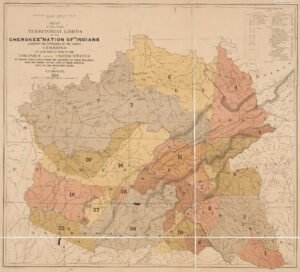
Map of Cherokee Land Cessions

The 1851 Siler Roll is a key genealogy resource for tracing Eastern Cherokee families who remained east of the Mississippi after the Trail of Tears. Compiled to identify those eligible for a federal per-capita payment, it lists households, family groupings, residences, ages, and relationships, but it is incomplete and should be used with the later Chapman Roll.

The Seminole War of 1816 and 1817 – Indian Wars

colonel clinch

In the aftermath of the War of 1812, British agents Edward Nicholls and James Woodbine rallied Indigenous and Black groups in Florida to challenge U.S. expansion. They fortified a stronghold that Colonel Clinch besieged, resulting in the fort’s destruction and a significant enemy casualty count. Following further conflicts and the rise of General Jackson, who captured key territories, the U.S. ultimately took control of Florida in 1819, resolving lingering tensions with Spain and concluding the Seminole War for the time being.

Biography of George W. Osburn, M. D.

George W. Osburn, M.D., born on November 15, 1841, in Gwinnett County, Georgia, pursued a career in medicine after initially working as a carpenter. A veteran of the Confederate service, he relocated to various cities before settling in Douglas County, Missouri, in 1871. There, he built a successful medical practice and became a prominent figure in the community. Married to Mary E. Gilliland in 1872, they had five children. Osburn was also politically active, serving as coroner and maintaining a Republican affiliation.

Biography of Hon. Melvin Nathaniel Dyer

Hon. Melvin Nathaniel Dyer, born in 1833 in Georgia, emerged as a prominent lawyer in Baxter County, Arkansas. The son of an eminent Baptist minister, Dyer served in the Confederate Army during the Civil War before pursuing law. A Mercer University graduate, he practiced in Georgia before relocating to Arkansas in 1870. Elected as prosecuting attorney for the Third Judicial District from 1882 to 1886, Dyer, a committed Mason and Baptist, contributed significantly to his community and the establishment of the Baptist College of Mountain Home.

Biography of George W. McCarty

George W. McCarty, born February 10, 1845, in Gwinnett County, Georgia, has been a Taney County resident since 1879. The eldest of six siblings, he comes from a family with strong community ties and values. A self-educated farmer, he owns a 330-acre farm and is respected for his agricultural success. Married twice, he is a Democratic politician, a Mason, and a committed member of the Missionary Baptist Church. His contributions to the county and community reflect his dedication and hard work.

Native American History of Gwinnett County, Georgia

Gwinnett County, Georgia, bordered by five counties and home to over 800,000 residents, has a rich Native American history. The region was inhabited by various indigenous peoples for thousands of years, including the Kataapa, Shawnee, and Creek tribes. Early inhabitants engaged in advanced agricultural practices, established trade routes, and built villages. The county was particularly influenced by Muskogean culture. Following European contact, Native populations suffered significant decline due to disease and displacement, culminating in the cession of their lands by the Creek Confederacy in the early 19th century.

Biography of John Rogers

John Rogers, born in Bullock County, Georgia, in 1774, was a significant figure in early Oklahoma development. He embodied benevolence and integrity, generously supporting the needy and contributing to education and religion. A veteran of the War of 1812, he earned commendations for his bravery, including a dangerous courier mission. Rogers raised a large family, with several of his children becoming notable individuals. His life reflected strong moral values, hospitality towards Native Americans, and dedication to both family and community.