
Prayer We Will Give . . . and often

In April 2010, the author found temporary shelter in a cabin in the Tuskeegee community of Graham County, North Carolina, after experiencing homelessness. He discovered that the area contained significant Creek history, with many local place names having Creek origins, despite locals believing in a solely Cherokee narrative. While pursuing archaeological insights, he faced skepticism from residents and law enforcement, who circulated false rumors about him. His living conditions deteriorated when the cabin’s owners faced foreclosure, culminating in eviction and the loss of his belongings, forcing him back to homelessness.
Tuskegee Indians

The Tuskegee Tribe, with an uncertain name possibly linked to the term “taska,” meaning warrior, was originally located near the Coosa and Tallapoosa Rivers and also on the upper Tennessee River. Historically, they appear in records as early as 1540 with references to settlements named Tasqui and Tasquiqui. The Tuskegee divided into bands, one eventually merging with the Cherokee, while another settled in present-day Alabama. Their name remains significant in locations such as Tuskegee, Alabama, known for the Tuskegee Normal and Industrial Institute.

Cherokee Tribe

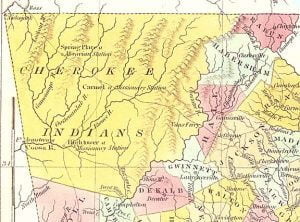
1830 Map of Cherokee Territory in Georgia

The Cherokee, a significant tribe of the Iroquoian family, historically occupied regions in the southern Alleghenies and claim ancestral ties to various groups, including the Choctaw. Their language comprises three main dialects, with the upper dialect prevalent in literature. Following initial European contact in 1540, the Cherokee engaged in conflicts with settlers and adapted a government reflecting U.S. models. They faced forced removal in 1838, enduring significant hardships, yet later reorganized. The tribe comprises various clans and has seen fluctuating population numbers throughout history.

Tuskegee Tribe

Robert Seale Map

The Tuskegee Indians, historically located near the confluence of the Coosa and Tallapoosa rivers, spoke a distinct dialect different from Muskogee. As European settlers encroached in the 17th century, the Tuskegee fragmented into several bands, with some absorbing into the Cherokee. Their settlements were marked on early maps, and references indicate their presence on the Tennessee River and surrounding areas. Over time, this tribe’s cultural and linguistic identity diminished, leading to their eventual migration and assimilation with nearby tribes, particularly the Creeks.

Cherokee Indians

The Cherokee Indians, whose name origins are uncertain, are historically significant Native Americans predominantly residing in the southern Appalachian region. They speak an Iroquoian language and were divided into three dialect groups linked to separate settlements in Tennessee and neighboring states. The tribe has a complex history marked by early contact with European settlers, significant migrations, and cultural adaptations, such as the creation of a written language by Sequoya. Over time, they faced numerous challenges, including disease and forced removal, yet they have maintained a notable cultural and historical presence.