
The Cox family in America

The Cox family in America

Two volumes of Cox family genealogy combined as one. The first volume contains information about the various early Cox families across America. The second volume deals specifically with the descendants of James and Sarah Cock of Killingworth upon Matinecock, in the township of Oysterbay, Long Island, New York.
Act of October 15, 1748

The Act of October 15, 1748, establishes legal protections for the Tuscarora Indians regarding their land in Bertie County, North Carolina. It confirms the boundaries of their territory, prohibits encroachments by English settlers, and nullifies any land purchases made from the Indians. The act mandates the removal of non-Indians from these lands by a specified date, imposes penalties for violations, and addresses issues related to livestock on Tuscarora lands. These measures aim to ensure the community’s right to occupy their ancestral territory peacefully.

Bertie County, North Carolina – Wills 1761-1799

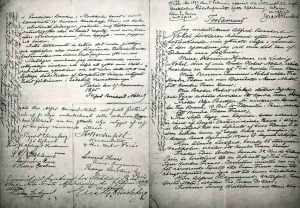
Sample Last Will and Testament

These abstracts were made on all Bertie County, North Carolina Wills dating from 1761-1799. The information contains the year of the will, the individual who wrote the will, and any family members mentioned in the will.

Saponi Indians

The Saponi Indians, a Siouan linguistic tribe closely related to the Tutelo, likely originated from the term Monasiccapano, meaning “shallow water.” They are historically associated with villages along the Rivanna River in Virginia. Over time, they migrated to Otter Creek and later to the junction of the Staunton and Dan Rivers while fleeing Iroquois attacks. By the 18th century, part of the Saponi moved north to Pennsylvania, while others remained in North Carolina, where they eventually merged with neighboring tribes. Their population dwindled over the centuries, with reports indicating only small numbers by the mid-1700s.

Chowanoc Indians

The Chowanoc Indians, part of the Algonquian linguistic family, inhabited the Chowan River area in northeastern North Carolina. Known for their prominence around 1584-85, they were a leading tribe with a population of about 1,500. The Chowanoc entered a treaty with the English in 1663 but faced decline after warfare and reduced land. By 1755, their population dwindled to just five individuals. Their legacy endures in the names of the Chowan River and Chowan County.

William M. Sutton, Jr.

William M. Sutton, Jr. enlisted in the military on August 5, 1918, in Windsor, North Carolina. He completed his initial training at Camp Wadsworth, South Carolina, before being sent to France. Sutton attended Officer Training Camp at Fort Oglethorpe, Georgia, for two months and served as a flying cadet in aviation. He was mustered out of service at Camp Lee, Virginia, on May 1, 1919.

J. V. Roane

Private J. V. Roane, born August 16, 1894, in Bertie County, North Carolina, served in Company L of the 117th Infantry, 30th Division during World War I. He enlisted on March 29, 1918, training at Camp Jackson and Camp Sevier before deploying to France on July 3, 1918. Roane participated in significant battles, including the Hindenburg Line and Bellicourt. He returned to the United States on March 1, 1919, and was mustered out at Fort Oglethorpe, Georgia, on April 16, 1919.

Thomas N. Peele

1st Sergeant of Engineers, Company B, Thomas N. Peele was born in Bertie County to Mr. and Mrs. Jackson Peele. He enlisted on May 27, 1917, at Lewiston, North Carolina, trained at Camp Jackson, South Carolina, and departed for France on September 14, 1918. Peele achieved the rank of 1st Sergeant in February 1919 and returned to the United States on July 4, 1919, before being discharged at Camp Jackson on July 14, 1919.

S. J. Fore

S. J. Fore, a Regt. Supply Sergeant in the 321st Regiment of the 81st Division, hailed from Bertie County, North Carolina. He was born to John A. and Sallie A. Fore and was married to Ethel Gattis. He enlisted on October 4, 1917, served at Camp Jackson and Camp Sevier, and sailed for France on August 17, 1918. Fore participated in key battles, including St. Die and the Meuse-Argonne offensive, returning to the United States on June 20, 1919, and mustering out a week later.

P. B. Davis

Private P. B. Davis, a member of the 13th Company from Bertie County, was the son of James A. and Mrs. Elnora Davis. He entered military service in August 1918 in Windsor, North Carolina, and was subsequently stationed at Camp Greene, North Carolina. Davis completed his service and was mustered out at Camp Greene in December 1919.

B. L. Cloniger

M. G. Cook, born in Bertie County to Mr. and Mrs. J. J. Cobb, enlisted in the military on June 22, 1918, at Windsor, North Carolina. He was assigned to Camp Hancock, Georgia, where he was promoted to Cook on June 25 and later to Mess Sergeant in August. Cook was discharged from service at Camp Hancock on December 27, 1918.

E. G. Cherry

Private 1st Class E.G. Cherry served in the Anti-Aircraft Battery of the 7th Regiment, hailing from Bertie County. The son of Sol and Mrs. E. W. Cherry, he married Annie May Sutton Cherry. He entered military service on May 5, 1917, in Windsor, N.C., was stationed at Ft. Caswell, and sailed to France on June 19, 1918. Cherry fought in key battles including St. Mihiel and Argonne, returning to the U.S. on March 7, 1919, and was mustered out on March 25, 1919, at Camp Lee, Virginia.

Sol Cherry

Corporal Sol Cherry, born on May 20, 1892, in Bertie County, enlisted in the military on May 4, 1917. After initial training at Ft. Caswell, he deployed to France on June 9, 1918, where he participated in key battles including Lorraine, the Toul Sector, the St. Mihiel offensive, and the Meuse-Argonne offensive. Promoted to Corporal on December 18, 1917, he returned to the United States on March 8, 1919, and was mustered out at Camp Lee on March 24, 1919.

William S. Bell

Private 1st Class William S. Bell served in Company H, 30th Division during World War I. Born in Bertie County to N. B. and Sarah Bell, he was married to Cassie Bryant. Bell entered service on June 25, 1917, at Roxobel, N.C., and was promoted to 1st Class Private by August. He fought in the Hindenburg Drive, where he was wounded by shrapnel on September 29, 1918. He returned to the U.S. on April 13, 1919, and was discharged on April 18, 1919.

Saponi Tribe

The Saponi were an eastern Siouan tribe originally from North Carolina and Virginia, now extinct. Historically linked with the Tutelo, their language and culture showed strong similarities. The tribe faced conflicts with Virginia settlers and moved frequently to escape enemies, ultimately settling near Roanoke and later in North Carolina. By the mid-18th century, they allied with the Cayuga and were documented living in Pennsylvania and New York. The last historical mentions suggest a remnant existed with the Cayuga, after which their fate remains unknown.

Laws of North Carolina 1827-1831

The North Carolina General Assembly enacted legislation concerning the sale of lands formerly occupied by the Tuscarora tribe in Bertie County. Appointing commissioners to oversee the sale, the act outlined procedures for advertising and selling the land, while respecting the existing lease with the Tuscarora. Proceeds from the sale were to be held for the tribe, and if the land were to go unsold, commissioners were instructed to report to the public treasurer. The complexities of land ownership and disputes involving other tribes were referenced, indicating ongoing challenges in tribal land negotiations.