Descendants of George and Maturin Ricker
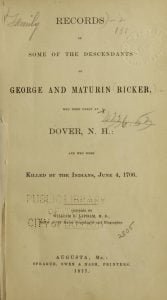
The descendants of two brothers, George and Maturin Ricker of Dover NH who’s descendants resided principally in New Hampshire and Maine.

The descendants of two brothers, George and Maturin Ricker of Dover NH who’s descendants resided principally in New Hampshire and Maine.
Marcus A. Low, born in 1842 in Maine, emerged as a key figure in Kansas through his diverse accomplishments in law, ranching, and oil development. Notably, he gained lasting recognition as a railroad builder, significantly enhancing transportation in the region. After moving to Topeka in 1887, he played a vital role in the city’s park system and served as general attorney for the Chicago, Rock Island and Pacific Railway. A steadfast Republican, Low was active in civic life and public service until his retirement in 1912.
Professor John W. Daniels, born in England in 1846, became a pivotal figure in establishing Boise’s public-school system. After immigrating to America as a child, he excelled academically and pursued teaching while furthering his education at Bates College. Upon moving to Boise in 1881, he organized the city’s nascent school system, significantly enhancing its quality and ensuring it became one of the best in the region. Renowned for his enthusiasm and discipline, Daniels also briefly practiced law before returning to education, demonstrating unwavering dedication to his students’ growth.
Charles B. Mitchell, born on October 9, 1870, in Brunswick, Maine, has established a successful legal practice in Miami, despite being a relatively recent addition to the bar. He has also made his mark as a writer, contributing to various magazines. After pursuing a career in journalism and the Presbyterian ministry, he returned to law, practicing in Oklahoma and Kansas before settling in Miami. Known for his eloquence and thorough preparation, Mitchell actively participates in community development and enjoys a cultured life enriched by literature and travel. He is married to Jessie F. Matthews.
Albert A. Newman, originally from Maine, has been a significant figure in Kansas since 1868, primarily in Arkansas City, where he played a pivotal role in its development. Arriving in 1870, he established a prosperous dry goods enterprise, later becoming the president of Newman Dry Goods Company, recognized as the largest department store in the region. He also contributed to local banking and utilities, founding several corporations. As a dedicated community leader and two-term mayor, Newman’s influence extended across business, industry, and civic engagement, shaping the economic landscape of Southern Kansas.
The Arosaguntacook Indians were part of the Abnaki confederacy, residing along the Androscoggin River in present-day Maine. Their village shared the same name and faced significant hardships due to conflicts with early English settlers. The tribe, engaged in various wars from 1675 until their relocation to Canada, saw their village destroyed in 1690. They eventually merged with other tribes and relocated to St. Francis, Canada, where they remained significant, with their dialect becoming predominant among the inhabitants.
John E. Cutter, born in 1844 in Maine, faced early loss with the deaths of his parents. He served as a soldier in the Civil War, rising from private to sergeant, and participated in key battles in the Shenandoah Valley. After the war, he became an educator, moving to Minnesota before settling in Riverside, California, in 1878. There, he became a prominent horticulturist, founding a nursery business and contributing to local education and community efforts. He married Annie L. Dinsmore, and they have one daughter.
Dr. Clark W. Sylvester, born in 1850 in Lawrence, Massachusetts, rose from humble beginnings to become a prominent citizen in Riverside, California. Educated through a combination of hard work and determination, he pursued dentistry, graduating from Harvard. After a challenging start, he relocated to Riverside in 1883, establishing a successful dental practice. Sylvester became influential in local real estate and various business ventures, including the Riverside Heights Water Company. A devoted family man, he credited much of his success to the support of his wife, Mary Abbie Davis.
George W. Garcelon, born in New Brunswick in 1832, became a prominent figure in Riverside, California, after moving there in 1872. Initially a successful druggist in Maine, he shifted focus to horticulture, cultivating citrus and deciduous trees and contributing to Riverside’s early citrus industry. He played a critical role in establishing the Citrus Fair Association in 1877 and developed innovative lemon-curing methods that improved local competitiveness. Garcelon was also active in local politics and community organizations, reflecting his deep commitment to Riverside’s growth and development.
Whitman Howard Jordan has served as the director of the New York Agricultural Experiment Station in Geneva since 1896. Born on October 27, 1851, in Raymond, Maine, to James and Sarah Jordan, he gained extensive agricultural knowledge while assisting his father before pursuing higher education. He held several academic positions and discovered significant advancements in scientific cultivation. Although he maintains a commitment to public welfare and Republican ideals, he prefers focusing on his professional endeavors over political aspirations. He married Emma Louise Wilson in 1880.
Henry Hill Couillard, born in 1828 in Exeter, Maine, led a life filled with adventure and change. His experiences spanned the Mexican War, the African slave trade, and gold mining in California, before transitioning to a successful career in the hotel industry and farming. Starting with humble beginnings, he owned over twenty-five hotels across New England and became a prominent cattle raiser. Couillard’s remarkable journey from impoverished youth to esteemed entrepreneur earned him widespread respect and admiration. He passed away in 1905.