
American Horse.
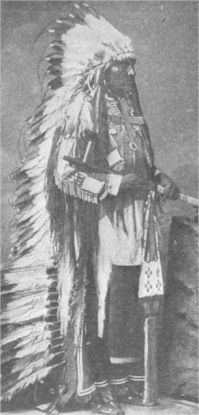

An Oglala Sioux chief, known in his tribe as Wasechun-tashunka.
He was probably the son or nephew of the American Horse who went out with Sitting Bull in the Sioux war and was killed at Slim buttes, South Dakota, Sept. 29, 1875. As speaker for the tribe he signed the treaty secured by the Crook commission in 1887, by which the Sioux reservation in Dakota was reduced by one-half. Nearly half the tribe objected to the cession, alleging that the promises of the commissioners could not be depended oil, and the malcontents, excited by the messianic craze that had recently reached the Sioux and by the killing of Sitting Bull, its chief exponent among them, in 1890, withdrew from the council and prepared to fight the Government. The expected benefits of the treaty proved illusory.
While the tribe were gathered at the agency to treat with the commissioners, their great herds of cattle destroyed their growing crops and were subsequently stolen. The signers expected that the rations of beef that had been cut off by the Government would be restored, and the agent began to issue the extra rations. In the following year, when drought had ruined the new crop, authority to increase the rations having been withheld, they were reduced at the most unseasonable time. The Sioux were actually starving when the malcontents took their arms and went out to the bad-lands to dance themselves into the exalted state necessary for the final struggle with the whites.
American Horse and other friendlies induced them to submit, and the episode would have been concluded without further bloodshed had not a collision occurred between some raw troops and Big Foot’s band after its surrender.
In 1891 American Horse headed the delegation from Pine Ridge to Washington, composed of leaders of both the friendly and the lately hostile party, and the conferences resulted in the issue of living rations and in fairer treatment of the Sioux.
Crazy Horse.
An Oglala Sioux chief. He is said to have received this name because a wild pony dashed through the village when he was born. His bold, adventurous disposition made him a leader of the southern Sioux, who scorned reservation life and delighted to engage in raiding expeditions against the Crows or the Mandan, or to wreak vengeance on whites wherever they could safely attack them. When the Sioux went on the warpath in 1875, on account of the occupancy of the Black Hills and other grievances, Crazy Horse and Sitting Bull were the leaders of the hostiles. Gen. Reynolds, commanding a column of the army of Gen. Crook, in the winter of 1875 surprised Crazy Horse’s camp and captured his horses, but the Indians succeeded in stampeding the herd in a blinding snowstorm. When Gen. Crook first encountered Crazy Horse’s band on Rosebud river, Mont., the former was compelled to fall back after a sharp fight. The band at that time consisted of about 600 Minneconjou Sioux and Cheyenne.
Later Crazy Horse was joined on Powder river by warlike Sioux of various tribes on the reservation, others going to swell the band of Sitting Bull in Dakota. Both bands united and annihilated the column of Gen. George A. Custer on Little Bighorn river, Montana, June 25, 1576. When Gen. Nelson A. Miles pursued the Sioux in the following winter the two camps separated again south of Yellowstone river, Crazy Horse taking his Cheyenne and Oglala and going back to Rosebud river. Gen. Mackenzie destroyed his camp on a stream that flows into Tongue river, losing several men in the engagement. Gen. Miles followed the hand toward Bighorn mountains and had a sharp engagement in which the troops could scarcely have withstood the repeated assaults of double their number without their artillery, which exploded shells among the Indians with great effect. Crazy Horse surrendered in the spring with over 2,000 followers. He was suspected of stirring up another war and was placed under arrest on Sept. 7, 1877, but broke from the guard and was shot. See Miles, Pers. Recol., 193, 244, 1896.
Young Man Afraid of His Horses. A chief of the Oglala Sioux, contemporaneous with Red Cloud and one of the leading lieutenants of the latter in the war of 1866 to defeat the building of the Montana road through the buffalo pastures of Powder r. His Sioux name, Tasunkakokipapi, is not properly interpreted; it really means that the bearer was so potent in battle that the mere sight of his horses inspired fear. After the peace of 1868 he lived at the Oglala agency and died at Pine Ridge, South Dakota.
Crow Dog
Crazy Dog (Kangisanka). An Oglala Sioux chief. He took no prominent part in the Sioux war of 1876, but in 1881 he shot Spotted Tail in a brawl, and for this was tried before a jury and sentenced to be hanged, but the United States Supreme Court ordered his release on habeas corpus, ruling that the Federal courts had no jurisdiction over crimes committed on reservations secured to Indian tribes by treaty. Other deeds attested his fearless nature, and when the Ghost-dance craze emboldened the Oglala to go upon the warpath, angered by a new treaty cutting down their reservation and rations, Crow Dog was one of the leaders of the desperate band that fled from Rosebud agency to the Badlands and defied Gen. J. A. Brooke’s brigade. He was inclined to yield when friendlies came to persuade them, and when the irreconcilable’s caught up their rifles to shoot the waverers he drew his blanket over his head, not wishing, as he said, to know who would be guilty of slaying a brother Dakota. When the troops still refrained from attacking, and the most violent of his companions saw the hopelessness of their plight, he led his followers back to the agency toward the close of Dec. 1890.
Red Fish.
A prominent Oglala Sioux chief about 1840.
He led his people against the Crows in 1841, and met a serious repulse which cost him his position and influence. Father De Smet met him at Ft Pierre, in the present South Dakota, in the latter year.